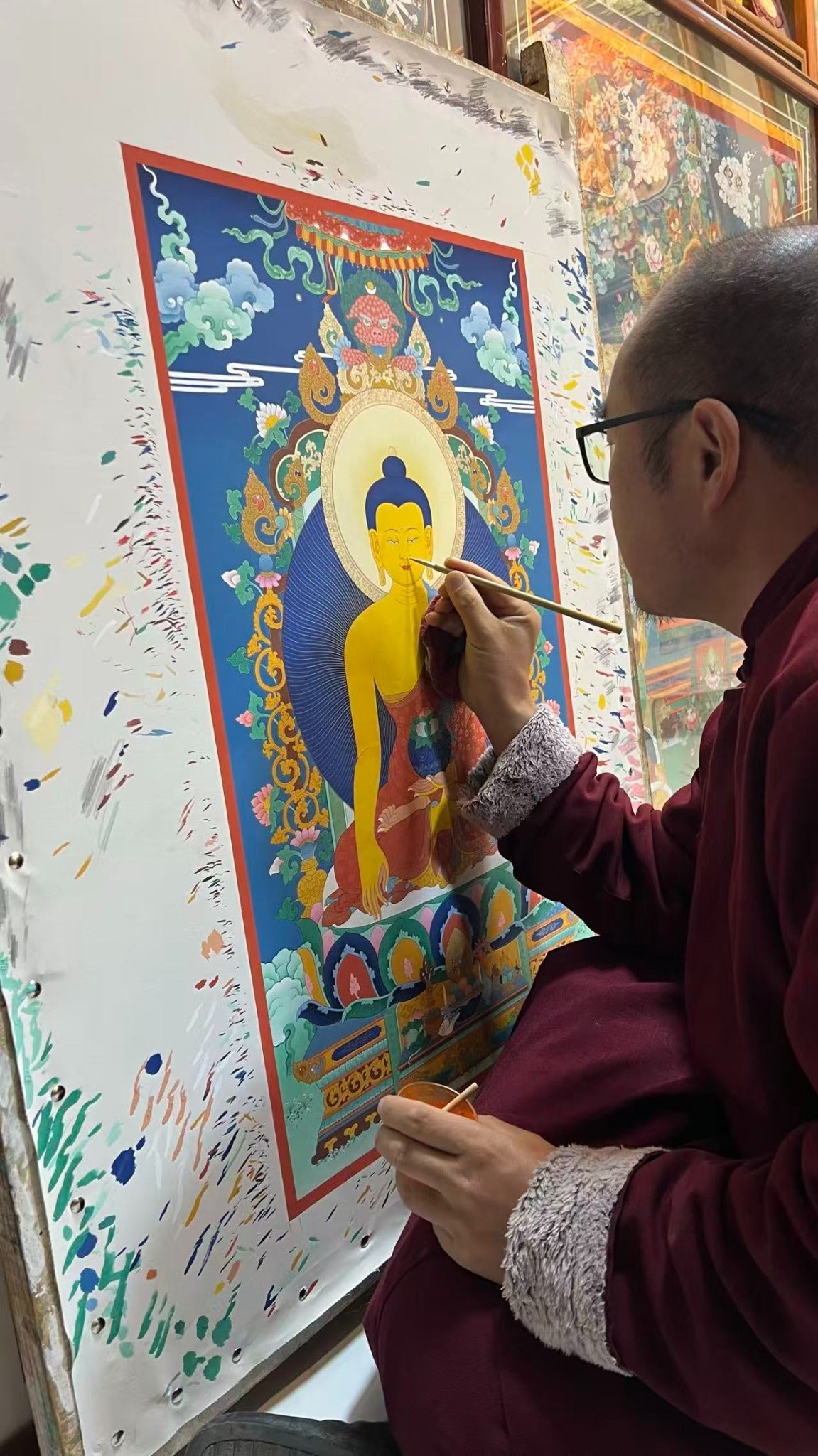
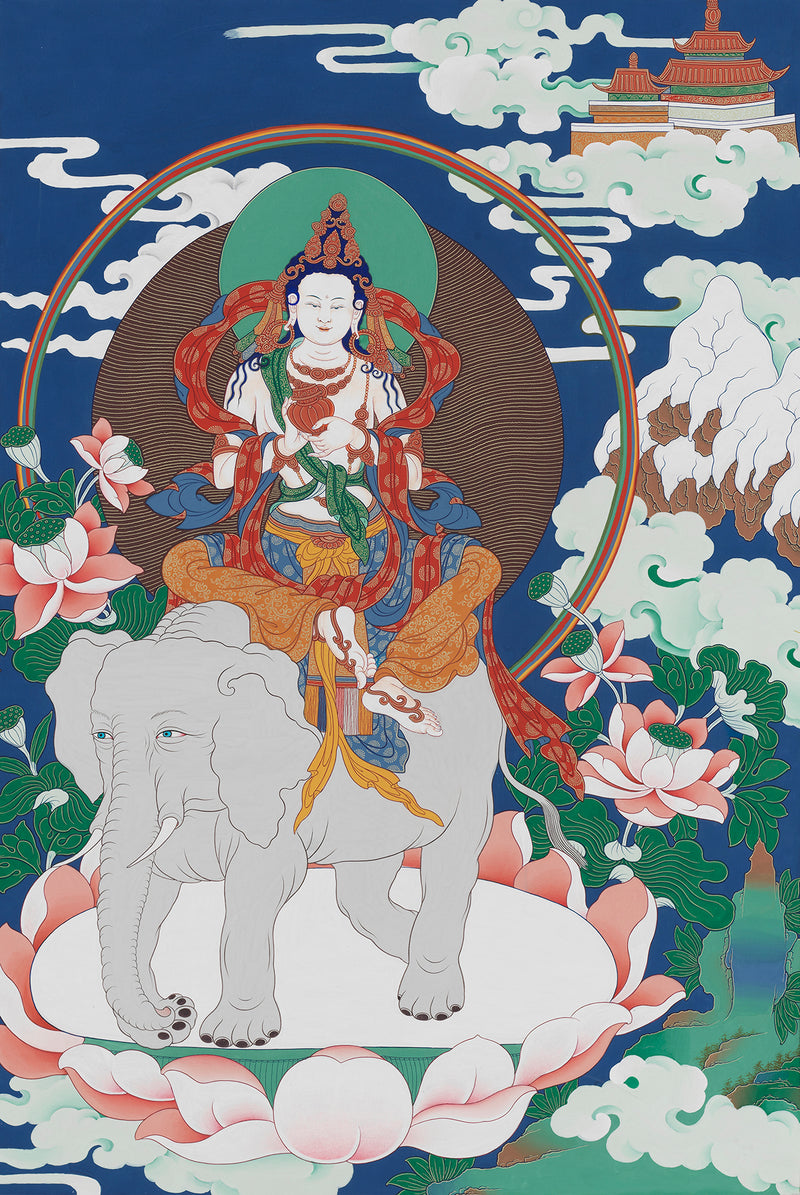
Luosang Daji · Cairang Dangzhou

Five Buddhas · Amoghasiddhi

Artwork introduction

Five Directional Buddhas: Amoghasiddhi (September 2019)

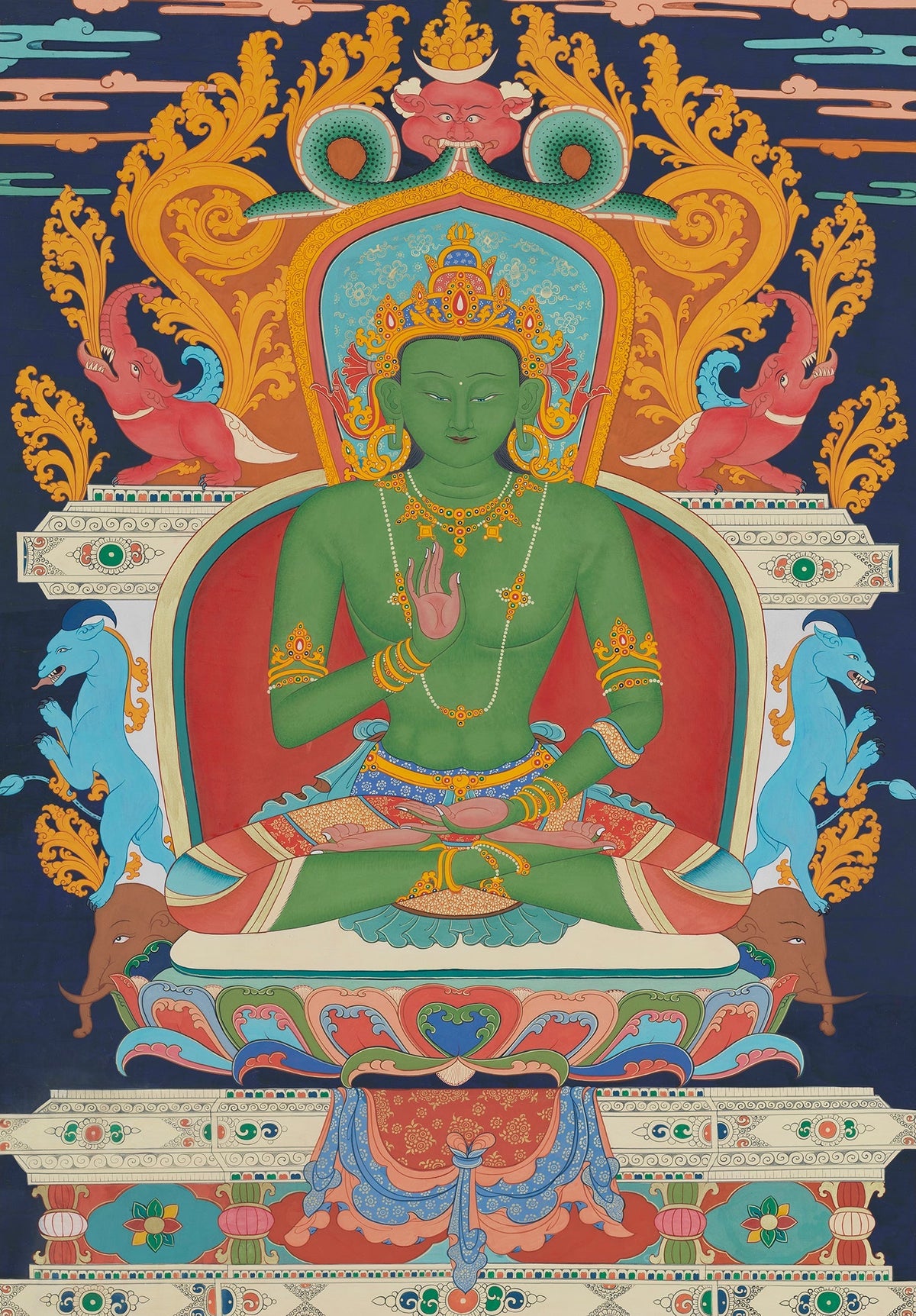
Amoghasiddhi of the north represents the wind element and 'all-accomplishing wisdom,' his whole body emerald green like jade. The spring breeze has no form, yet dispels gloom. The 'unfailing' in his name means that grounded acts of goodness and care for others are never in vain. Addressing jealousy, inner friction, and the anxiety of comparison, he is a calming remedy for life's journey.

At the top of his aureole, Garuda spreads its wings while seizing and tearing venomous snakes, symbolizing the absolute will that shatters fear and jealousy and restores a clear, open sky to the heart. The Buddha raises his right hand before his chest in the fear-dispelling mudra, its flat palm facing forward, conveying the vow to 'dispel fear and protect peace' and guiding us to move bravely through unknown trials. Pure, warm natural malachite green interweaves with the midnight-blue aureole and warm yellow throne top, brimming with vitality. By releasing blind comparison, working steadily on the path beneath our feet, and living without fear, we can succeed in what lies ahead and remain at ease.

$6,764.00
勉唐画派宗师传人 罗桑达吉·才让当周大师作品
Quantity:

Total: $6,764.00

  • AliPay
  • American Express
  • Apple Pay
  • Bancontact
  • Google Pay
  • Mastercard
  • MB WAY
  • Shop Pay
  • Union Pay
  • Visa

Explore the collection: Five Buddhas · Amoghasiddhi

SamantabhadraYama TeachingManjushriHayagrivaPalden Lhamo
  • Hand-painted Thangka Art
  • 📦 Artwork photographs and presentation details are confirmed before dispatch.
  • 🚚 Free Shipping, Trackable Logistics
  • ↩ 30-day returns on eligible non-custom works
Artwork Details & Confirmation

Each Thangka has its own composition, dimensions and presentation. Please review the photographs and catalogue notes, and contact the museum about the work’s condition, materials or mounting before ordering.

We confirm artwork photographs and dispatch details before shipping. For a commissioned work, the subject, dimensions, materials, schedule and any agreed review stages are discussed separately.

Eligible non-custom works may be returned within 30 days of receipt, subject to the return policy.

Delivery time

Estimated delivery for available works: 10–16 business days. This consists of 5–9 business days for preparation and 5–7 business days in transit.

Preparation: order and address confirmation, checking the selected Thangka’s condition and mounting, and protective packing appropriate to the work. Commissioned works follow an individually agreed schedule.

Transit: the carrier and tracking information are provided when the work is dispatched. Commissioned works or special mounting arrangements require a separately agreed schedule. See our shipping policy.

Returns & Refunds

30-day return window: contact the museum within 30 days of receipt for eligible non-custom works. The work must be unused, in its original condition and packaging, with proof of purchase.

Commissioned or personalised works: these are non-returnable unless damaged or defective. Please discuss any difference from the confirmed commission with the museum.

Return shipping: 香港合丰 covers damaged, defective or incorrect items. For a change of mind, size or preference, the customer pays the actual return shipping cost. There is no restocking fee. Obtain return instructions before sending the work.

Approved refunds are made to the original payment method within 10 business days. If more than 15 business days have passed after approval, contact the museum. See the full return policy.

Payment Method Guide

Payment methods available for your country and currency are displayed at checkout. Please use the options shown there to complete your order.

For questions about a particular Thangka, confirm its availability, dimensions and presentation with 香港合丰 before payment. See payment information.

香港合丰 Artwork introduction

About this Thangka

Five Buddhas · Amoghasiddhi

五方佛 · 不空成就佛

Five Directional Buddhas: Amoghasiddhi (September 2019)

Each day, we introduce a thangka. Today, we meet Amoghasiddhi, the Buddha of the north among the Five Directional Buddhas, who blows away inner friction and protects the success of our endeavors.

In the system of the Five Directional Buddhas, why is Amoghasiddhi entirely emerald green like jade, his right hand raised high before his chest with the palm facing outward? Behind this image lies a subtle Eastern wisdom for dissolving mental strain. In Buddhist culture, Amoghasiddhi of the north represents the wind element and 'all-accomplishing wisdom.' Wind has neither form nor visible shape, yet it can blow away all the world's gloom. Modern people often feel weary and depleted because of jealousy and anxiety: always feeling behind others, always caught in endless draining comparison. Amoghasiddhi's clear emerald green is like a mild spring breeze across the face, dispelling the fixation of jealousy. His name, 'unfailing accomplishment,' means that, so long as you remain grounded in goodness and care for others, every drop of sweat and every effort you make will never be wasted. More than a Buddha, he is like a calming remedy along life's road, teaching us to work steadily and without fear before competition and pressure.

With this story in mind, the divine animals of the throne suddenly become clear. At the very center atop his aureole, the king of birds, Garuda, majestically spreads its wings. Its claws firmly seize and tear venomous snakes, while its beak holds treasures. Ancient artists placed Garuda at the summit to draw on the story of its tearing apart and devouring poisonous snakes, symbolizing the absolute will that crushes the three poisons of fear and jealousy and restores a clear, open sky to the heart.

Now look more closely at the Buddha's sacred form and hand gesture. Wearing a jeweled crown, he appears peaceful. His right hand rises before his chest in the fear-dispelling mudra, its flat palm facing forward. In the scriptures, it conveys the great vow to sentient beings: 'Do not be afraid; I will dispel your fear.' It guides us to step bravely forward when facing the unknown and its trials, without wavering again.

In its color, the body pigment ground from natural malachite is pure and warm. It interweaves with the deep midnight blue of the aureole and the flame-like warm yellow at the top of the throne. Bright and fresh, the palette conveys the vitality of vigorous growth.

Once you understand this Amoghasiddhi, you will see that, when comparison is released and the heart is free of fear, the path ahead naturally leads to accomplishment.

May you, too, free yourself from anxiety and inner friction, walk the path beneath your feet with grounded care, and gain the ease of knowing that cultivation brings a harvest.

Follow 香港合丰 to discover more of the Eastern stories held within these paintings!

Luosang Daji · Cairang Dangzhou

Luosang Daji · Cairang Dangzhou

Luosang Daji · Cairang Dangzhou began learning Thangka painting at seven and studied at Wutun Upper Temple under Master Xiawu Cairang. His practice is rooted in the Menri tradition.

View artist
Artwork & Order Confirmation

Artwork & Order Confirmation

Confirm the selected Thangka, its dimensions and presentation with the museum. After ordering, check that your contact details and delivery address are correct so we can discuss the work and its dispatch.
Details & Mounting

Details & Mounting

Review photographs of the actual work and confirm its condition and mounting before dispatch. For a commission, the subject, format, materials and review stages are agreed individually with the artist and museum.

Protective Packing & Delivery

Protective Packing & Delivery

The work is packed according to its dimensions, support and mounting. Tracking details are provided after dispatch. Keep the packaging until you have inspected the Thangka and confirmed that it has arrived safely.
Viewing & Care

Viewing & Care

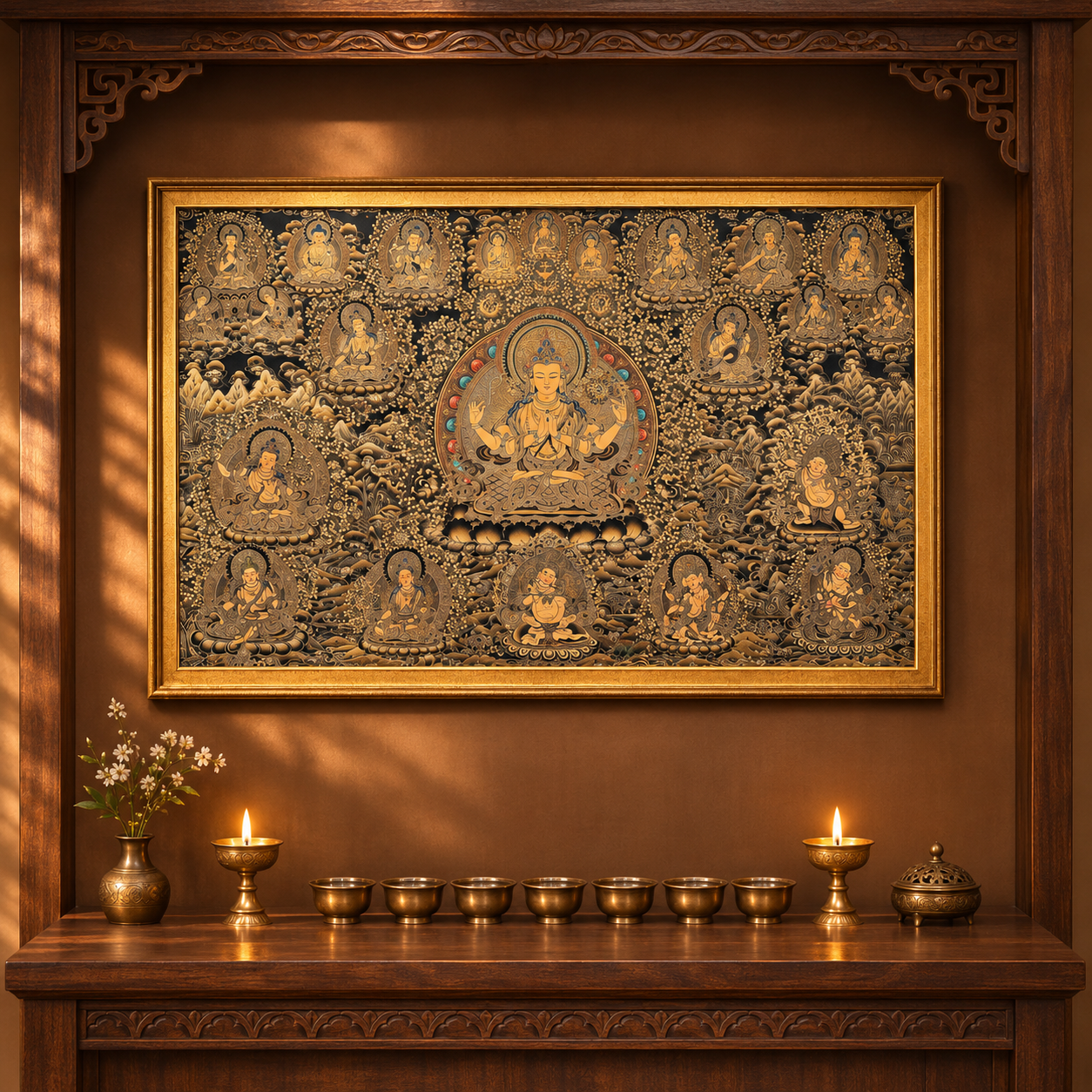
Spend time with the figures, line work and composition of the Thangka. Display it away from direct sunlight and damp conditions. Ask the museum for advice about mounting, framing or handling the specific work; avoid touching the painted surface.