Luosang Daji · Cairang Dangzhou

Samantabhadra

Artwork introduction

Samantabhadra (August 2025)

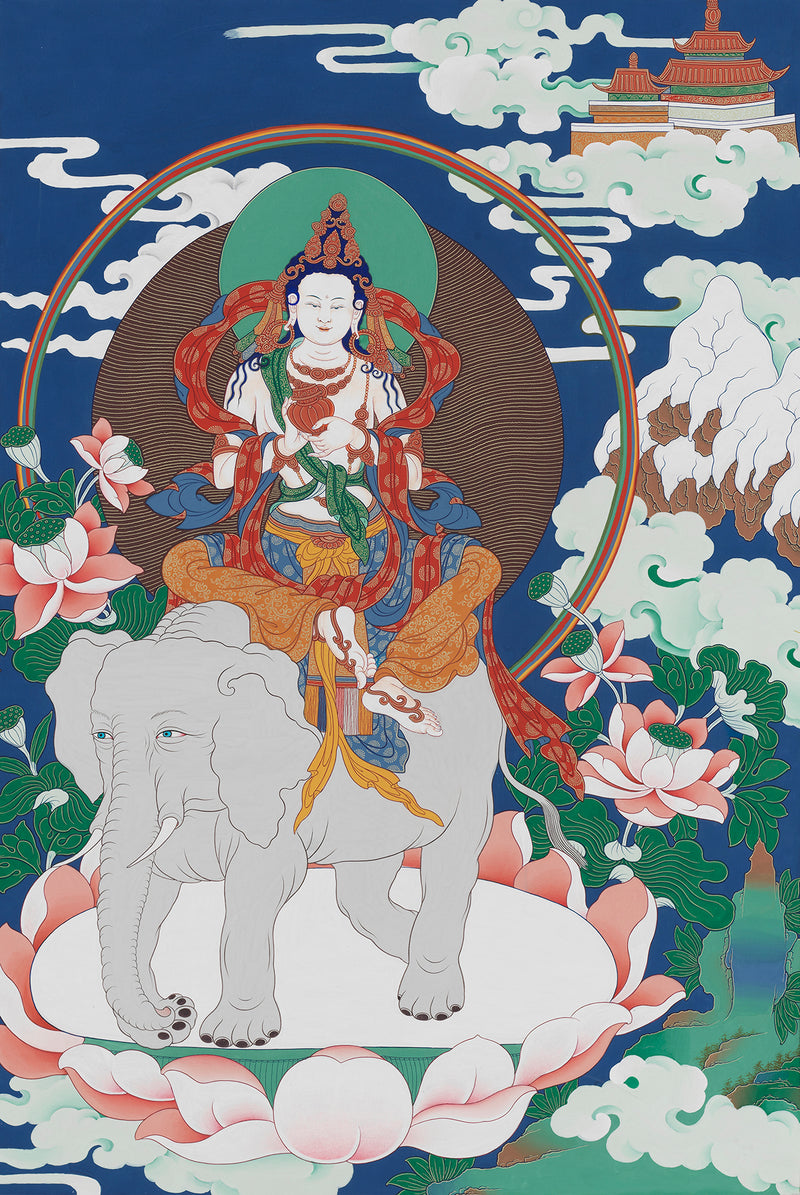
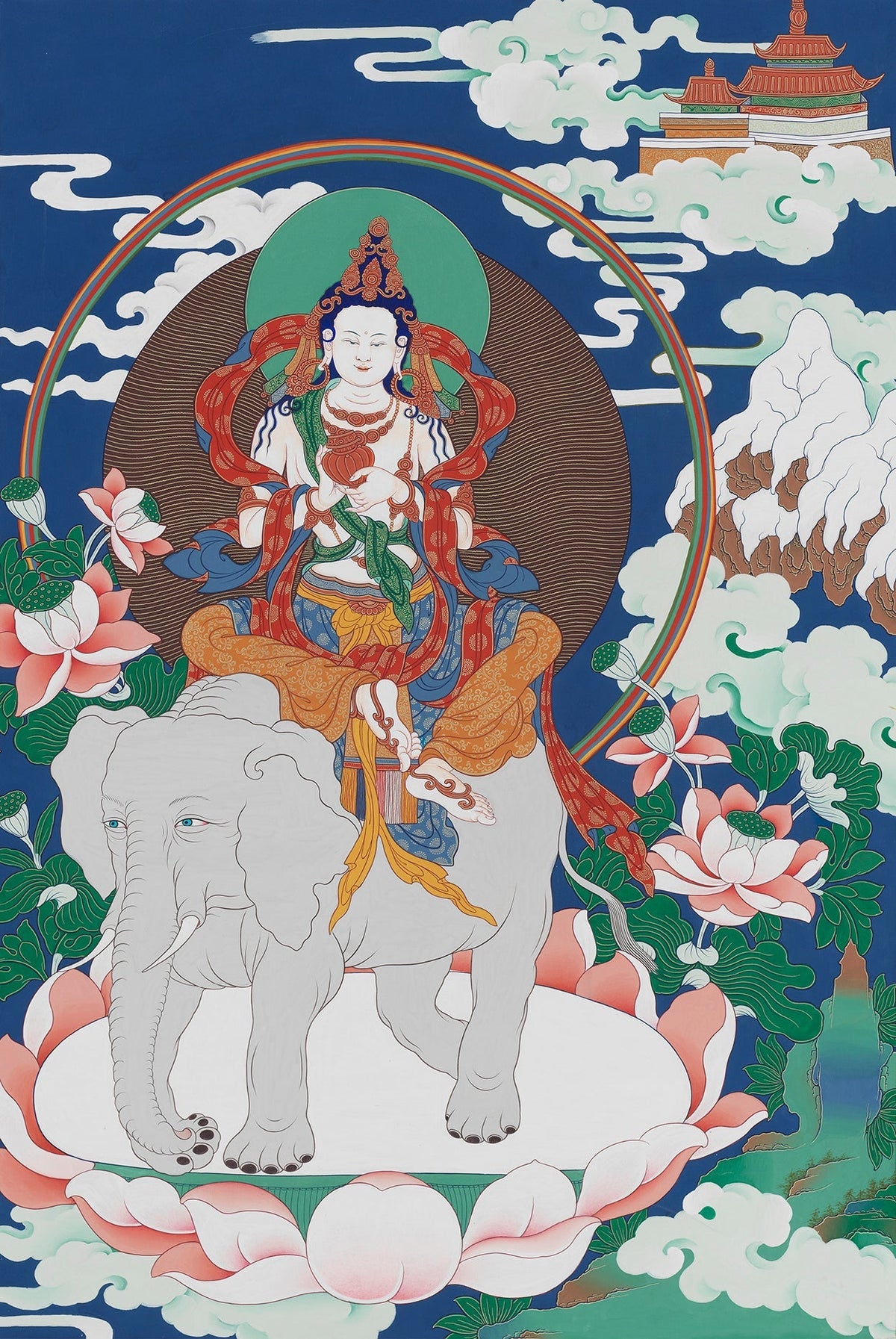
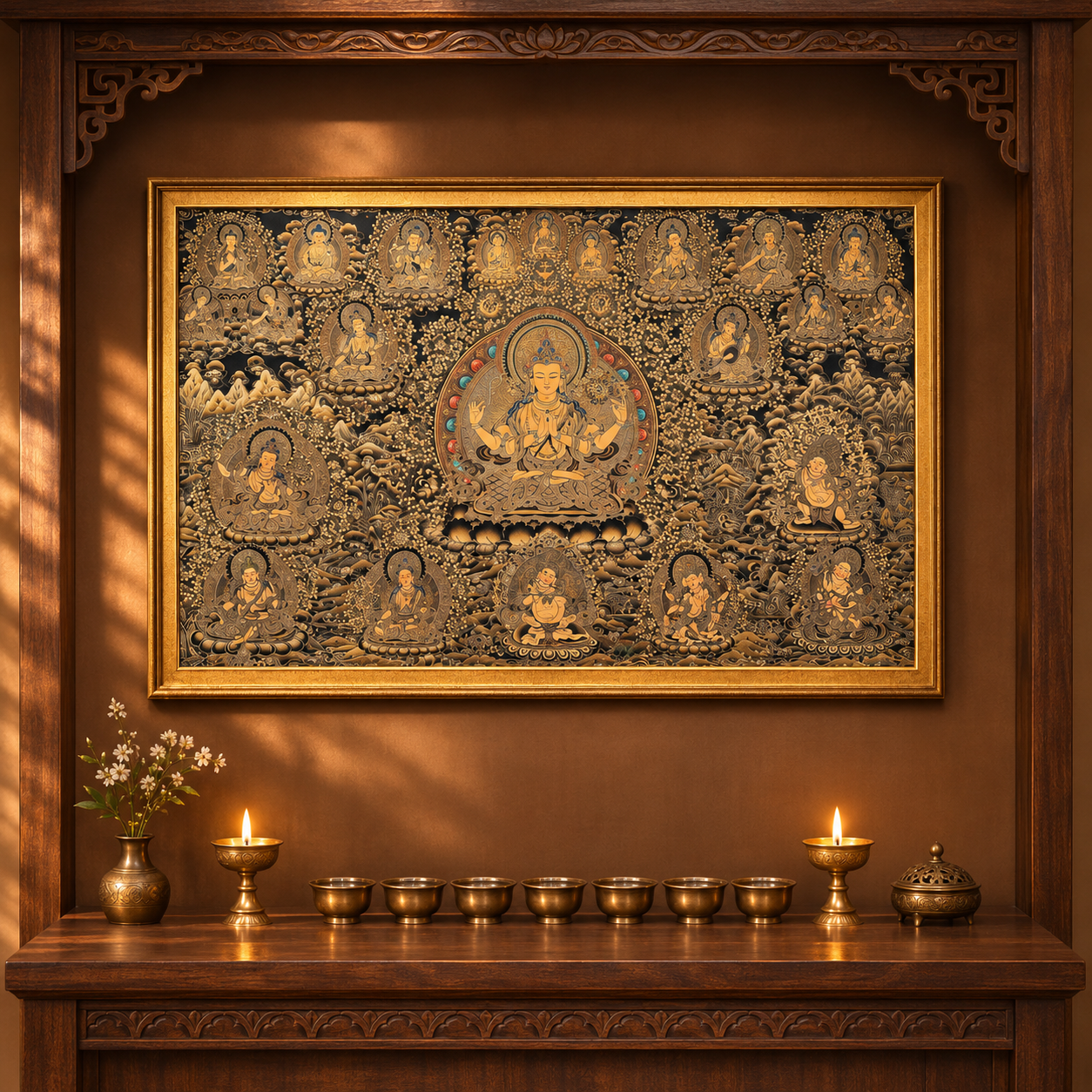
Samantabhadra rides a six-tusked white elephant, embodying the power of action through the 'great practice' that unites knowledge and conduct. While Manjushri presides over wisdom, Samantabhadra puts principles into practice. The gentle white elephant's six tusks symbolize the six perfections of generosity, ethical discipline, patience, diligence, meditation, and wisdom: accomplishing difficult things requires the elephant's steady, resolute stride.

In the painting, the bodhisattva sits at ease with one leg slightly lowered, ready to rise and help others at any moment. The wish-fulfilling jewel held in both hands proclaims that 'action accumulates blessings': fulfillment comes only through doing. The blue lotus lightly held in his left hand expresses the untainted purity of one's original intention, like a flower unstained by the mud from which it grows. Against a deep mineral midnight-blue ground, the white elephant glows with the gentle warmth of jade. Warm orange celestial robes intertwine with a cinnabar-red skirt, while fine gold lines flow like morning light, revealing the refined nobility of polychrome thangka painting as an intangible cultural heritage. The work reminds us that achievement rests on steadfast focus, rather than idle dreams. By releasing needless inner turmoil and taking each step firmly, we can find ease and fulfillment.

$6,764.00
勉唐画派宗师传人 罗桑达吉·才让当周大师作品
Quantity:

Total: $6,764.00

  • AliPay
  • American Express
  • Apple Pay
  • Bancontact
  • Google Pay
  • Mastercard
  • MB WAY
  • Shop Pay
  • Union Pay
  • Visa

Explore the collection: Samantabhadra

SamantabhadraYama TeachingManjushriHayagrivaPalden Lhamo
  • Hand-painted Thangka Art
  • 📦 Artwork photographs and presentation details are confirmed before dispatch.
  • 🚚 Free Shipping, Trackable Logistics
  • ↩ 30-day returns on eligible non-custom works
Artwork Details & Confirmation

Each Thangka has its own composition, dimensions and presentation. Please review the photographs and catalogue notes, and contact the museum about the work’s condition, materials or mounting before ordering.

We confirm artwork photographs and dispatch details before shipping. For a commissioned work, the subject, dimensions, materials, schedule and any agreed review stages are discussed separately.

Eligible non-custom works may be returned within 30 days of receipt, subject to the return policy.

Delivery time

Estimated delivery for available works: 10–16 business days. This consists of 5–9 business days for preparation and 5–7 business days in transit.

Preparation: order and address confirmation, checking the selected Thangka’s condition and mounting, and protective packing appropriate to the work. Commissioned works follow an individually agreed schedule.

Transit: the carrier and tracking information are provided when the work is dispatched. Commissioned works or special mounting arrangements require a separately agreed schedule. See our shipping policy.

Returns & Refunds

30-day return window: contact the museum within 30 days of receipt for eligible non-custom works. The work must be unused, in its original condition and packaging, with proof of purchase.

Commissioned or personalised works: these are non-returnable unless damaged or defective. Please discuss any difference from the confirmed commission with the museum.

Return shipping: 香港合丰 covers damaged, defective or incorrect items. For a change of mind, size or preference, the customer pays the actual return shipping cost. There is no restocking fee. Obtain return instructions before sending the work.

Approved refunds are made to the original payment method within 10 business days. If more than 15 business days have passed after approval, contact the museum. See the full return policy.

Payment Method Guide

Payment methods available for your country and currency are displayed at checkout. Please use the options shown there to complete your order.

For questions about a particular Thangka, confirm its availability, dimensions and presentation with 香港合丰 before payment. See payment information.

香港合丰 Artwork introduction

About this Thangka

Samantabhadra

普贤菩萨

Samantabhadra (August 2025)

Each day, we introduce a thangka. Today, we meet Samantabhadra, the bodhisattva who symbolizes the unity of knowledge and action and brings us the strength to remain steadfast.

Why, among the four great bodhisattvas, does Samantabhadra alone ride a white elephant with six tusks? There is a deeply moving meaning behind this image. In traditional culture, Samantabhadra represents 'great practice'—the absolute power to act. Manjushri explains profound wisdom and principles, while Samantabhadra turns those principles into concrete deeds. The hardest thing in life has never been understanding lofty ideas; it is bringing knowledge and action together. More than a distant deity beyond our reach, he resembles a guide to action in our daily lives, using the steadiest, most powerful footsteps to crush our procrastination and hesitation.

With this story in mind, the painting's details suddenly become clear. Look at the great white elephant beneath him: enormous in size, yet extraordinarily gentle, with soft, clear eyes. Its most distinctive features are its six tusks, which respectively symbolize the six perfections of generosity, ethical discipline, patience, diligence, meditation, and wisdom. Ancient artists depicted these as elephant tusks to convey more than majesty. Their message is that no difficult undertaking is accomplished through a momentary impulse: like a walking elephant, we must plant every step firmly, unshaken by anything.

Now look more closely at his sacred form and ritual objects. His face is peaceful, and he sits at ease with one leg slightly lowered. This is no sign of complacent leisure: he is ready to rise at any moment to support the world. The object held in both hands before his chest is a wish-fulfilling jewel. The old saying 'action accumulates blessings' reminds us that only genuine effort and action can bring substantial fulfillment. His left hand lightly holds the stem of a blue lotus, drawing on the ancient image of a flower emerging unstained from mud. It expresses the hope that, however complicated our circumstances, we will preserve our original purity and simplicity.

In its color, the deep, tranquil mineral midnight-blue ground brings out the white elephant's jade-like warmth. Warm orange celestial robes and a cinnabar-red skirt complement one another, while delicate gold lines flow like the first light of dawn. Together, they express just the right measure of the refinement and nobility of polychrome thangka painting as an intangible cultural heritage.

Once you understand this Samantabhadra, you will see that accomplishing anything difficult depends on the steadfast focus of a quiet mind, rather than empty imagination.

May you, too, release unnecessary inner strain, see the path beneath your feet clearly, and take each step well, finding your own ease and fulfillment through grounded action.

Follow 香港合丰 to discover more of the Eastern stories held within these paintings!

Luosang Daji · Cairang Dangzhou

Luosang Daji · Cairang Dangzhou

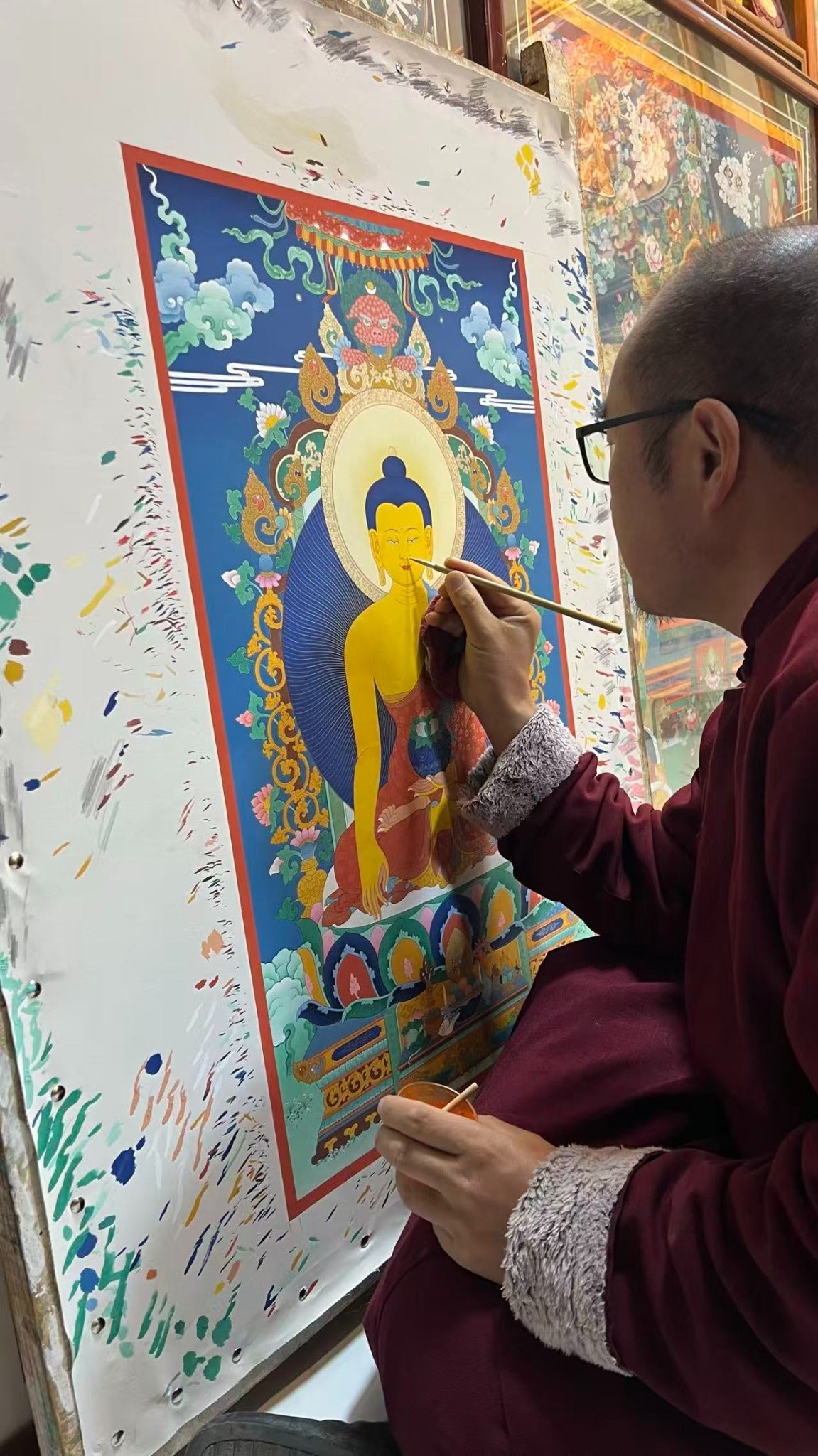
Luosang Daji · Cairang Dangzhou began learning Thangka painting at seven and studied at Wutun Upper Temple under Master Xiawu Cairang. His practice is rooted in the Menri tradition.

View artist
Artwork & Order Confirmation

Artwork & Order Confirmation

Confirm the selected Thangka, its dimensions and presentation with the museum. After ordering, check that your contact details and delivery address are correct so we can discuss the work and its dispatch.
Details & Mounting

Details & Mounting

Review photographs of the actual work and confirm its condition and mounting before dispatch. For a commission, the subject, format, materials and review stages are agreed individually with the artist and museum.
Protective Packing & Delivery

Protective Packing & Delivery

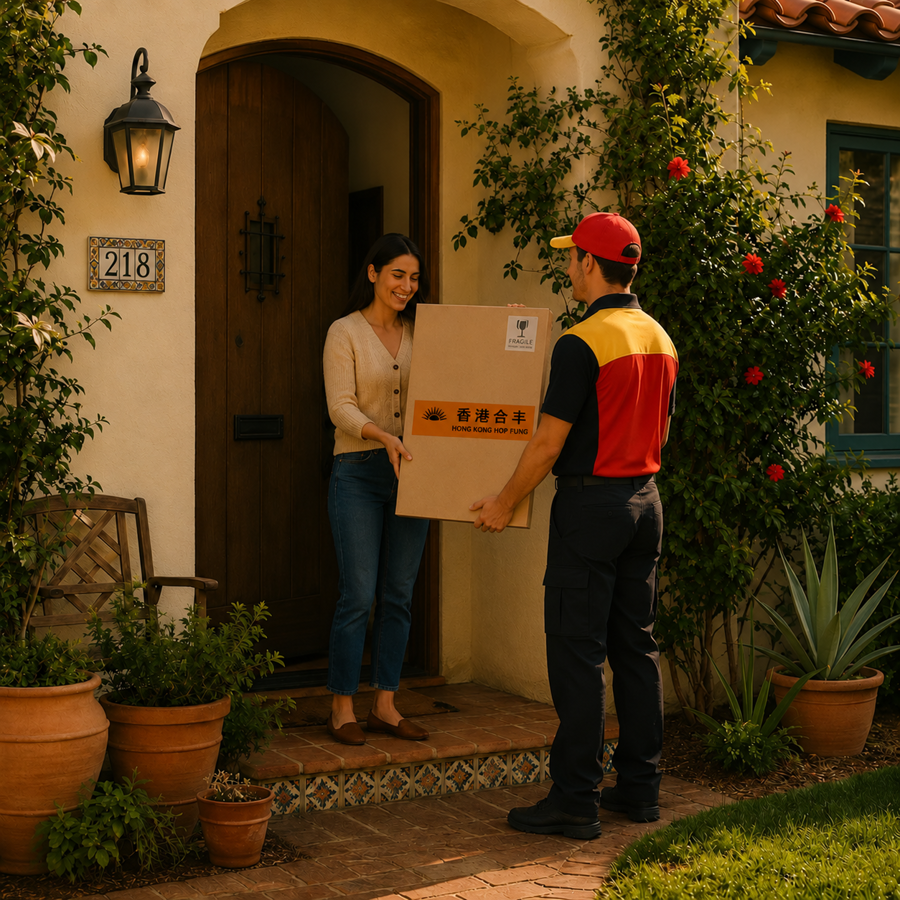
The work is packed according to its dimensions, support and mounting. Tracking details are provided after dispatch. Keep the packaging until you have inspected the Thangka and confirmed that it has arrived safely.
Viewing & Care

Viewing & Care

Spend time with the figures, line work and composition of the Thangka. Display it away from direct sunlight and damp conditions. Ask the museum for advice about mounting, framing or handling the specific work; avoid touching the painted surface.