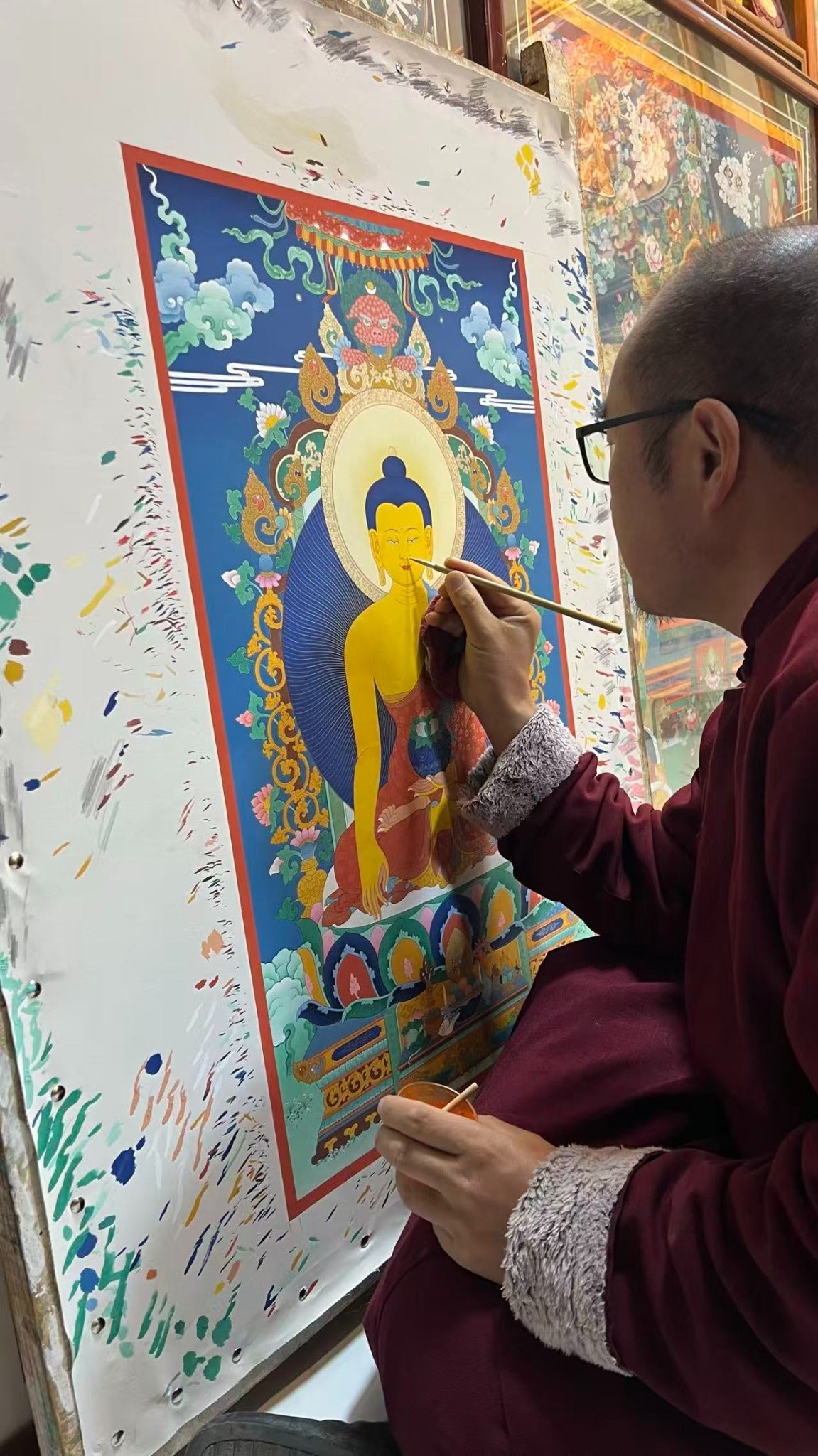
Luosang Daji · Cairang Dangzhou

Tsongkhapa in a Pure Land

Artwork introduction

Tsongkhapa's Pure Land (May 2015)

Master Tsongkhapa, the great teacher of the Tibetan plateau, restored monastic discipline and founded the Gelug school, with Manjushri's sword and scripture blooming above his shoulders. Facing worldly restlessness, he advocated scholarship and rigorous practice, revealing 'freedom through discipline.' Life's confusion often begins when order breaks down; only by establishing principles of conduct and self-discipline can we gain the confidence to dispel delusion.

The master sits at the center of auspicious clouds, his two great disciples Gyaltsab Je and Khedrup Je attending on either side. Tushita Palace rises above, while Yama, the Dharma King, guards amid flames at the lower left, bringing celestial realms and demon subjugation into one scroll. His yellow pandita hat signifies learning and noble virtue; his teaching mudra is gentle as a spring breeze. The sword and Prajnaparamita Sutra above his shoulders represent the decisiveness to cut through ignorance and the depth of extensive scriptural learning. Malachite-green mountains, auspicious clouds, and rainbow light embrace the figures in solemn, luminous colors. With a clear mirror in the heart and principles in our actions, self-discipline leads to inner clarity and freedom.

$17,795.00
勉唐画派宗师传人 罗桑达吉·才让当周大师作品
Quantity:

Total: $17,795.00

  • AliPay
  • American Express
  • Apple Pay
  • Bancontact
  • Google Pay
  • Mastercard
  • MB WAY
  • Shop Pay
  • Union Pay
  • Visa

Explore the collection: Tsongkhapa in a Pure Land

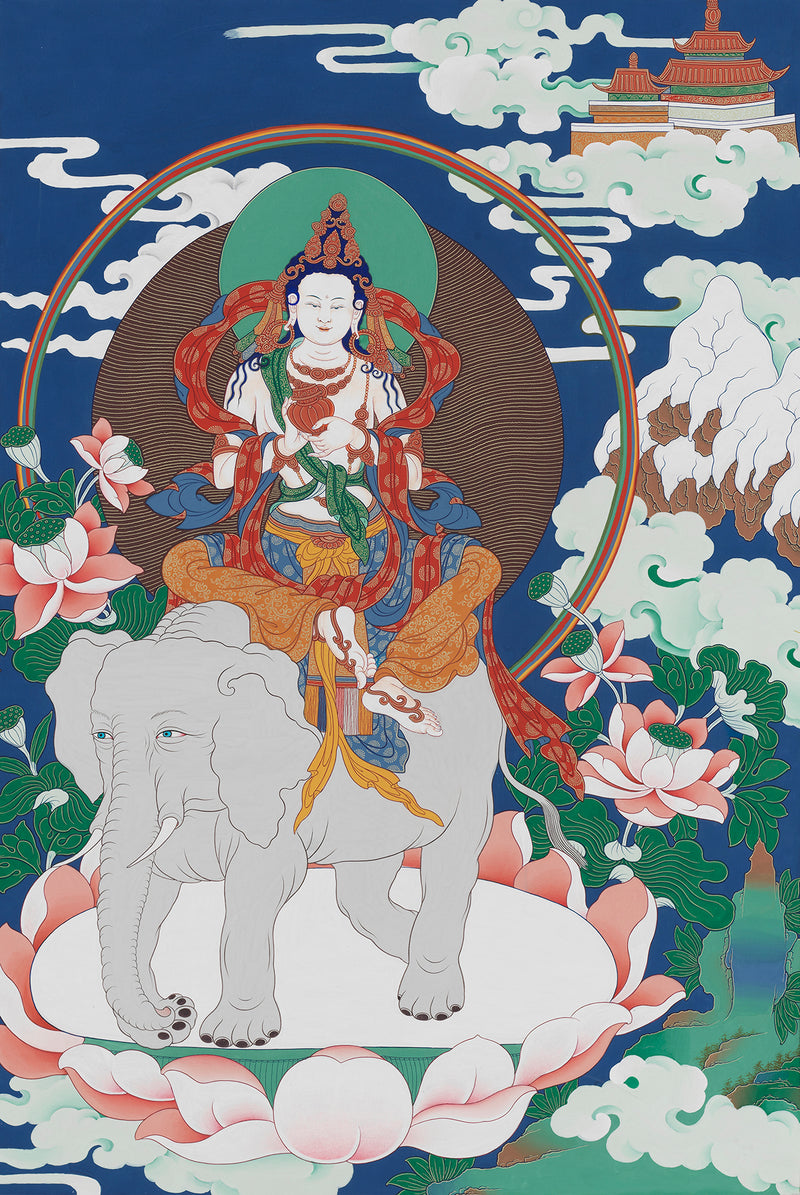
SamantabhadraYama TeachingManjushriHayagrivaPalden Lhamo
  • Hand-painted Thangka Art
  • 📦 Artwork photographs and presentation details are confirmed before dispatch.
  • 🚚 Free Shipping, Trackable Logistics
  • ↩ 30-day returns on eligible non-custom works
Artwork Details & Confirmation

Each Thangka has its own composition, dimensions and presentation. Please review the photographs and catalogue notes, and contact the museum about the work’s condition, materials or mounting before ordering.

We confirm artwork photographs and dispatch details before shipping. For a commissioned work, the subject, dimensions, materials, schedule and any agreed review stages are discussed separately.

Eligible non-custom works may be returned within 30 days of receipt, subject to the return policy.

Delivery time

Estimated delivery for available works: 10–16 business days. This consists of 5–9 business days for preparation and 5–7 business days in transit.

Preparation: order and address confirmation, checking the selected Thangka’s condition and mounting, and protective packing appropriate to the work. Commissioned works follow an individually agreed schedule.

Transit: the carrier and tracking information are provided when the work is dispatched. Commissioned works or special mounting arrangements require a separately agreed schedule. See our shipping policy.

Returns & Refunds

30-day return window: contact the museum within 30 days of receipt for eligible non-custom works. The work must be unused, in its original condition and packaging, with proof of purchase.

Commissioned or personalised works: these are non-returnable unless damaged or defective. Please discuss any difference from the confirmed commission with the museum.

Return shipping: 香港合丰 covers damaged, defective or incorrect items. For a change of mind, size or preference, the customer pays the actual return shipping cost. There is no restocking fee. Obtain return instructions before sending the work.

Approved refunds are made to the original payment method within 10 business days. If more than 15 business days have passed after approval, contact the museum. See the full return policy.

Payment Method Guide

Payment methods available for your country and currency are displayed at checkout. Please use the options shown there to complete your order.

For questions about a particular Thangka, confirm its availability, dimensions and presentation with 香港合丰 before payment. See payment information.

香港合丰 Artwork introduction

About this Thangka

Tsongkhapa in a Pure Land

宗喀巴极乐世界

Tsongkhapa's Pure Land (May 2015)

Each day, we introduce a thangka. Today, we explore a monumental work in rich mineral colors that reveals the spiritual Pure Land of the Tibetan plateau's great teacher and inspires profound self-discipline and clear inner confidence: Tsongkhapa's Pure Land, painted in 2015.

Why, in Tibetan Buddhist history, is Master Tsongkhapa alone honored as the 'Second Buddha'? Clearly a scholar and teacher in monastic robes, why does he have Manjushri's sword and scripture blooming above both shoulders? Behind this image lies a great awakening that restored Tibetan faith six hundred years ago. It is said that, in Tsongkhapa's era, discipline had weakened and hearts had grown restless, with many pursuing fame and gain in the name of practice. Facing this disorder, he did not follow the current. With Manjushri-like clarity and supreme wisdom, he put on the yellow hat symbolizing purity and learning, advocated rigorous scholarship and austere observance of discipline, and single-handedly founded the strictly principled Gelug school. In life, our confusion and difficulty often arise less from poor external conditions than from disrupted inner 'order': uncontrolled routines, overflowing emotions, and a lack of self-discipline. Tsongkhapa's upright, exacting seated posture teaches the highest cultivation of 'freedom through discipline.' Only by first establishing principles in our conduct can we gain the confidence to break through every veil of confusion.

With this story in mind, the painting's overall details suddenly become clear. The master sits in the very center of auspicious clouds, with his two great disciples, Gyaltsab Je and Khedrup Je, attending before him on the left and right. Together they are known as the 'three venerable figures of master and disciples.' High above, deep within a rainbow, rises the golden-roofed Tushita Palace where Maitreya teaches the Dharma. In the flames at the lower left stands Yama, the Dharma King, protecting the pure and true teaching. The painter gathers heavenly sacred realms, the human transmission of teachings, and protectors subduing demons into one scroll for more than a crowded composition. It tells us that a true spiritual Pure Land has never been an intangible fantasy: it is an inner home genuinely cultivated through a pure, self-disciplined life.

Now look more closely at the sacred form and details. The master's tall, pointed yellow pandita hat is known in Tibet as the 'crown of the learned,' symbolizing wide knowledge of the world's philosophy and noble virtue. His hands gently form the teaching mudra before his chest, awakening confused beings through explanations as nourishing as spring wind and rain. On the pink lotuses blooming above his shoulders, a wisdom sword rests at the right and the **Prajnaparamita Sutra** is securely supported at the left. They draw on Manjushri's supreme qualities—'one sword cuts through ignorance, one scripture illuminates truth'—to remind us that true awakening requires both decisiveness and cultivated learning.

In its color, the bright yellow pandita hat shines against the red cinnabar of the master's robe. Natural mineral malachite pigment shades the verdant mountains, woods, and springs behind him. Warm, pure white wish-fulfilling clouds and seven-colored rainbow light embrace the figures in layers. Luminous and solemn in color, refined in atmosphere, the painting reveals the meticulous Eastern beauty of temple halls through rich mineral-color painting as an intangible cultural heritage.

Once you understand this Tsongkhapa's Pure Land, you will see that, with a clear mirror in the heart and principles in our actions, self-discipline leads to true freedom.

May you, too, preserve your inner principles and clarity, resist simply following the current, and gain a clear, assured steadiness.

Follow 香港合丰 to discover more of the Eastern stories held within these paintings!

Luosang Daji · Cairang Dangzhou

Luosang Daji · Cairang Dangzhou

Luosang Daji · Cairang Dangzhou began learning Thangka painting at seven and studied at Wutun Upper Temple under Master Xiawu Cairang. His practice is rooted in the Menri tradition.

View artist
Artwork & Order Confirmation

Artwork & Order Confirmation

Confirm the selected Thangka, its dimensions and presentation with the museum. After ordering, check that your contact details and delivery address are correct so we can discuss the work and its dispatch.

Details & Mounting

Details & Mounting

Review photographs of the actual work and confirm its condition and mounting before dispatch. For a commission, the subject, format, materials and review stages are agreed individually with the artist and museum.

Protective Packing & Delivery

Protective Packing & Delivery

The work is packed according to its dimensions, support and mounting. Tracking details are provided after dispatch. Keep the packaging until you have inspected the Thangka and confirmed that it has arrived safely.
Viewing & Care

Viewing & Care

Spend time with the figures, line work and composition of the Thangka. Display it away from direct sunlight and damp conditions. Ask the museum for advice about mounting, framing or handling the specific work; avoid touching the painted surface.