Luosang Daji · Cairang Dangzhou

Hayagriva

Artwork introduction

Hayagriva (October 2019)

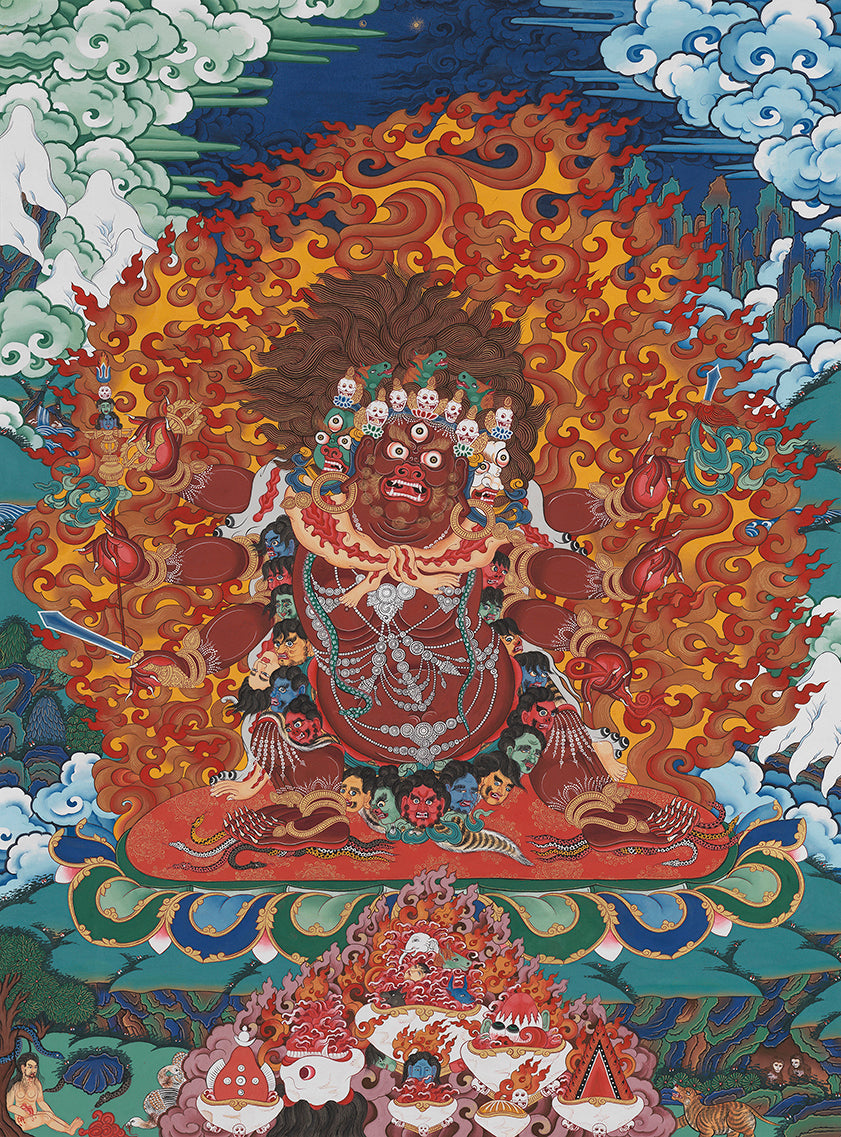
Why does compassionate Avalokiteshvara manifest as the fierce, crimson Hayagriva? Because extreme malice in the world and cowardice within cannot be resolved by gentle words alone; continued submission only draws us deeper into the mire. Three green horses atop his head rear back and neigh toward the sky, their cries shattering every shadow, embodying 'a bodhisattva's heart and thunderous methods.'

With three eyes wide open, fangs bared, and a five-skull crown, Hayagriva stands astride crimson flames. The demon-subduing sword raised in his right hand severs weakness and inner turmoil; the vajra noose in his left hand tightly binds uncontrolled thoughts and fears, while bare feet crush venomous snakes and other stumbling blocks. Searing flames frame his dark, weighty body. The green atop his head and the deep night sky create a vivid meeting of warm and cool colors, filling the mineral-color painting with tension. It is a warning for life: kindness without an edge is merely weakness. When confronted with unreasonable treatment, we must stand firmly and strongly to preserve true peace.

$10,310.00
勉唐画派宗师传人 罗桑达吉·才让当周大师作品
Quantity:

Total: $10,310.00

  • AliPay
  • American Express
  • Apple Pay
  • Bancontact
  • Google Pay
  • Mastercard
  • MB WAY
  • Shop Pay
  • Union Pay
  • Visa

Explore the collection: Hayagriva

SamantabhadraYama TeachingManjushriHayagrivaPalden Lhamo
  • Hand-painted Thangka Art
  • 📦 Artwork photographs and presentation details are confirmed before dispatch.
  • 🚚 Free Shipping, Trackable Logistics
  • ↩ 30-day returns on eligible non-custom works
Artwork Details & Confirmation

Each Thangka has its own composition, dimensions and presentation. Please review the photographs and catalogue notes, and contact the museum about the work’s condition, materials or mounting before ordering.

We confirm artwork photographs and dispatch details before shipping. For a commissioned work, the subject, dimensions, materials, schedule and any agreed review stages are discussed separately.

Eligible non-custom works may be returned within 30 days of receipt, subject to the return policy.

Delivery time

Estimated delivery for available works: 10–16 business days. This consists of 5–9 business days for preparation and 5–7 business days in transit.

Preparation: order and address confirmation, checking the selected Thangka’s condition and mounting, and protective packing appropriate to the work. Commissioned works follow an individually agreed schedule.

Transit: the carrier and tracking information are provided when the work is dispatched. Commissioned works or special mounting arrangements require a separately agreed schedule. See our shipping policy.

Returns & Refunds

30-day return window: contact the museum within 30 days of receipt for eligible non-custom works. The work must be unused, in its original condition and packaging, with proof of purchase.

Commissioned or personalised works: these are non-returnable unless damaged or defective. Please discuss any difference from the confirmed commission with the museum.

Return shipping: 香港合丰 covers damaged, defective or incorrect items. For a change of mind, size or preference, the customer pays the actual return shipping cost. There is no restocking fee. Obtain return instructions before sending the work.

Approved refunds are made to the original payment method within 10 business days. If more than 15 business days have passed after approval, contact the museum. See the full return policy.

Payment Method Guide

Payment methods available for your country and currency are displayed at checkout. Please use the options shown there to complete your order.

For questions about a particular Thangka, confirm its availability, dimensions and presentation with 香港合丰 before payment. See payment information.

香港合丰 Artwork introduction

About this Thangka

Hayagriva

马头明王

Hayagriva (October 2019)

Each day, we introduce a thangka. Today, we explore a powerful work in rich mineral colors, its flames surging, that can awaken the courage to fight back from weakness: Hayagriva.

We usually picture Avalokiteshvara dressed in snow-white robes, his eyes lowered in compassion. Why, in this painting, does he manifest as a fierce warrior deity, three eyes wide open, his whole body crimson, with three green horses hidden in his hair? Behind this image lies one of Eastern philosophy's most uncompromising lessons for life. Legend says that, while helping sentient beings, Avalokiteshvara discovered that certain extremes of malice, stubborn fear, and inner cowardice cannot be awakened by gentle words alone. Before an abyss, endless forbearance only lets the mire swallow us. Thus, the supremely compassionate Avalokiteshvara manifested his wrathful form: Hayagriva. Three green horses amid his hair neigh toward the sky, and legend says their cries can shatter all the world's shadows and fears. This is what the ancients meant by 'a bodhisattva's heart and thunderous methods.' Beyond his terrifying face, he is like the heavy armor of resistance we must put on when trapped in desperate circumstances, teaching us never to hold back when it is time to defend ourselves.

With this story in mind, the painting's overall details suddenly become clear. Look at him standing with legs spread amid rolling crimson flames, his powerful physique like volcanic lava. His three faces glare with wide-open eyes and bared fangs, while his five-skull crown symbolizes transforming greed, anger, and ignorance into wisdom. The painter gives this protector such fierce majesty for more than instilling fear. His unstoppable presence tells us that, before injustice and unreasonable treatment, only by standing firmly and strongly ourselves can we deter the malicious and safeguard peace.

Now look more closely at his sacred form and ritual objects. The demon-subduing sword brandished in his right hand once sliced through the web of desire woven by inner demons; it is meant to cut away, at once, the tangled weakness and inner friction in our lives. The vajra noose tightly gripped in his left hand is described in esoteric scriptures as a means of subduing frenzied, rampaging evil thoughts. It aims to bind panic and uncontrolled emotions completely, placing control firmly back in our hands. Layers of necklaces made of human heads hang across his chest, while his eight bare feet firmly crush intertwined venomous snakes, utterly flattening every stumbling block on the path ahead.

In its color, roaring, searing flames set off his dark, weighty body. A touch of emerald green atop his head forms a striking warm-and-cool interplay with the deep night sky. Dense and intense, the colors fully reveal the solemnity and tension of Eastern painting in rich mineral pigments.

Once you understand this Hayagriva, you will see that kindness without an edge is often merely another name for weakness.

May you treat others gently in life, while also putting on your armor when storms arrive and refusing to yield an inch.

Follow 香港合丰 to discover more of the Eastern stories held within these paintings!

Luosang Daji · Cairang Dangzhou

Luosang Daji · Cairang Dangzhou

Luosang Daji · Cairang Dangzhou began learning Thangka painting at seven and studied at Wutun Upper Temple under Master Xiawu Cairang. His practice is rooted in the Menri tradition.

View artist
Artwork & Order Confirmation

Artwork & Order Confirmation

Confirm the selected Thangka, its dimensions and presentation with the museum. After ordering, check that your contact details and delivery address are correct so we can discuss the work and its dispatch.
Details & Mounting

Details & Mounting

Review photographs of the actual work and confirm its condition and mounting before dispatch. For a commission, the subject, format, materials and review stages are agreed individually with the artist and museum.

Protective Packing & Delivery

Protective Packing & Delivery

The work is packed according to its dimensions, support and mounting. Tracking details are provided after dispatch. Keep the packaging until you have inspected the Thangka and confirmed that it has arrived safely.
Viewing & Care

Viewing & Care

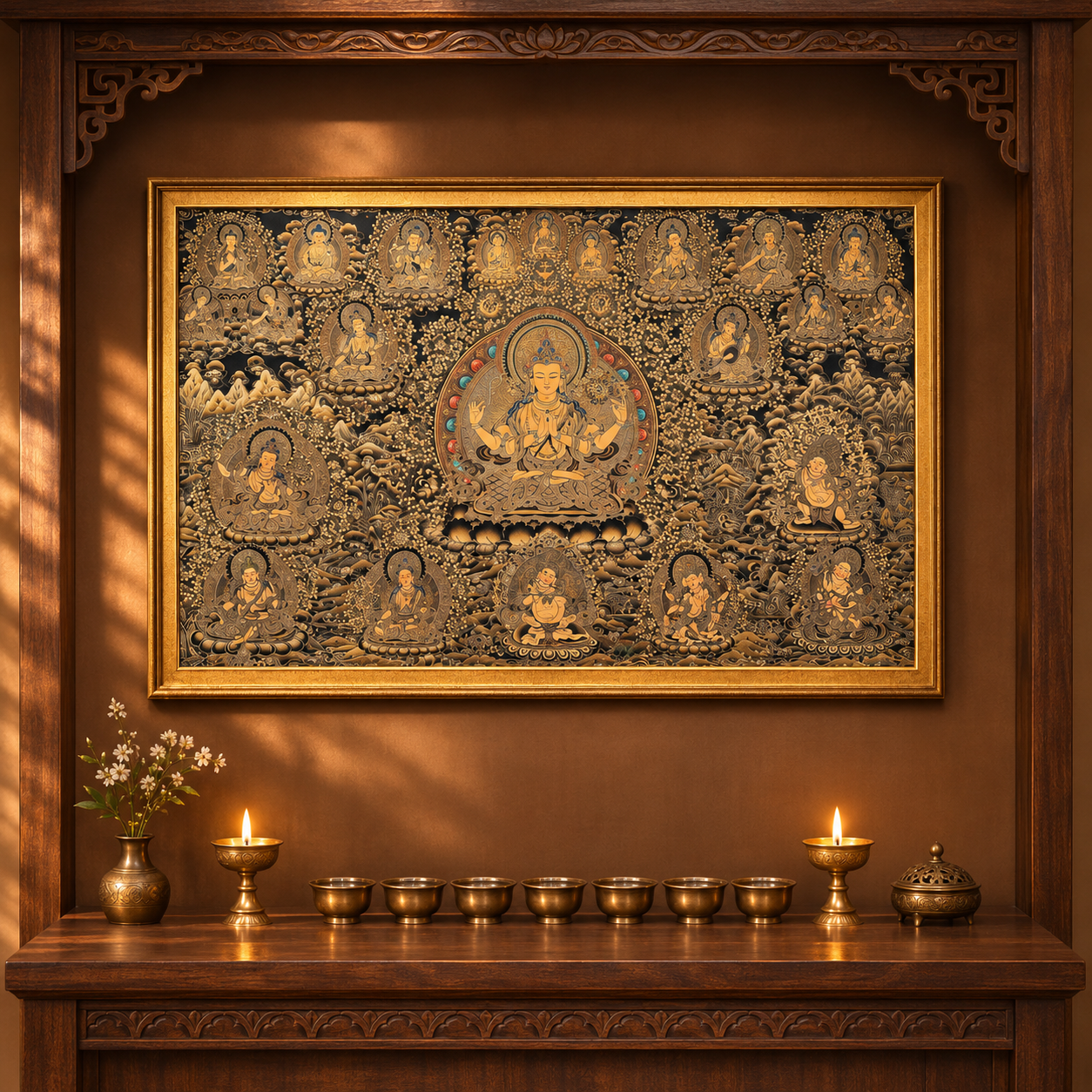
Spend time with the figures, line work and composition of the Thangka. Display it away from direct sunlight and damp conditions. Ask the museum for advice about mounting, framing or handling the specific work; avoid touching the painted surface.