Luosang Daji · Cairang Dangzhou

Green Tara

Artwork introduction

Green Tara (August 2013)

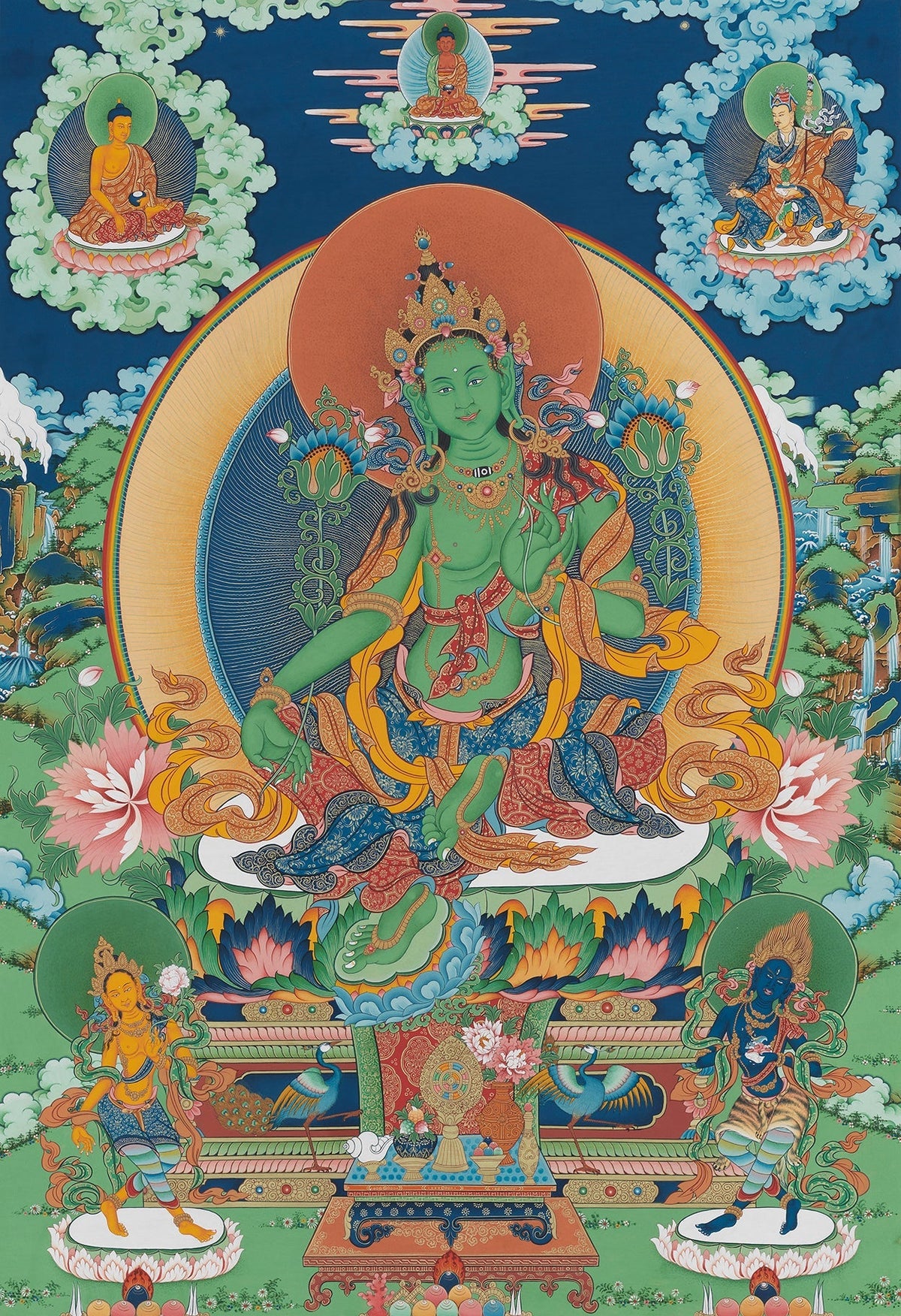
Two deep blue peacocks bow toward Tara beneath her throne, while golden and blue celestial maidens stand beside her. Peacocks feed on poisonous plants and insects yet transform their toxins into brilliant light in their tail feathers, offering a metaphor for life's cultivation. The weak are easily poisoned by negativity; the wise transform poison into nourishment like peacocks, turning adversity and grievances into the wings of growth.

Tara sits with graceful composure on a lotus throne, the two peacocks turning to bow toward her. The golden goddess increases blessings; the dark blue goddess subdues obstacles, uniting gentleness and firmness. Above, Amitabha, Shakyamuni, and Padmasambhava sit together among auspicious clouds. Her right hand's boon-granting mudra promises fulfillment of wishes, while the utpala in her left signifies wisdom beyond the three times. Pure, warm malachite green contrasts intensely with the vermilion halo and sapphire-blue peacocks; waterfalls and springs teem with life. Only by absorbing life's hardships and grievances can we open its brilliant blossom and move steadily toward distant goals.

$17,795.00
勉唐画派宗师传人 罗桑达吉·才让当周大师作品
Quantity:

Total: $17,795.00

  • AliPay
  • American Express
  • Apple Pay
  • Bancontact
  • Google Pay
  • Mastercard
  • MB WAY
  • Shop Pay
  • Union Pay
  • Visa

Explore the collection: Green Tara

SamantabhadraYama TeachingManjushriHayagrivaPalden Lhamo
  • Hand-painted Thangka Art
  • 📦 Artwork photographs and presentation details are confirmed before dispatch.
  • 🚚 Free Shipping, Trackable Logistics
  • ↩ 30-day returns on eligible non-custom works
Artwork Details & Confirmation

Each Thangka has its own composition, dimensions and presentation. Please review the photographs and catalogue notes, and contact the museum about the work’s condition, materials or mounting before ordering.

We confirm artwork photographs and dispatch details before shipping. For a commissioned work, the subject, dimensions, materials, schedule and any agreed review stages are discussed separately.

Eligible non-custom works may be returned within 30 days of receipt, subject to the return policy.

Delivery time

Estimated delivery for available works: 10–16 business days. This consists of 5–9 business days for preparation and 5–7 business days in transit.

Preparation: order and address confirmation, checking the selected Thangka’s condition and mounting, and protective packing appropriate to the work. Commissioned works follow an individually agreed schedule.

Transit: the carrier and tracking information are provided when the work is dispatched. Commissioned works or special mounting arrangements require a separately agreed schedule. See our shipping policy.

Returns & Refunds

30-day return window: contact the museum within 30 days of receipt for eligible non-custom works. The work must be unused, in its original condition and packaging, with proof of purchase.

Commissioned or personalised works: these are non-returnable unless damaged or defective. Please discuss any difference from the confirmed commission with the museum.

Return shipping: 香港合丰 covers damaged, defective or incorrect items. For a change of mind, size or preference, the customer pays the actual return shipping cost. There is no restocking fee. Obtain return instructions before sending the work.

Approved refunds are made to the original payment method within 10 business days. If more than 15 business days have passed after approval, contact the museum. See the full return policy.

Payment Method Guide

Payment methods available for your country and currency are displayed at checkout. Please use the options shown there to complete your order.

For questions about a particular Thangka, confirm its availability, dimensions and presentation with 香港合丰 before payment. See payment information.

香港合丰 Artwork introduction

About this Thangka

Green Tara

绿度母

Green Tara (August 2013)

Each day, we introduce a thangka. Today, we explore a treasured hand-painted polychrome work with an exceptionally lively composition, accompanied by two peacocks and a pair of golden and blue celestial maidens: Green Tara, painted in 2013.

This is another Green Tara who rescues beings from suffering. Why does the painter deliberately place two deep blue peacocks joyfully bowing beneath her throne, with two very different celestial maidens—one gold, one blue—standing beside her? Behind this image lies one of the wisest metaphors in Tibetan spiritual practice. In Eastern legend, the peacock is a sacred bird of great spiritual sensitivity. It is said to feed only on poisonous plants and insects, yet neutralize their deadly toxins within and transform them into the brilliant, seven-colored radiance of its tail feathers. Buddhism uses this to reveal a path of cultivation in life. We inevitably encounter gossip, harsh circumstances, or an overwhelming load of negative energy. Ordinary people are easily harmed by the 'deadly poison of emotion,' while the wise, like peacocks, can swallow and digest adversity, turning it into nourishment that strengthens their wings. Tara's attendants, one gentle and one firm, further tell us that, when facing the world's complexity, we need both the composed cultivation to neutralize poison and firm boundaries that protect us. More than a Buddhist painting, the work resembles a guide to the heart's way of living through worldly turmoil, teaching us to transform life's poison into the light of growth.

With this story in mind, the painting's overall details suddenly become clear. At the center, Tara is graceful and composed, emerald green like jade, seated upon a pink-and-white lotus throne. Two magnificent deep blue peacocks beneath her seat turn their heads toward her in noble homage. A gentle, lovely golden goddess attends on the left, while a majestic, fierce dark blue protector goddess stands on the right. Above, among auspicious clouds, Amitabha, Shakyamuni Buddha, and Master Padmasambhava sit together. The painter gathers sacred birds, celestial maidens, and three supreme figures into one scroll for more than a show of grandeur. It tells us that, when we understand how to turn adversity into nourishment, help from benefactors and an auspicious presence naturally arise around us in every direction.

Now look more closely at her sacred form and details. Tara's lowered right hand forms the boon-granting mudra, arising from the supreme vow to answer every appeal. Like a mother's warm palm, it promises that wishes will be fulfilled on the road ahead. The utpala flowers lightly held in her left hand before her chest are described in the scriptures as one stem in bud and one in full bloom, symbolizing wisdom that transcends past, present, and future and always remains in the heart. The golden and blue celestial maidens, stepping and dancing calmly on either side of the throne, represent respectively the increase of blessings and the subduing of obstacles. They guide us to join firmness and gentleness in life so that we can advance steadily toward distant goals.

In its color, the malachite green covering Tara's body is warm and pure. A bright, clear coral-vermilion halo behind her head and a golden body aureole expand outward in layers. The sapphire blue of the peacocks below interweaves and contrasts with the goddess's bright yellow. Behind her, waterfalls and springs flow murmuring through verdant mountains. Luminous, richly colored, and layered in depth, the painting radiates a thriving, magnificent Eastern beauty.

Once you understand this Green Tara, you will see that only by taking in life's grievances and hardships can we open its brilliant, dazzling blossom.

May you, too, transform every adversity as the peacock transforms poison, finding peace in body and mind and leaving fragrance with every step.

Follow 香港合丰 to discover more of the Eastern stories held within these paintings!

Luosang Daji · Cairang Dangzhou

Luosang Daji · Cairang Dangzhou

Luosang Daji · Cairang Dangzhou began learning Thangka painting at seven and studied at Wutun Upper Temple under Master Xiawu Cairang. His practice is rooted in the Menri tradition.

View artist
Artwork & Order Confirmation

Artwork & Order Confirmation

Confirm the selected Thangka, its dimensions and presentation with the museum. After ordering, check that your contact details and delivery address are correct so we can discuss the work and its dispatch.
Details & Mounting

Details & Mounting

Review photographs of the actual work and confirm its condition and mounting before dispatch. For a commission, the subject, format, materials and review stages are agreed individually with the artist and museum.

Protective Packing & Delivery

Protective Packing & Delivery

The work is packed according to its dimensions, support and mounting. Tracking details are provided after dispatch. Keep the packaging until you have inspected the Thangka and confirmed that it has arrived safely.
Viewing & Care

Viewing & Care

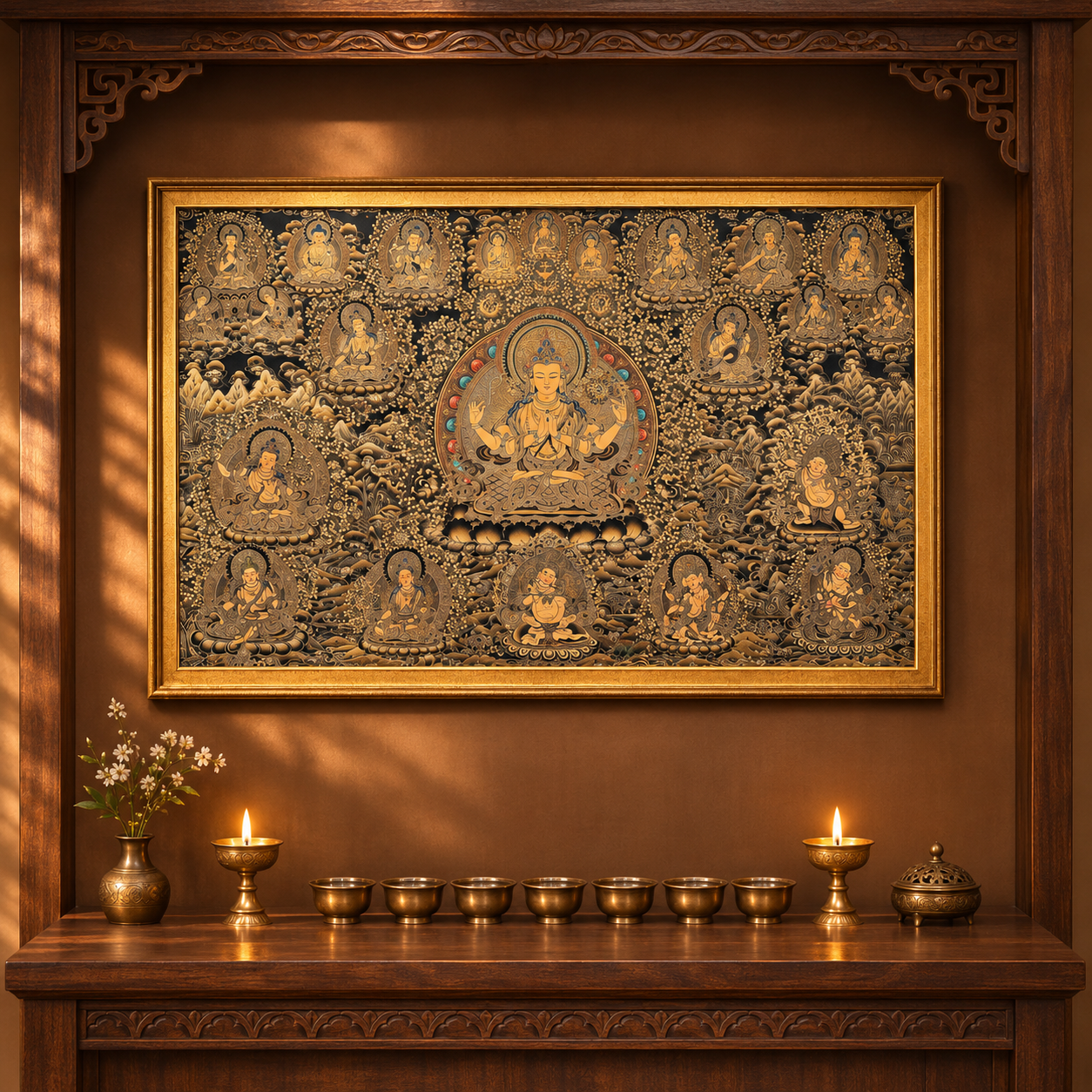
Spend time with the figures, line work and composition of the Thangka. Display it away from direct sunlight and damp conditions. Ask the museum for advice about mounting, framing or handling the specific work; avoid touching the painted surface.