Luosang Daji · Cairang Dangzhou

Yellow Jambhala

Artwork introduction

Yellow Jambhala (September 2015)

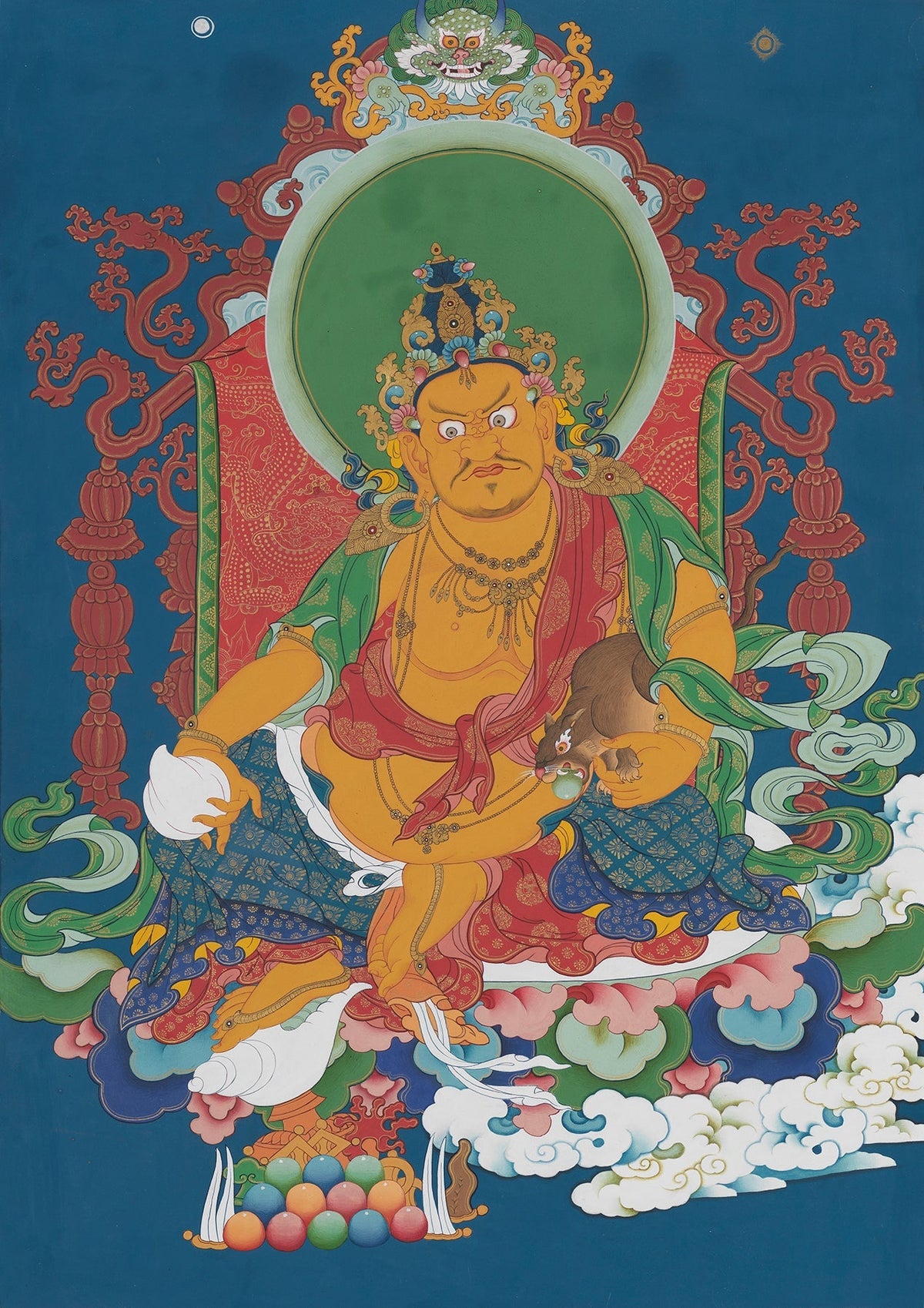
Yellow Jambhala's eyes glare wide above a slightly rounded belly. He is not angry: he is examining human greed and restlessness. Much anxiety comes from dreams of sudden riches without the steadiness to preserve wealth. His majesty is a sharp awakening: modest wealth comes through diligence, great wealth through virtue. Only grounded, honest living enables us to bear the world's riches.

His full golden body sits on a dragon-patterned throne, with jewels piled high before him, radiating precious light in a solemn composure. In his left hand he embraces a jewel-spitting mongoose with a jewel in its mouth, showing that wealth comes from steady cultivation. The auspicious white conch in his right hand reminds us to honor trust in business and conduct. His right foot rests on a white-conch treasure vessel, suggesting that only an expansive heart can hold wealth. His orpiment-yellow body glows warmly like molten gold against a malachite-green halo and vermilion-and-gold dragons, splendid without gaudiness. True abundance is the ease and peace of heart that follow grounded effort, walking steadily toward a distant goal.

$10,310.00
勉唐画派宗师传人 罗桑达吉·才让当周大师作品
Quantity:

Total: $10,310.00

  • AliPay
  • American Express
  • Apple Pay
  • Bancontact
  • Google Pay
  • Mastercard
  • MB WAY
  • Shop Pay
  • Union Pay
  • Visa

Explore the collection: Yellow Jambhala

SamantabhadraYama TeachingManjushriHayagrivaPalden Lhamo
  • Hand-painted Thangka Art
  • 📦 Artwork photographs and presentation details are confirmed before dispatch.
  • 🚚 Free Shipping, Trackable Logistics
  • ↩ 30-day returns on eligible non-custom works
Artwork Details & Confirmation

Each Thangka has its own composition, dimensions and presentation. Please review the photographs and catalogue notes, and contact the museum about the work’s condition, materials or mounting before ordering.

We confirm artwork photographs and dispatch details before shipping. For a commissioned work, the subject, dimensions, materials, schedule and any agreed review stages are discussed separately.

Eligible non-custom works may be returned within 30 days of receipt, subject to the return policy.

Delivery time

Estimated delivery for available works: 10–16 business days. This consists of 5–9 business days for preparation and 5–7 business days in transit.

Preparation: order and address confirmation, checking the selected Thangka’s condition and mounting, and protective packing appropriate to the work. Commissioned works follow an individually agreed schedule.

Transit: the carrier and tracking information are provided when the work is dispatched. Commissioned works or special mounting arrangements require a separately agreed schedule. See our shipping policy.

Returns & Refunds

30-day return window: contact the museum within 30 days of receipt for eligible non-custom works. The work must be unused, in its original condition and packaging, with proof of purchase.

Commissioned or personalised works: these are non-returnable unless damaged or defective. Please discuss any difference from the confirmed commission with the museum.

Return shipping: 香港合丰 covers damaged, defective or incorrect items. For a change of mind, size or preference, the customer pays the actual return shipping cost. There is no restocking fee. Obtain return instructions before sending the work.

Approved refunds are made to the original payment method within 10 business days. If more than 15 business days have passed after approval, contact the museum. See the full return policy.

Payment Method Guide

Payment methods available for your country and currency are displayed at checkout. Please use the options shown there to complete your order.

For questions about a particular Thangka, confirm its availability, dimensions and presentation with 香港合丰 before payment. See payment information.

香港合丰 Artwork introduction

About this Thangka

Yellow Jambhala

黄财神

Yellow Jambhala (September 2015)

Each day, we introduce a thangka. Today, we explore a classic polychrome work depicting the foremost of the five wealth deities, who gives a restless heart the confidence of grounded abundance: Yellow Jambhala.

Why do the wealth gods people usually worship beam with smiles, while Yellow Jambhala in thangka paintings has wide, glaring eyes, a slightly rounded belly, and an especially stern, imposing appearance? Behind this image lies Eastern culture's clearest insight into 'true wealth.' In Tibetan philosophy, Yellow Jambhala's stern gaze has never meant anger. It examines human greed and restlessness. Many people's anxiety comes less from a lack of opportunities to earn money than from a lack of the steadiness needed to preserve wealth: always dreaming of overnight riches, blindly speculating, and remaining impatient. Yellow Jambhala's glare sharply calls a halt to our greed and unreasonable desires. More than dispensing gold and silver from nowhere, he resembles a revealing mirror of wealth and character, teaching us, in a world pursuing material things, that modest wealth comes through diligence and great wealth through virtue. Only through grounded conduct and an expansive heart can we truly bear the world's blessings.

With this story in mind, the painting's overall details suddenly become clear. His entire body is golden yellow and full, seated peacefully on an architectural throne adorned with painted and carved dragon designs, his expression majestic and composed. Auspicious clouds drift before him, while multicolored mani jewels rise in a high pile below, their precious light shining in every direction. The painter gives Yellow Jambhala such weighty dignity and solemnity for more than instilling fear. It tells us that the most lasting prosperity is always built on the bearing and principles of upright conduct and a firm stance.

Now look more closely at his sacred form and ritual objects. The jewel-spitting mongoose tightly embraced in his left hand is described in the scriptures as a divine animal that originally guarded treasure in the deep-sea dragon palace. After being transformed by goodness, it accompanied him with a wish-fulfilling jewel in its mouth. It means that wealth is never sought outside ourselves but emerges from within through grounded effort. The object raised in his right hand is an auspicious white conch. Its fine sound traveling in all directions reminds us to value trustworthiness and reputation in both business and personal conduct: only upright deeds and an honest bearing allow a good name to travel far. His right foot rests upon a white-conch treasure vessel, suggesting a heart as open as a valley, receiving a hundred rivers: the wider the heart's capacity, the larger the vessel that can hold wealth.

In its color, natural orpiment gives the body the warm, steady glow of molten gold, creating a striking contrast with the deep, verdant malachite-green halo behind his head. Finely intricate dragon designs in vermilion and pure gold adorn the throne, grounded by a dark blue brocade skirt. Splendid in gold and green yet entirely free of vulgarity, the painting reveals the noble Eastern grandeur of rich mineral-color painting as an intangible cultural heritage.

Once you understand this Yellow Jambhala, you will see that true abundance is the harvest of grounded effort and the openness and peace within the heart.

May you, too, let go of restlessness, advance steadily toward distant goals, and find an ease enriched in both wealth and spirit.

Follow 香港合丰 to discover more of the Eastern stories held within these paintings!

Luosang Daji · Cairang Dangzhou

Luosang Daji · Cairang Dangzhou

Luosang Daji · Cairang Dangzhou began learning Thangka painting at seven and studied at Wutun Upper Temple under Master Xiawu Cairang. His practice is rooted in the Menri tradition.

View artist
Artwork & Order Confirmation

Artwork & Order Confirmation

Confirm the selected Thangka, its dimensions and presentation with the museum. After ordering, check that your contact details and delivery address are correct so we can discuss the work and its dispatch.
Details & Mounting

Details & Mounting

Review photographs of the actual work and confirm its condition and mounting before dispatch. For a commission, the subject, format, materials and review stages are agreed individually with the artist and museum.

Protective Packing & Delivery

Protective Packing & Delivery

The work is packed according to its dimensions, support and mounting. Tracking details are provided after dispatch. Keep the packaging until you have inspected the Thangka and confirmed that it has arrived safely.
Viewing & Care

Viewing & Care

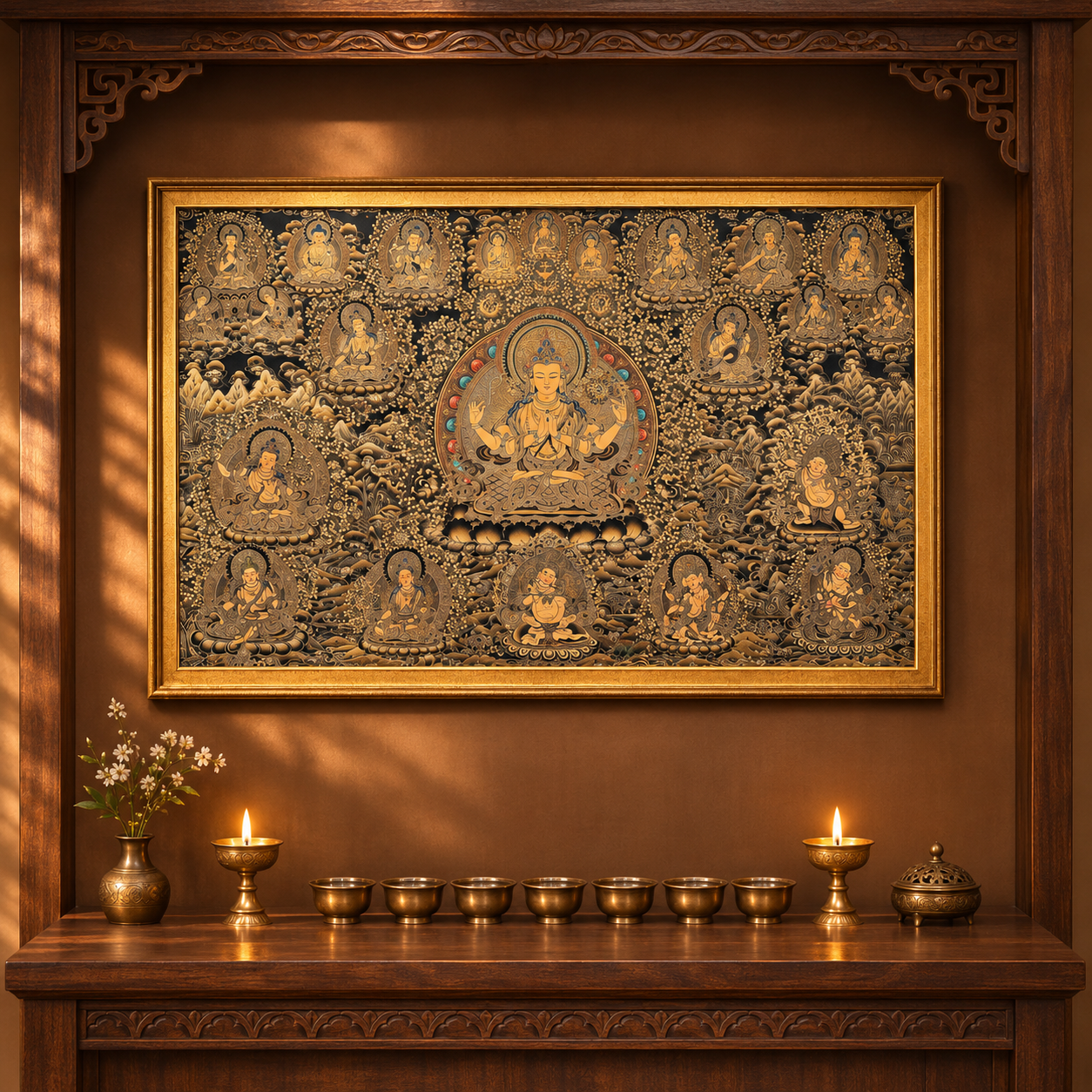
Spend time with the figures, line work and composition of the Thangka. Display it away from direct sunlight and damp conditions. Ask the museum for advice about mounting, framing or handling the specific work; avoid touching the painted surface.