Luosang Daji · Cairang Dangzhou

Four-Armed Avalokiteshvara in the Pure Land

Artwork introduction

Four-Armed Avalokiteshvara's Pure Land of Bliss (2013)

Breaking with the convention of Amitabha presiding over the Pure Land, this painting places Four-Armed Avalokiteshvara, palms joined, in command of the golden-roofed celestial palace. Amitabha at the top represents ultimate truth, while Avalokiteshvara is the bridge of deliverance that reaches into the mire. There is no need to abandon everything to reach liberation and peace. When you embrace the world's regrets with great compassion and learn to treat yourself and others gently, your heart is already within its own Pure Land of Bliss.

Jade-white Avalokiteshvara sits upright on a thousand-petaled lotus. Behind him, dozens of golden-roofed pavilions with layered eaves rise along mountains; peacocks and sacred birds perch among them; Amitabha watches from his hall; and in the seven-jeweled pool, miraculously born children emerge with joined palms. The architectural painting is exquisitely precise. Joined palms protect the jewel and preserve the goodness of one's nature; the lotus in his left hand perfumes the world; crystal prayer beads in his right hand express an unwavering vow to sustain living beings; Amitabha guides toward wisdom like a lighthouse. His jade-white body is framed by lapis-blue radiance and a peacock-green head halo; red walls and golden roofs glow among green mountains, still dazzling after more than a decade. When great compassion arises, this moment is a pure land. With compassion as the bridge, life has no hopeless place.

$17,795.00
勉唐画派宗师传人 罗桑达吉·才让当周大师作品
Quantity:

Total: $17,795.00

  • AliPay
  • American Express
  • Apple Pay
  • Bancontact
  • Google Pay
  • Mastercard
  • MB WAY
  • Shop Pay
  • Union Pay
  • Visa

Explore the collection: Four-Armed Avalokiteshvara in the Pure Land

SamantabhadraYama TeachingManjushriHayagrivaPalden Lhamo
  • Hand-painted Thangka Art
  • 📦 Artwork photographs and presentation details are confirmed before dispatch.
  • 🚚 Free Shipping, Trackable Logistics
  • ↩ 30-day returns on eligible non-custom works
Artwork Details & Confirmation

Each Thangka has its own composition, dimensions and presentation. Please review the photographs and catalogue notes, and contact the museum about the work’s condition, materials or mounting before ordering.

We confirm artwork photographs and dispatch details before shipping. For a commissioned work, the subject, dimensions, materials, schedule and any agreed review stages are discussed separately.

Eligible non-custom works may be returned within 30 days of receipt, subject to the return policy.

Delivery time

Estimated delivery for available works: 10–16 business days. This consists of 5–9 business days for preparation and 5–7 business days in transit.

Preparation: order and address confirmation, checking the selected Thangka’s condition and mounting, and protective packing appropriate to the work. Commissioned works follow an individually agreed schedule.

Transit: the carrier and tracking information are provided when the work is dispatched. Commissioned works or special mounting arrangements require a separately agreed schedule. See our shipping policy.

Returns & Refunds

30-day return window: contact the museum within 30 days of receipt for eligible non-custom works. The work must be unused, in its original condition and packaging, with proof of purchase.

Commissioned or personalised works: these are non-returnable unless damaged or defective. Please discuss any difference from the confirmed commission with the museum.

Return shipping: 香港合丰 covers damaged, defective or incorrect items. For a change of mind, size or preference, the customer pays the actual return shipping cost. There is no restocking fee. Obtain return instructions before sending the work.

Approved refunds are made to the original payment method within 10 business days. If more than 15 business days have passed after approval, contact the museum. See the full return policy.

Payment Method Guide

Payment methods available for your country and currency are displayed at checkout. Please use the options shown there to complete your order.

For questions about a particular Thangka, confirm its availability, dimensions and presentation with 香港合丰 before payment. See payment information.

香港合丰 Artwork introduction

About this Thangka

Four-Armed Avalokiteshvara in the Pure Land

四臂观音极乐世界

Four-Armed Avalokiteshvara's Pure Land of Bliss (2013)

Every day, we introduce a thangka. Today, we explore a classic major work in rich mineral colors from a decade ago that breaks convention by placing greatly compassionate Avalokiteshvara at the center of the Pure Land of Bliss: Four-Armed Avalokiteshvara's Pure Land of Bliss, painted in 2013.

In nearly every Pure Land of Bliss painting we have seen, Amitabha occupies the center. So why, in this rare scroll from ten years ago, is Four-Armed Avalokiteshvara, palms joined, the one presiding over the entire golden-roofed celestial palace? Behind this lies Eastern culture's warmest teaching on 'how to reach liberation and happiness.' Buddhist scriptures record that Avalokiteshvara is not only the successor to the Pure Land of Bliss but also the sole 'bridge of compassion' connecting the everyday world with the Pure Land. The Buddha sits high at the top, representing ultimate awakening and truth; yet for ordinary people suffering below, such lofty awakening can sometimes seem remote and unattainable. Avalokiteshvara, by contrast, is the guide willing to step into the mire and listen to every sigh. In this anxious and lonely age, many feel that they are 'too far from happiness': they think they are not good enough, have too many troubles, and do not deserve a peaceful, beautiful life. This painting reveals an ultimate truth: entering the Pure Land of Bliss never requires abandoning everything. When you are willing to embrace the regrets around you with great compassion, when you begin to treat yourself and others with gentleness, you are already seated within a pure land of your own. More than a heavenly vista, it is like a 'warm resting place for the spirit,' teaching us that the key to the door of inner peace has never been abstruse preaching, but the compassion deep in the heart that never dies.

With this story in mind, the painting's grand composition becomes clear. At the center, Four-Armed Avalokiteshvara is gentle as white jade, seated peacefully on a blooming thousand-petaled lotus throne. Behind him, dozens of golden-roofed pavilions with layered eaves are built along mountains, with peacocks and sacred birds joyfully perching among roof ridges and flowering trees. Amitabha quietly watches from the highest palace at the top. In the courtyards and corridors below, monks stroll in small groups discussing the Dharma; at the very bottom, white lotuses bloom in the seven-jeweled pool, and miraculously born children emerge from the water with palms joined. Finely executed in architectural brushwork, with layer upon layer of mountain ridges, the painting took the artist months to trace every brick and tile of this land of bliss. It tells us that life's fulfilled destination is precisely this great earthly peace, where all things coexist and quiet warmth fills the world.

Look more closely at the sacred forms and details. The mani jewel clasped between Avalokiteshvara's joined palms at his chest represents, in the scriptures, 'fulfilling all good wishes and purity of one's own nature,' guiding us to preserve the foundation of goodness already complete within us amid life's temptations of fame and gain. The exquisite blooming pink-white lotus in his upper left hand symbolizes releasing an otherworldly fragrance even while living in the everyday world. The clear crystal prayer beads in his upper right hand carry the vow to remain ever mindful and never abandon a single suffering being. Amitabha in the palace at the top represents the ultimate lighthouse of spiritual belonging, guiding great compassion toward supreme wisdom.

In color, Avalokiteshvara's white-jade body appears sacred and clear against the lapis-lazuli royal-blue aureole and malachite-green head halo behind him. The cinnabar-red walls and glazed golden roofs of the layered-eave halls shine among lush green mountains. The gently rippling emerald water of the seven-jeweled pool below interweaves with pink-white peonies throughout. Bright and rich in color, rigorously composed in its architectural painting, the work remains dazzling after more than a decade, exuding the exquisitely considered Eastern beauty of temple halls in this rich mineral-painting heritage.

Once you understand this Four-Armed Avalokiteshvara's Pure Land of Bliss, you will see: when great compassion arises, this very moment is a pure land. With compassion as the bridge, life has no hopeless place.

May you have great compassion within and peace around you in your hurried life, with an unburdened heart that naturally creates its own pure land.

Follow 香港合丰 to discover more Eastern stories within these paintings!

Luosang Daji · Cairang Dangzhou

Luosang Daji · Cairang Dangzhou

Luosang Daji · Cairang Dangzhou began learning Thangka painting at seven and studied at Wutun Upper Temple under Master Xiawu Cairang. His practice is rooted in the Menri tradition.

View artist
Artwork & Order Confirmation

Artwork & Order Confirmation

Confirm the selected Thangka, its dimensions and presentation with the museum. After ordering, check that your contact details and delivery address are correct so we can discuss the work and its dispatch.

Details & Mounting

Details & Mounting

Review photographs of the actual work and confirm its condition and mounting before dispatch. For a commission, the subject, format, materials and review stages are agreed individually with the artist and museum.

Protective Packing & Delivery

Protective Packing & Delivery

The work is packed according to its dimensions, support and mounting. Tracking details are provided after dispatch. Keep the packaging until you have inspected the Thangka and confirmed that it has arrived safely.
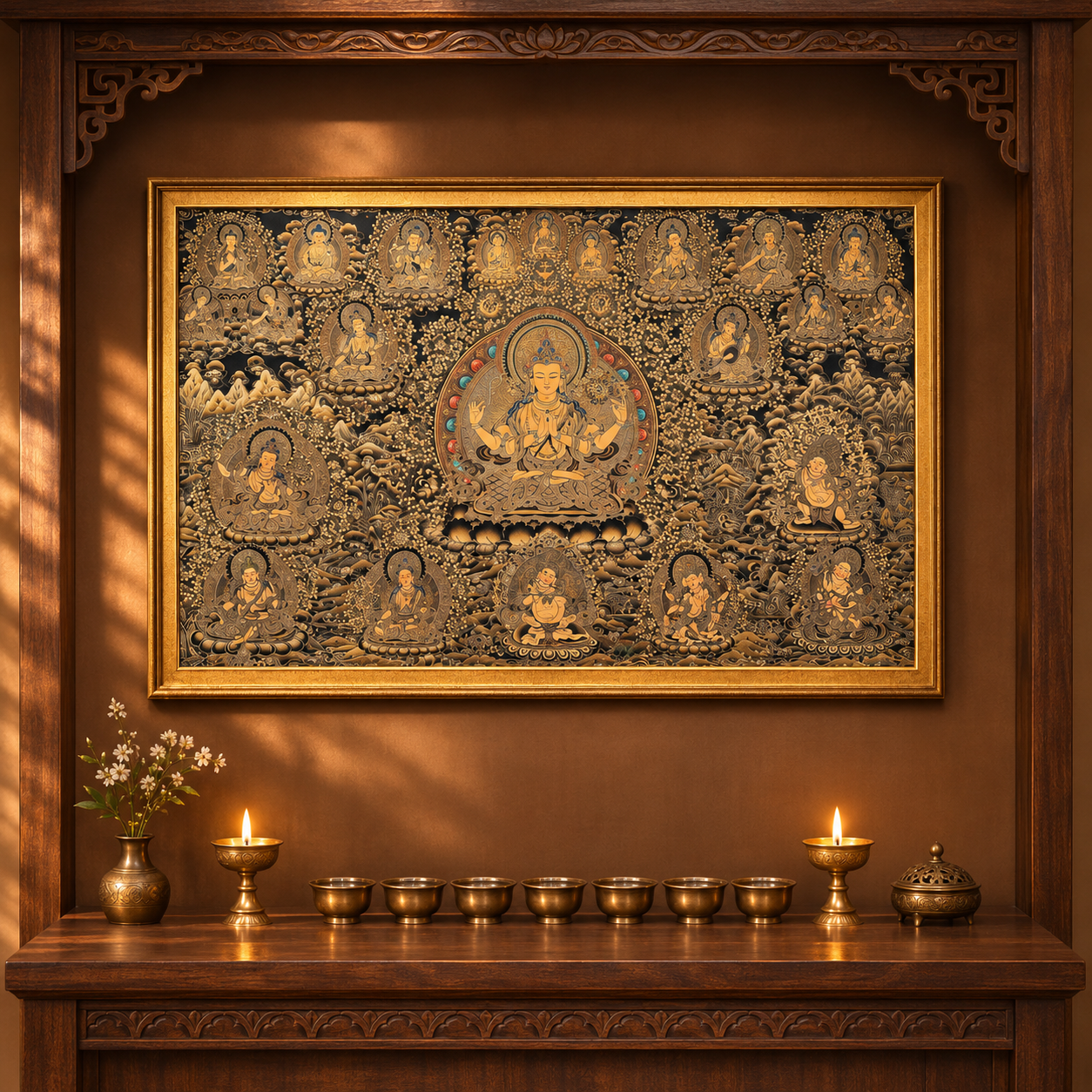
Viewing & Care

Viewing & Care

Spend time with the figures, line work and composition of the Thangka. Display it away from direct sunlight and damp conditions. Ask the museum for advice about mounting, framing or handling the specific work; avoid touching the painted surface.