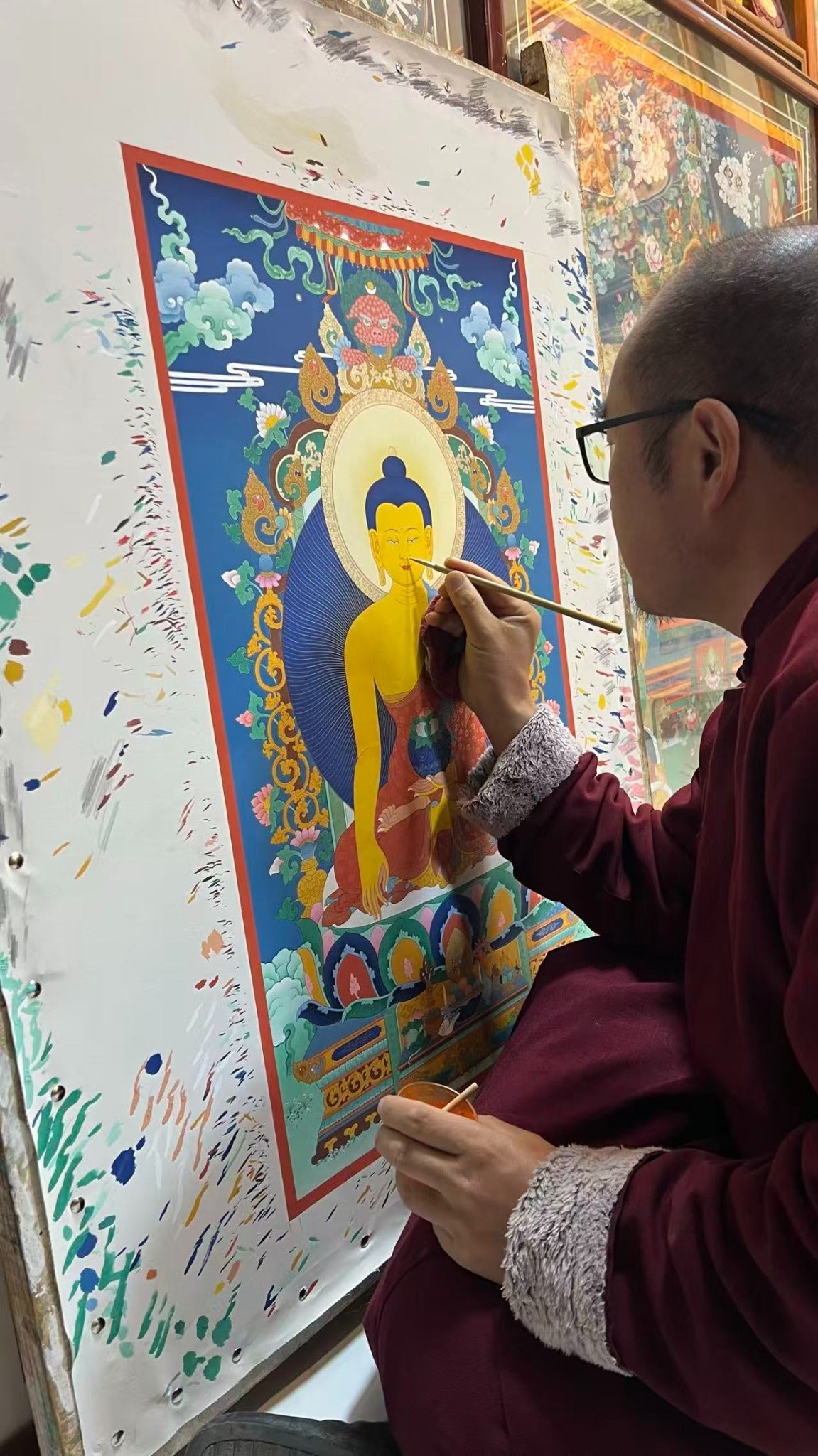
Luosang Daji · Cairang Dangzhou

Amitabha’s Pure Land — Black and Gold

Artwork introduction

Black-and-Gold Amitabha's Pure Land of Bliss (2013)

On black xuan paper, pure-gold fine lines alone build a 'never-dark city of golden palaces' suspended in space. In the Pure Land of Bliss, 'the ground is gold, and the Buddha's light shines by itself.' The black ground represents deep space without beginning or end, while flowing gold lines represent imperishable truth and the power of vows. Many people today lack security. The golden palace the painter spent a year constructing brick by brick reveals that the highest security is a city built within, unshakable even amid storms and upheaval.

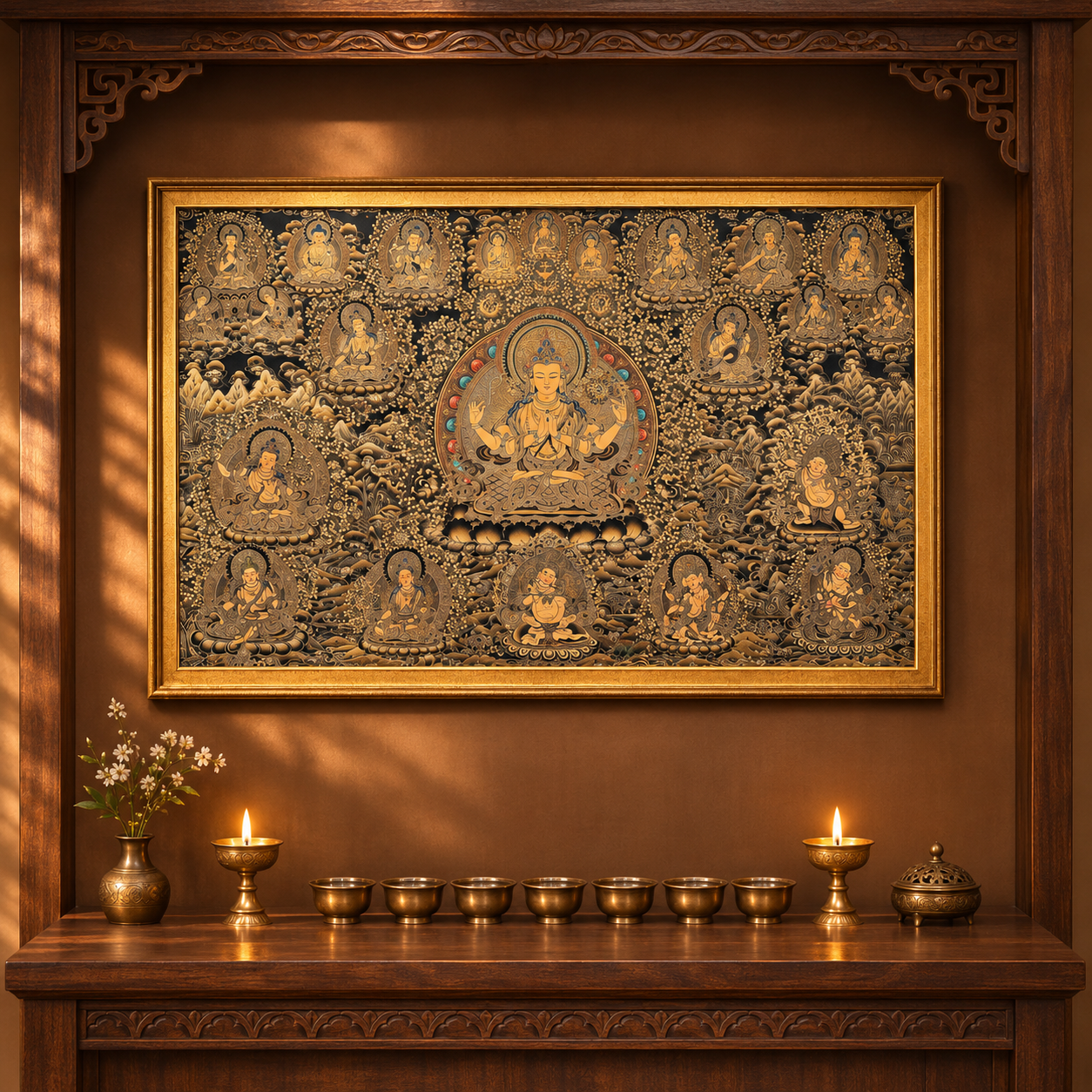
Golden Amitabha sits upright, his light opening like a star, guarded by the Eight Great Bodhisattvas. Hundreds of golden pavilions with layered eaves rise along mountains; flying celestials play music, and a great procession of monks walks the corridors. Dense yet orderly, the scene follows rigorous structure. The meditation mudra supports a lapis-lazuli nectar bowl, gathering restless thoughts; rare touches of lapis-blue light appear in golden palaces and jeweled crowns; monks below suggest that only grounded practice brings freedom. Dense black xuan paper meets restrained, mellow gold lines, occasionally pierced by a telling cool lapis blue, in extraordinary architectural painting. If the heart is a splendid golden city, no outside storm can shake it, and a lifetime of ease and peace becomes possible.

$17,795.00
勉唐画派宗师传人 罗桑达吉·才让当周大师作品
Quantity:

Total: $17,795.00

  • AliPay
  • American Express
  • Apple Pay
  • Bancontact
  • Google Pay
  • Mastercard
  • MB WAY
  • Shop Pay
  • Union Pay
  • Visa

Explore the collection: Amitabha’s Pure Land — Black and Gold

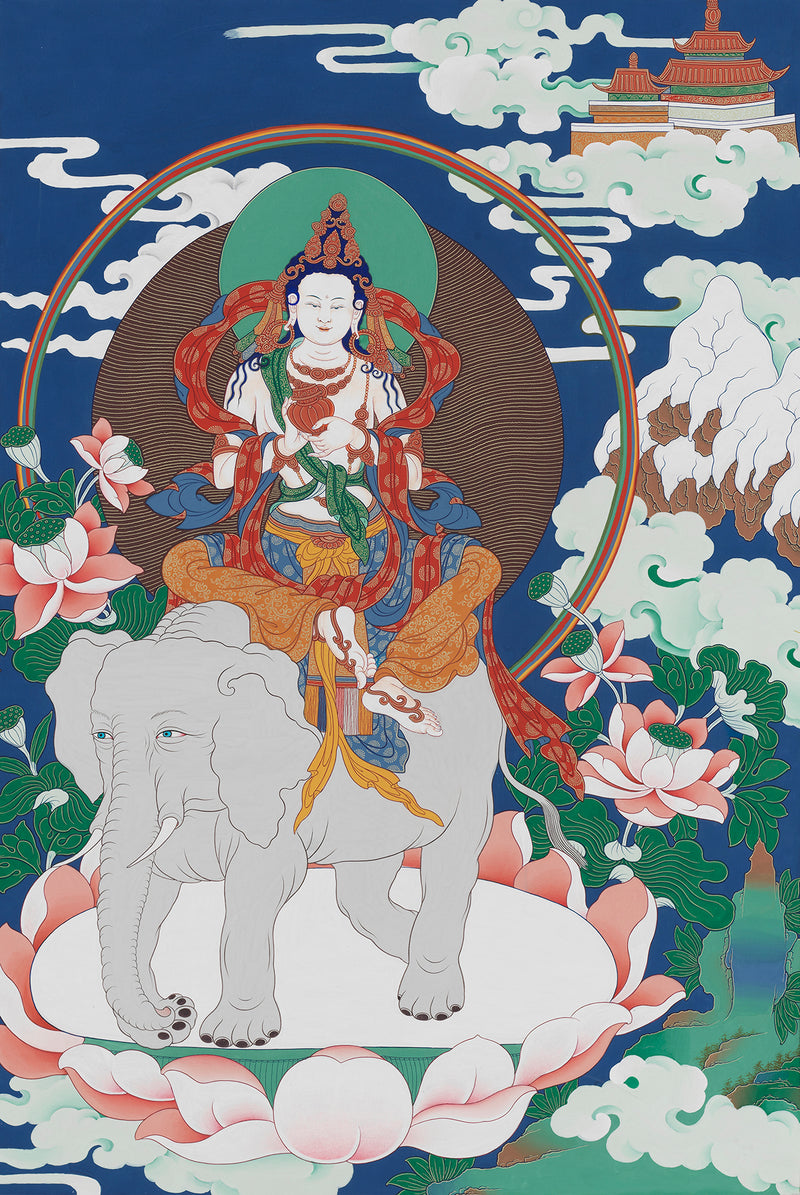
SamantabhadraYama TeachingManjushriHayagrivaPalden Lhamo
  • Hand-painted Thangka Art
  • 📦 Artwork photographs and presentation details are confirmed before dispatch.
  • 🚚 Free Shipping, Trackable Logistics
  • ↩ 30-day returns on eligible non-custom works
Artwork Details & Confirmation

Each Thangka has its own composition, dimensions and presentation. Please review the photographs and catalogue notes, and contact the museum about the work’s condition, materials or mounting before ordering.

We confirm artwork photographs and dispatch details before shipping. For a commissioned work, the subject, dimensions, materials, schedule and any agreed review stages are discussed separately.

Eligible non-custom works may be returned within 30 days of receipt, subject to the return policy.

Delivery time

Estimated delivery for available works: 10–16 business days. This consists of 5–9 business days for preparation and 5–7 business days in transit.

Preparation: order and address confirmation, checking the selected Thangka’s condition and mounting, and protective packing appropriate to the work. Commissioned works follow an individually agreed schedule.

Transit: the carrier and tracking information are provided when the work is dispatched. Commissioned works or special mounting arrangements require a separately agreed schedule. See our shipping policy.

Returns & Refunds

30-day return window: contact the museum within 30 days of receipt for eligible non-custom works. The work must be unused, in its original condition and packaging, with proof of purchase.

Commissioned or personalised works: these are non-returnable unless damaged or defective. Please discuss any difference from the confirmed commission with the museum.

Return shipping: 香港合丰 covers damaged, defective or incorrect items. For a change of mind, size or preference, the customer pays the actual return shipping cost. There is no restocking fee. Obtain return instructions before sending the work.

Approved refunds are made to the original payment method within 10 business days. If more than 15 business days have passed after approval, contact the museum. See the full return policy.

Payment Method Guide

Payment methods available for your country and currency are displayed at checkout. Please use the options shown there to complete your order.

For questions about a particular Thangka, confirm its availability, dimensions and presentation with 香港合丰 before payment. See payment information.

香港合丰 Artwork introduction

About this Thangka

Amitabha’s Pure Land — Black and Gold

黑金阿弥陀佛极乐世界

Black-and-Gold Amitabha's Pure Land of Bliss (2013)

Every day, we introduce a thangka. Today, we explore a monumental black-and-gold work from a decade ago, building countless glazed palaces in pure-gold fine lines on deep black xuan paper and acclaimed as a pinnacle of Pure Land imagery: Black-and-Gold Amitabha's Pure Land of Bliss, painted in 2013.

Both paintings show Amitabha's Pure Land of Bliss, so why was the previous one an earthly paradise of green mountains and clear waters, while this treasured masterpiece from ten years ago abandons every ostentatious mixed color and uses pure gold alone to trace a 'never-dark city of pure gold' suspended in endless night? Behind this lies one of the most astonishing truths about the Pure Land in Buddhist scripture. The Infinite Life Sutra records that in the land of bliss, 'the ground is gold; there are no sun and moon, and the Buddha's light shines by itself.' There is no sun or moon, no day or night, because the light radiated by the Buddha himself illuminates the entire universe. In the eyes of traditional painters, the black canvas represents 'deep space without beginning or end,' while the flowing gold lines represent 'imperishable truth and the power of vows.' In today's uncertain world, many people's greatest fear is 'a lack of security': fear of losing a job, fear of a relationship breaking down, a sense that life could collapse at any moment. The painter devoted an entire year to tracing this impregnable golden palace brick by brick in the black void, to tell us that the highest security is never rented from the outside world, but 'built stroke by stroke' within ourselves. More than a Pure Land painting, it is like an 'ultimate fortress for the mind,' teaching us, when facing outside storms and upheaval, to generate light within and build a golden city that no one can breach.

With this story in mind, the scroll's magnificent details become clear. At the center, Amitabha sits upright in golden form, countless golden rays bursting outward behind him like a star. The Eight Great Bodhisattvas stand solemnly in a sea of clouds on either side. Hundreds of golden-roofed pavilions with layered eaves rise along the mountains behind him, while flying celestials play music in the golden clouds. At the very bottom, a vast assembly of monks in robes walks respectfully in orderly lines through the magnificent golden courtyards. Dense yet never chaotic, rigorously ordered, the entire Buddhist land of bliss is rendered in hundreds of thousands of pure-gold lines, each fine detail clear. The painter tells us that when a person's inner faith and order are sufficiently precise, the once barren, dark wilderness of life naturally becomes a miracle radiant with golden light.

Look more closely at the sacred forms and details. At the center, Amitabha's hands form a meditation mudra before his abdomen, steady as rock. They support a lapis-lazuli precious nectar bowl, described in tantric scriptures as filled with the nectar of immortality, symbolizing the supreme capacity to gather restless thoughts and hold refreshing wisdom. Throughout the pure-gold pavilions and the minute details of the bodhisattvas' jeweled crowns, rare, brilliant touches of lapis-blue mineral pigment appear like stars scattered across a golden city, reminding us to retain a clear, perceptive spiritual awareness of worldly affairs even within pure resolve. The great assembly of monks walking the lower corridors silently conveys that the great way is supremely simple: only grounded spiritual practice allows us to move, step by step, toward inner composure.

In color, deep, dense black xuan paper covers the entire ground. Pure-gold lines build layers of pavilions, flying eaves, roof-tile ridges, railings, and vast clouds and mist within the night. After more than a decade, there is no oxidation or flaking; the gold is restrained, mellow, noble, and steady. Occasionally, a pure lapis-lazuli deep blue breaks through in the Buddha's curled topknot and the medicinal bowl in his palms. Gold and black blend throughout, with architectural brushwork of unparalleled precision, exuding the beauty of an Eastern royal palace that makes the viewer hold their breath and focus.

Once you understand this Black-and-Gold Amitabha's Pure Land of Bliss, you will see: nothing lies outside the mind, and circumstances are created by the heart. If the heart is a splendid golden city, no outside storm can shake it.

May you build yourself an indestructible inner pure land along life's long road, with your heart's lamp always bright, untouched by storms, and peaceful and unhurried throughout your life.

Follow 香港合丰 to discover more Eastern stories within these paintings!

Luosang Daji · Cairang Dangzhou

Luosang Daji · Cairang Dangzhou

Luosang Daji · Cairang Dangzhou began learning Thangka painting at seven and studied at Wutun Upper Temple under Master Xiawu Cairang. His practice is rooted in the Menri tradition.

View artist
Artwork & Order Confirmation

Artwork & Order Confirmation

Confirm the selected Thangka, its dimensions and presentation with the museum. After ordering, check that your contact details and delivery address are correct so we can discuss the work and its dispatch.

Details & Mounting

Details & Mounting

Review photographs of the actual work and confirm its condition and mounting before dispatch. For a commission, the subject, format, materials and review stages are agreed individually with the artist and museum.

Protective Packing & Delivery

Protective Packing & Delivery

The work is packed according to its dimensions, support and mounting. Tracking details are provided after dispatch. Keep the packaging until you have inspected the Thangka and confirmed that it has arrived safely.
Viewing & Care

Viewing & Care

Spend time with the figures, line work and composition of the Thangka. Display it away from direct sunlight and damp conditions. Ask the museum for advice about mounting, framing or handling the specific work; avoid touching the painted surface.