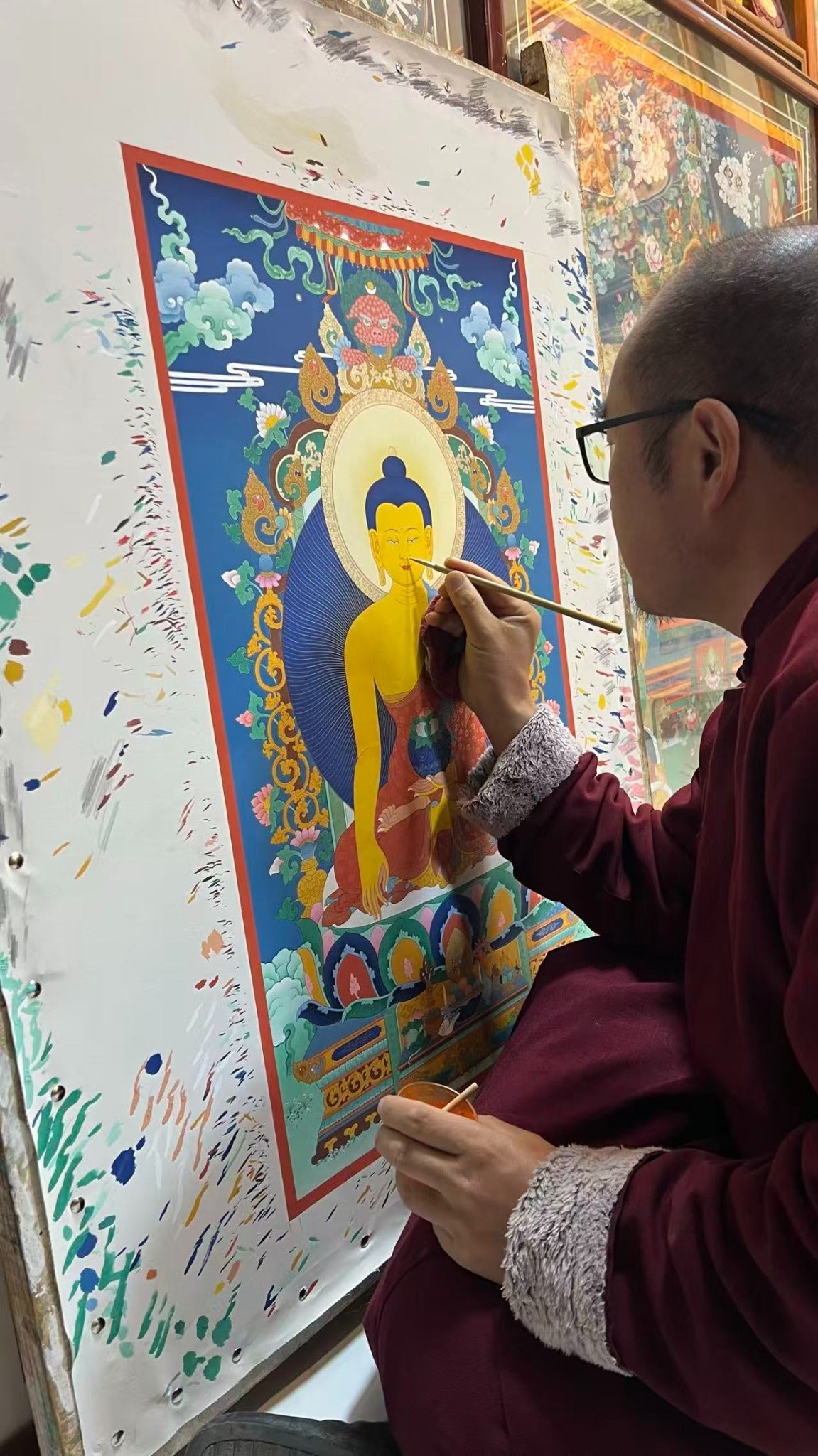
Luosang Daji · Cairang Dangzhou

Five Buddhas · Akshobhya

Artwork introduction

Five Directional Buddhas: Akshobhya (September 2019)

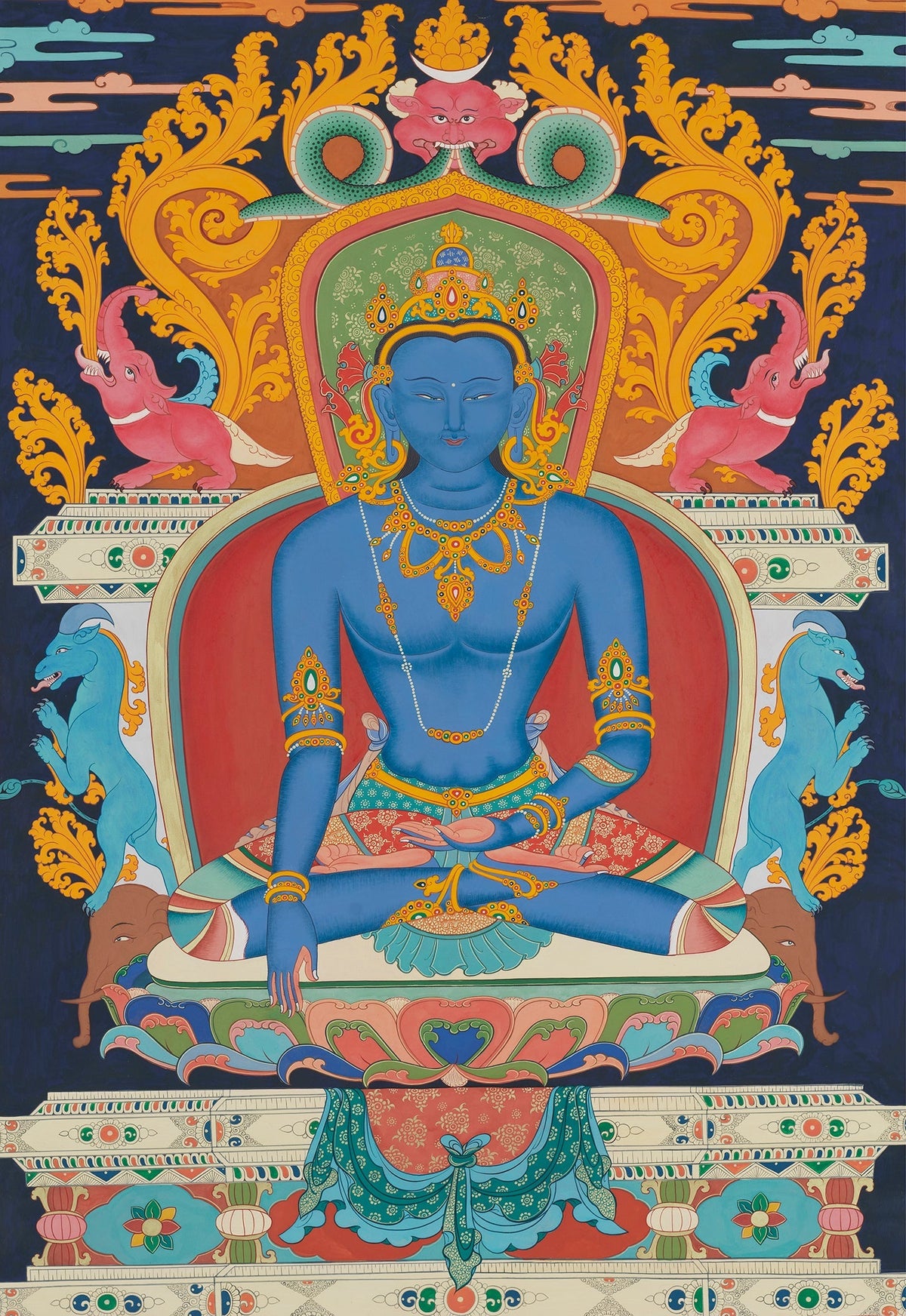
Akshobhya of the east represents the water element and 'great mirror-like wisdom,' his whole body a deep lapis-lazuli blue. Still water reflects all things, but once disturbed it becomes cloudy and unclear. His blue-green body, like a fathomless pool, absorbs and subdues human anger and irritability, becoming a cool, clear mirror that reveals our attachments.

Pink makaras leap and tumble on either side of his halo, suggesting that only by springing free of the bitter sea of craving and anger can we release pure vitality. The Buddha's fingertips reach toward the ground in the earth-touching mudra, also called the demon-subduing mudra, calling the steadfast earth goddess as witness. It symbolizes remaining as immovable as the earth before worldly threats and temptations, subduing inner demons. Ground natural lapis lazuli creates a color as deep as a pool of black jade, contrasting coolly with bright golden scrolling foliage and a warm red aureole in a calm majesty. However fierce the waves, a steady heart remains at peace. Refraining from anger and preserving a deep-sea steadiness is the highest wisdom.

$6,764.00
勉唐画派宗师传人 罗桑达吉·才让当周大师作品
Quantity:

Total: $6,764.00

  • AliPay
  • American Express
  • Apple Pay
  • Bancontact
  • Google Pay
  • Mastercard
  • MB WAY
  • Shop Pay
  • Union Pay
  • Visa

Explore the collection: Five Buddhas · Akshobhya

SamantabhadraYama TeachingManjushriHayagrivaPalden Lhamo
  • Hand-painted Thangka Art
  • 📦 Artwork photographs and presentation details are confirmed before dispatch.
  • 🚚 Free Shipping, Trackable Logistics
  • ↩ 30-day returns on eligible non-custom works
Artwork Details & Confirmation

Each Thangka has its own composition, dimensions and presentation. Please review the photographs and catalogue notes, and contact the museum about the work’s condition, materials or mounting before ordering.

We confirm artwork photographs and dispatch details before shipping. For a commissioned work, the subject, dimensions, materials, schedule and any agreed review stages are discussed separately.

Eligible non-custom works may be returned within 30 days of receipt, subject to the return policy.

Delivery time

Estimated delivery for available works: 10–16 business days. This consists of 5–9 business days for preparation and 5–7 business days in transit.

Preparation: order and address confirmation, checking the selected Thangka’s condition and mounting, and protective packing appropriate to the work. Commissioned works follow an individually agreed schedule.

Transit: the carrier and tracking information are provided when the work is dispatched. Commissioned works or special mounting arrangements require a separately agreed schedule. See our shipping policy.

Returns & Refunds

30-day return window: contact the museum within 30 days of receipt for eligible non-custom works. The work must be unused, in its original condition and packaging, with proof of purchase.

Commissioned or personalised works: these are non-returnable unless damaged or defective. Please discuss any difference from the confirmed commission with the museum.

Return shipping: 香港合丰 covers damaged, defective or incorrect items. For a change of mind, size or preference, the customer pays the actual return shipping cost. There is no restocking fee. Obtain return instructions before sending the work.

Approved refunds are made to the original payment method within 10 business days. If more than 15 business days have passed after approval, contact the museum. See the full return policy.

Payment Method Guide

Payment methods available for your country and currency are displayed at checkout. Please use the options shown there to complete your order.

For questions about a particular Thangka, confirm its availability, dimensions and presentation with 香港合丰 before payment. See payment information.

香港合丰 Artwork introduction

About this Thangka

Five Buddhas · Akshobhya

五方佛 · 不动如来

Five Directional Buddhas: Akshobhya (September 2019)

Each day, we introduce a thangka. Today, we meet Akshobhya, the Buddha of the east among the Five Directional Buddhas, who helps the heart become as firm as rock, without a ripple.

In the system of the Five Directional Buddhas, why is Akshobhya's whole body a lapis-lazuli blue like the deep sea or night sky, with his right hand reaching straight toward the earth? Behind this image lies a powerful Eastern key to cultivating the mind and overcoming anger. In Buddhist culture, Akshobhya of the east represents the water element and 'great mirror-like wisdom.' Just as a peaceful lake can faithfully reflect all things, once the water is disturbed nothing can be seen clearly. Much of the loss of control and inner friction in modern life arises from anger and irritability: at the first setback, anger fills the heart and words and actions become excessive. Akshobhya's blue-green body is like a pool of unfathomable depth, absorbing and cooling every heated emotion. More than a solemn Buddha image, he is like a clear mirror that reveals our attachments, teaching us to preserve a heart's rock-solid strength without impatience or anger when storms arrive.

With this story in mind, the divine animals of the throne suddenly become clear. At the upper level on either side of his halo, a pink makara leaps and rolls, with an elephant-like trunk, a scaled fish body, and scrolling foliage pouring from its mouth. Ancient artists placed this mysterious great beast, originally hidden in the ocean's abyss, above the throne. Drawing on the legend of its leap from the deep sea to release marvelous treasures, it suggests that only by leaping completely free of the bitter sea of desire, greed, and anger can we release a pure, unrestrained vitality.

Now look more closely at the Buddha's sacred form and hand gesture. He wears a five-leaf jeweled crown, his expression as tranquil as the sea. His right fingertips reach down to form the earth-touching mudra, also called the demon-subduing mudra. In Buddhist scriptures, it represents the Buddha calling the steadfast earth goddess as witness at the moment of his awakening. It symbolizes a heart as immovable as the earth before every worldly threat and temptation, utterly subduing all inner demons.

In its color, the painting uses ground precious natural lapis lazuli to produce a dark blue as deep as an abyss of black jade. The bright golden scrolling foliage above the throne and the warm red aureole create an intense interplay of cool and warm. Majesty emerges through stillness, fully revealing the composed order of Eastern painting in rich mineral colors.

Once you understand this Akshobhya, you will see that, however fierce the waves, a steady heart remains at peace; refraining from anger is the highest wisdom.

When life becomes turbulent and confused, may you, too, have the deep sea's tranquil steadiness and remain as firm as Mount Tai through wind and rain.

Follow 香港合丰 to discover more of the Eastern stories held within these paintings!

Luosang Daji · Cairang Dangzhou

Luosang Daji · Cairang Dangzhou

Luosang Daji · Cairang Dangzhou began learning Thangka painting at seven and studied at Wutun Upper Temple under Master Xiawu Cairang. His practice is rooted in the Menri tradition.

View artist
Artwork & Order Confirmation

Artwork & Order Confirmation

Confirm the selected Thangka, its dimensions and presentation with the museum. After ordering, check that your contact details and delivery address are correct so we can discuss the work and its dispatch.
Details & Mounting

Details & Mounting

Review photographs of the actual work and confirm its condition and mounting before dispatch. For a commission, the subject, format, materials and review stages are agreed individually with the artist and museum.

Protective Packing & Delivery

Protective Packing & Delivery

The work is packed according to its dimensions, support and mounting. Tracking details are provided after dispatch. Keep the packaging until you have inspected the Thangka and confirmed that it has arrived safely.
Viewing & Care

Viewing & Care

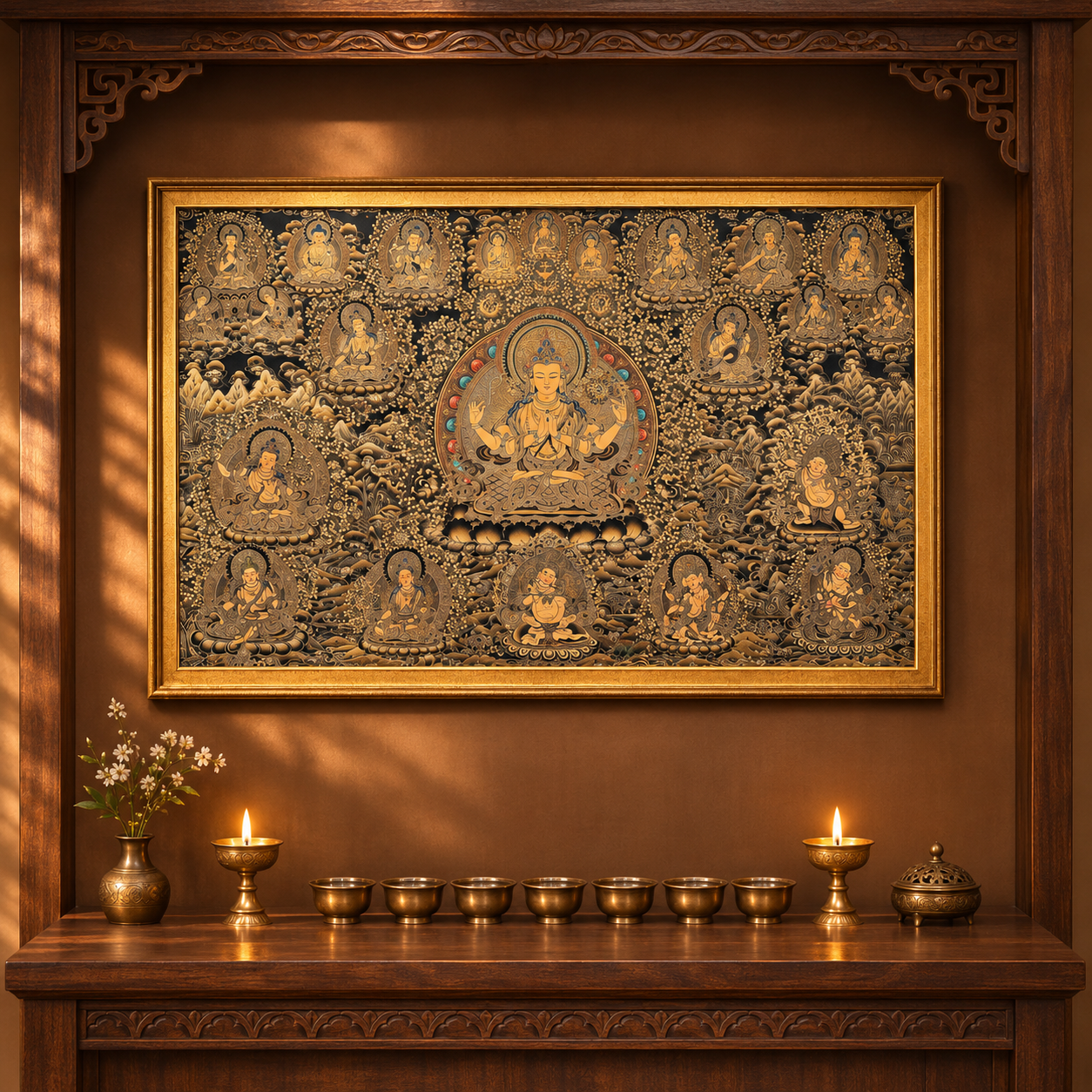
Spend time with the figures, line work and composition of the Thangka. Display it away from direct sunlight and damp conditions. Ask the museum for advice about mounting, framing or handling the specific work; avoid touching the painted surface.