Luosang Daji · Cairang Dangzhou

Manjushri

Artwork introduction

Manjushri (August 2025)

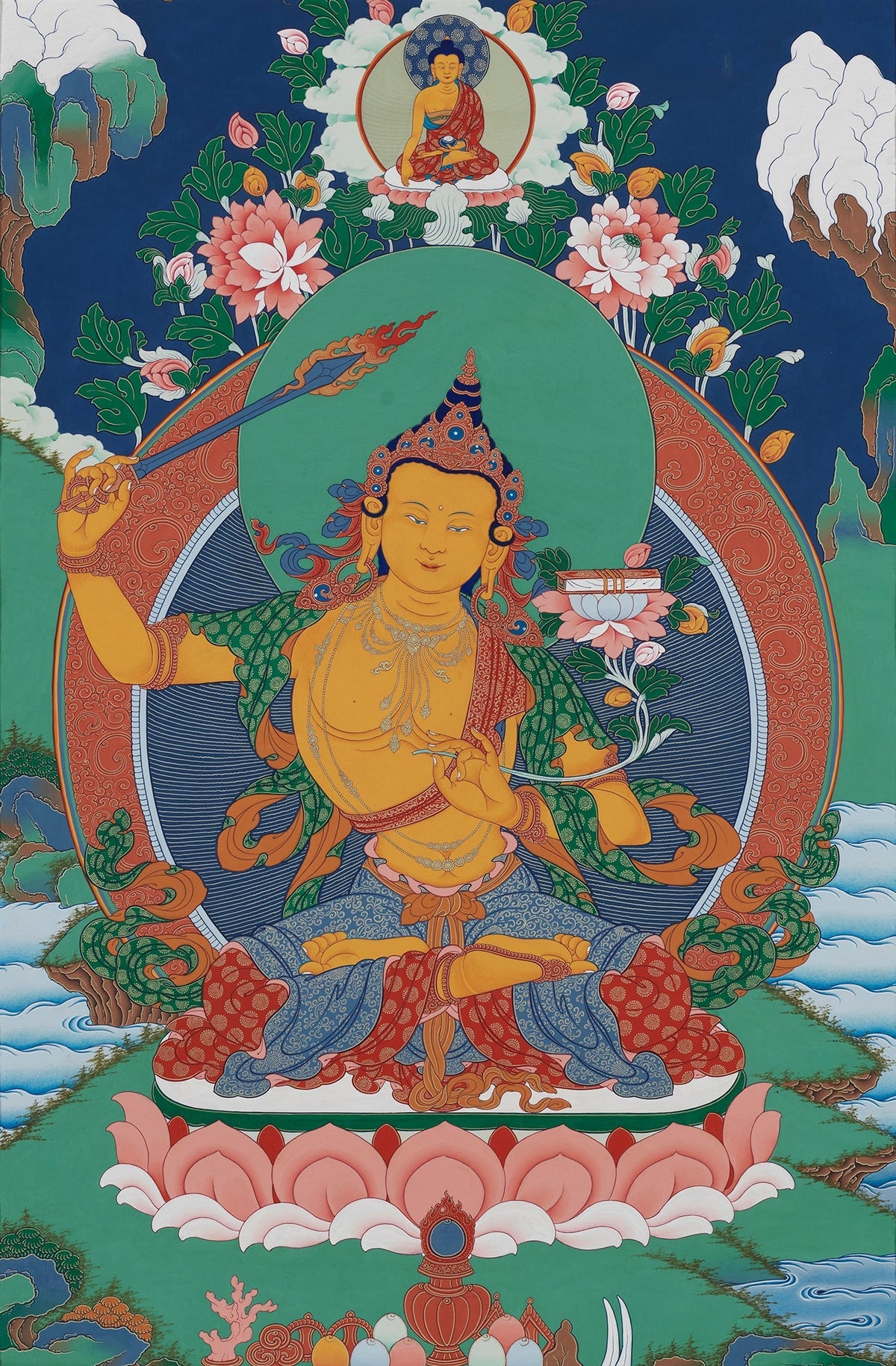
Manjushri, the teacher of all Buddhas, holds a sword aloft. Its purpose is neither defense nor destruction: it is the ultimate Eastern symbol of wisdom. Much of life's suffering arises from inner ignorance and entanglement. This 'sword of wisdom' is the light of dawn that cuts through the tangled threads of affliction.

Depicted as a youthful sixteen-year-old, Manjushri has an orpiment-yellow body glowing like gold and sits cross-legged on a pink-and-white lotus throne. His youthful form suggests a pure, clear heart that remains free of world-weariness even after experiencing worldly life. The unsheathed sword in his right hand cuts away delusion and inner turmoil; the blue lotus beside his left shoulder securely supports the Prajnaparamita Sutra, symbolizing the clarity to understand the world after relinquishing rigid attachments. His dawn-like yellow complexion, green-and-gold brocade scarf, peonies, and layered landscape complement one another. A lapis-lazuli aureole interweaves with a rainbow halo, creating an ethereal atmosphere beyond worldly concerns. The work reminds us that true 'great wisdom' lies in deciding when to let go. With the heart untroubled by emotional entanglement, clarity and ease become possible.

$6,764.00
勉唐画派宗师传人 罗桑达吉·才让当周大师作品
Quantity:

Total: $6,764.00

  • AliPay
  • American Express
  • Apple Pay
  • Bancontact
  • Google Pay
  • Mastercard
  • MB WAY
  • Shop Pay
  • Union Pay
  • Visa

Explore the collection: Manjushri

SamantabhadraYama TeachingManjushriHayagrivaPalden Lhamo
  • Hand-painted Thangka Art
  • 📦 Artwork photographs and presentation details are confirmed before dispatch.
  • 🚚 Free Shipping, Trackable Logistics
  • ↩ 30-day returns on eligible non-custom works
Artwork Details & Confirmation

Each Thangka has its own composition, dimensions and presentation. Please review the photographs and catalogue notes, and contact the museum about the work’s condition, materials or mounting before ordering.

We confirm artwork photographs and dispatch details before shipping. For a commissioned work, the subject, dimensions, materials, schedule and any agreed review stages are discussed separately.

Eligible non-custom works may be returned within 30 days of receipt, subject to the return policy.

Delivery time

Estimated delivery for available works: 10–16 business days. This consists of 5–9 business days for preparation and 5–7 business days in transit.

Preparation: order and address confirmation, checking the selected Thangka’s condition and mounting, and protective packing appropriate to the work. Commissioned works follow an individually agreed schedule.

Transit: the carrier and tracking information are provided when the work is dispatched. Commissioned works or special mounting arrangements require a separately agreed schedule. See our shipping policy.

Returns & Refunds

30-day return window: contact the museum within 30 days of receipt for eligible non-custom works. The work must be unused, in its original condition and packaging, with proof of purchase.

Commissioned or personalised works: these are non-returnable unless damaged or defective. Please discuss any difference from the confirmed commission with the museum.

Return shipping: 香港合丰 covers damaged, defective or incorrect items. For a change of mind, size or preference, the customer pays the actual return shipping cost. There is no restocking fee. Obtain return instructions before sending the work.

Approved refunds are made to the original payment method within 10 business days. If more than 15 business days have passed after approval, contact the museum. See the full return policy.

Payment Method Guide

Payment methods available for your country and currency are displayed at checkout. Please use the options shown there to complete your order.

For questions about a particular Thangka, confirm its availability, dimensions and presentation with 香港合丰 before payment. See payment information.

香港合丰 Artwork introduction

About this Thangka

Manjushri

文殊菩萨

Manjushri (August 2025)

Each day, we introduce a thangka. Today, we meet Manjushri of Great Wisdom, who represents the highest wisdom and helps us cut through every kind of worldly confusion.

Why, among all the bodhisattvas with compassionate faces, does Manjushri alone raise a sharp sword high in his hand? What is he guarding against? What is he cutting away? Behind this image lies a profound Eastern insight into wisdom. In tradition, Manjushri is called the 'teacher of all Buddhas.' It is said that many practitioners asked him about the path to liberation. Rather than giving complicated sermons, he exposed one essential truth: the greatest suffering in life often comes from inner 'ignorance,' rather than obstacles outside us—the dead ends we cannot escape and the tangled emotions we cannot cut free. This is why his sword is called the 'sword of wisdom.' It has never been intended for killing; its special purpose is to cleave through our inner entanglements and attachments. More than a weapon, it is like the light of dawn when we lose our way, teaching us to cut decisively through confusion in a complicated world.

With this story in mind, the painting's details suddenly become clear. Look at his luminous orpiment-yellow body, radiant as pure gold, and his delicate face, like that of a sixteen-year-old youth. He sits cross-legged upon a blossoming, thousand-petaled pink-and-white lotus throne. Buddhism deliberately depicts the bearer of great wisdom as a youth for more than visual beauty. It tells us that the highest clarity is not the calculating attitude of a world-weary person, but a heart that remains innocent and clear after passing through worldly life, untouched by its weary cynicism.

Now look more closely at his sacred form and ritual objects. In legend, the wisdom sword raised in his right hand can cut through the illusory web of delusion the moment it leaves its sheath. Its sharp edge cuts decisively through entanglement, cleaving apart the inner friction and indecision of daily life. The blue lotus blooming beside his left shoulder securely supports the **Prajnaparamita Sutra**. Through Buddhism's profound scripture of sudden insight, it suggests that only after we break free of blindly pursued dead ends can the heart gain the clarity to see the world as it is.

In its color, the bright, warm orpiment-yellow body resembles the breaking dawn. A green-and-gold brocade scarf overlaps with pink-and-white peonies and blue-green mountains and streams behind him. The deep lapis-lazuli aureole interweaves with a rainbow halo, giving the work an elegant, ethereal quality beyond worldly concerns.

Once you understand this Manjushri, you will see that true 'great wisdom' is the decisiveness to let go at the right time.

May you, too, possess a wisdom sword that cuts through affliction, leaving your heart free of confinement and your emotions untroubled, and bringing clarity and ease into your life.

Follow 香港合丰 to discover more of the Eastern stories held within these paintings!

Luosang Daji · Cairang Dangzhou

Luosang Daji · Cairang Dangzhou

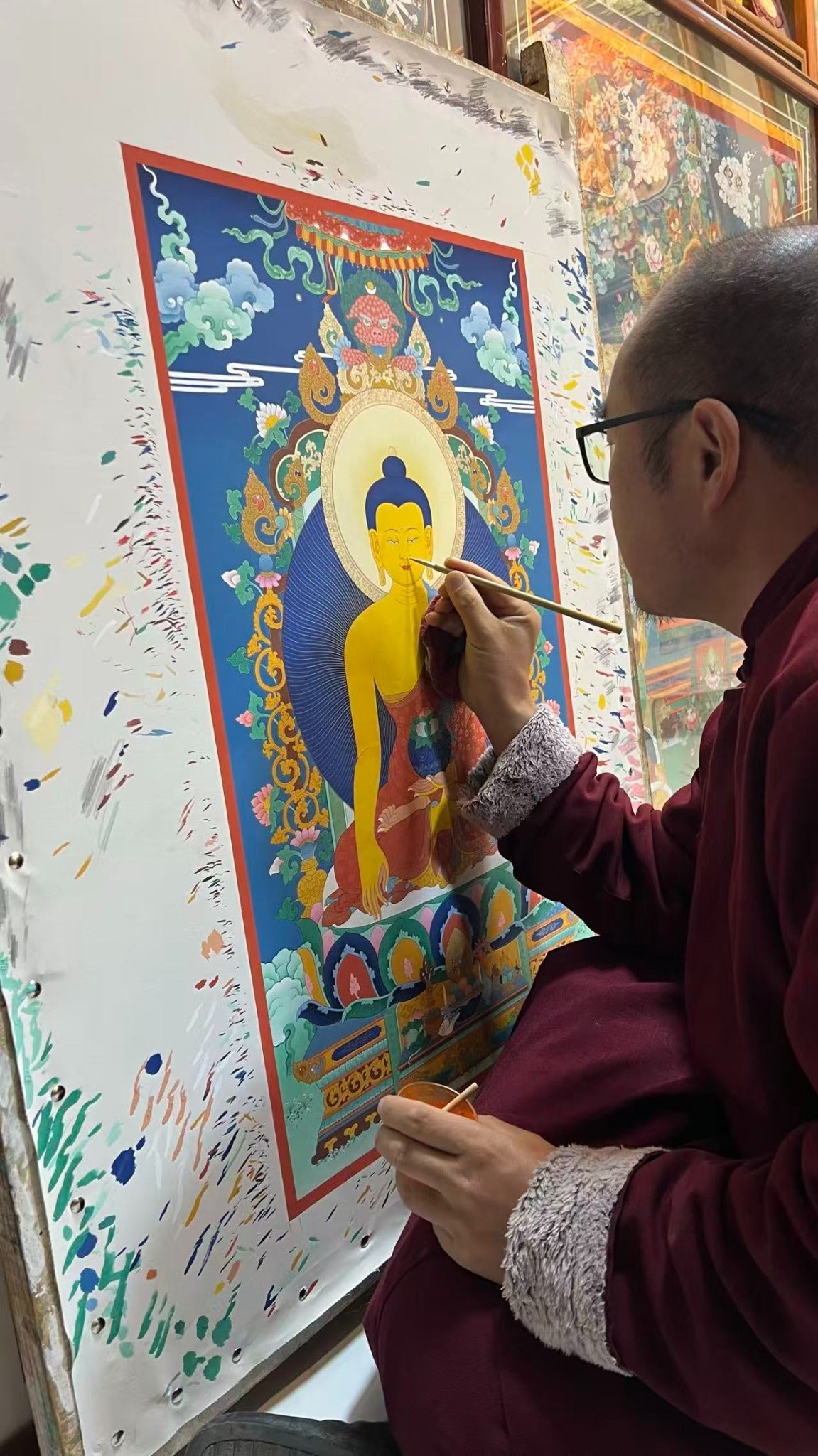
Luosang Daji · Cairang Dangzhou began learning Thangka painting at seven and studied at Wutun Upper Temple under Master Xiawu Cairang. His practice is rooted in the Menri tradition.

View artist
Artwork & Order Confirmation

Artwork & Order Confirmation

Confirm the selected Thangka, its dimensions and presentation with the museum. After ordering, check that your contact details and delivery address are correct so we can discuss the work and its dispatch.
Details & Mounting

Details & Mounting

Review photographs of the actual work and confirm its condition and mounting before dispatch. For a commission, the subject, format, materials and review stages are agreed individually with the artist and museum.

Protective Packing & Delivery

Protective Packing & Delivery

The work is packed according to its dimensions, support and mounting. Tracking details are provided after dispatch. Keep the packaging until you have inspected the Thangka and confirmed that it has arrived safely.
Viewing & Care

Viewing & Care

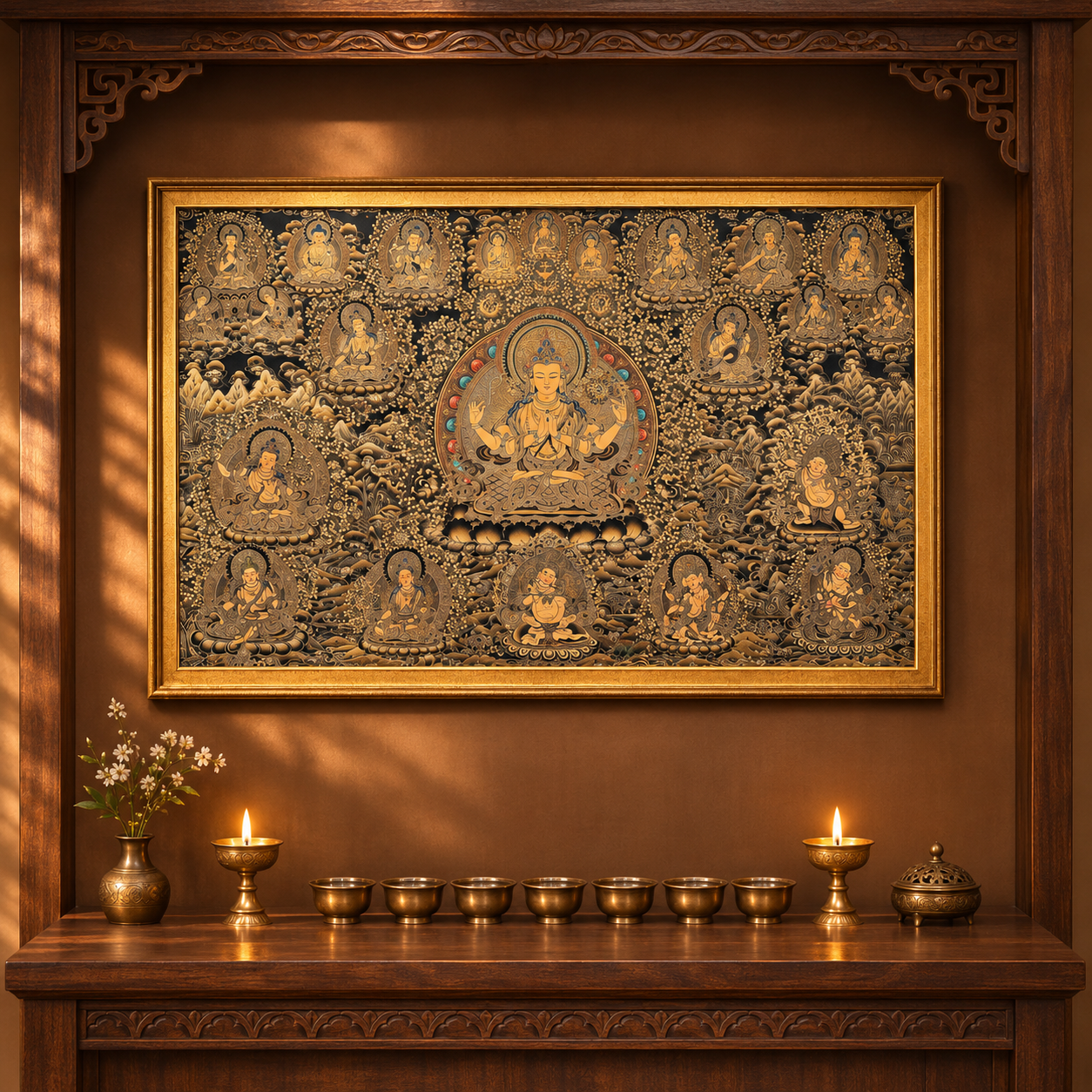
Spend time with the figures, line work and composition of the Thangka. Display it away from direct sunlight and damp conditions. Ask the museum for advice about mounting, framing or handling the specific work; avoid touching the painted surface.