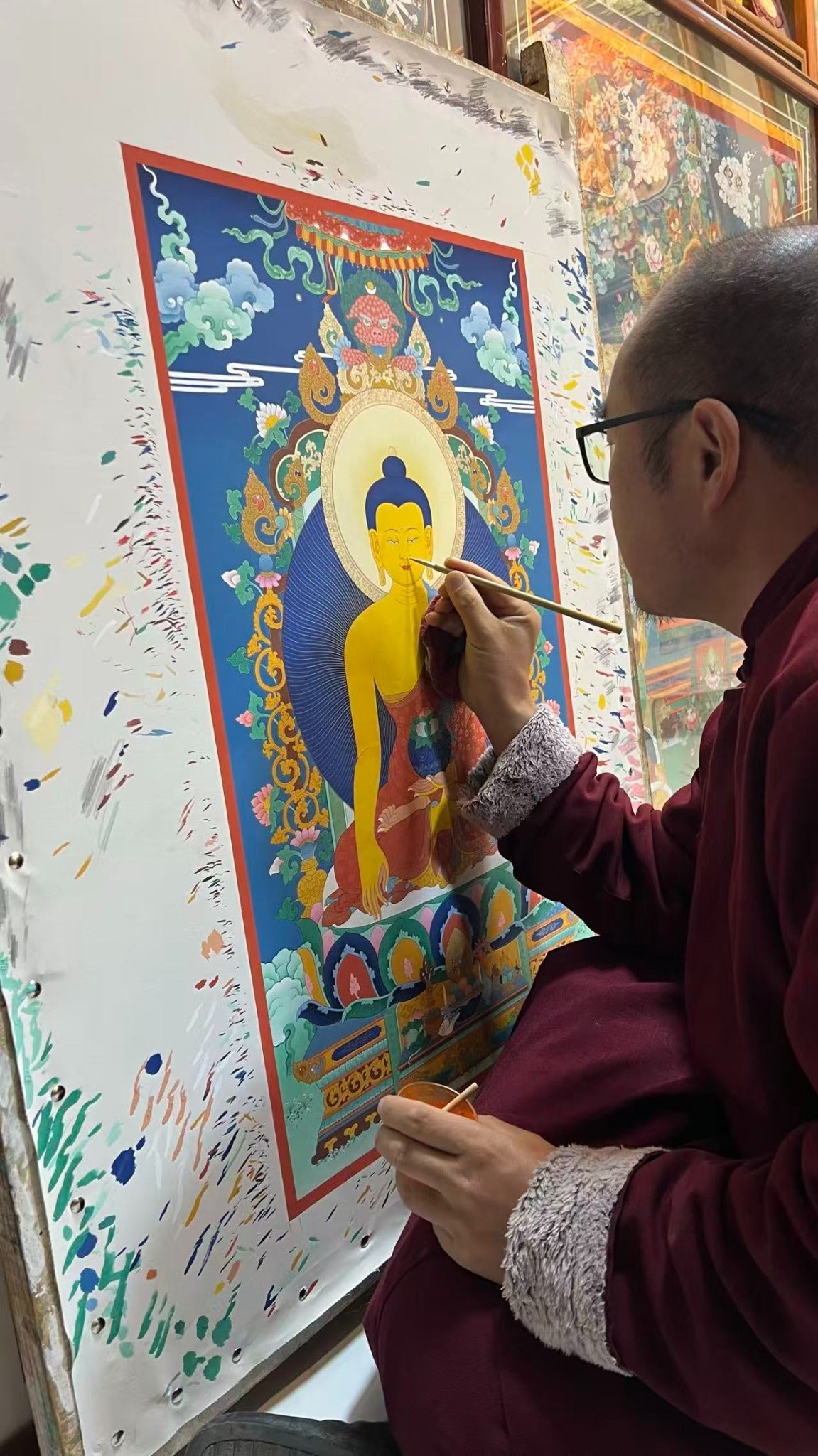
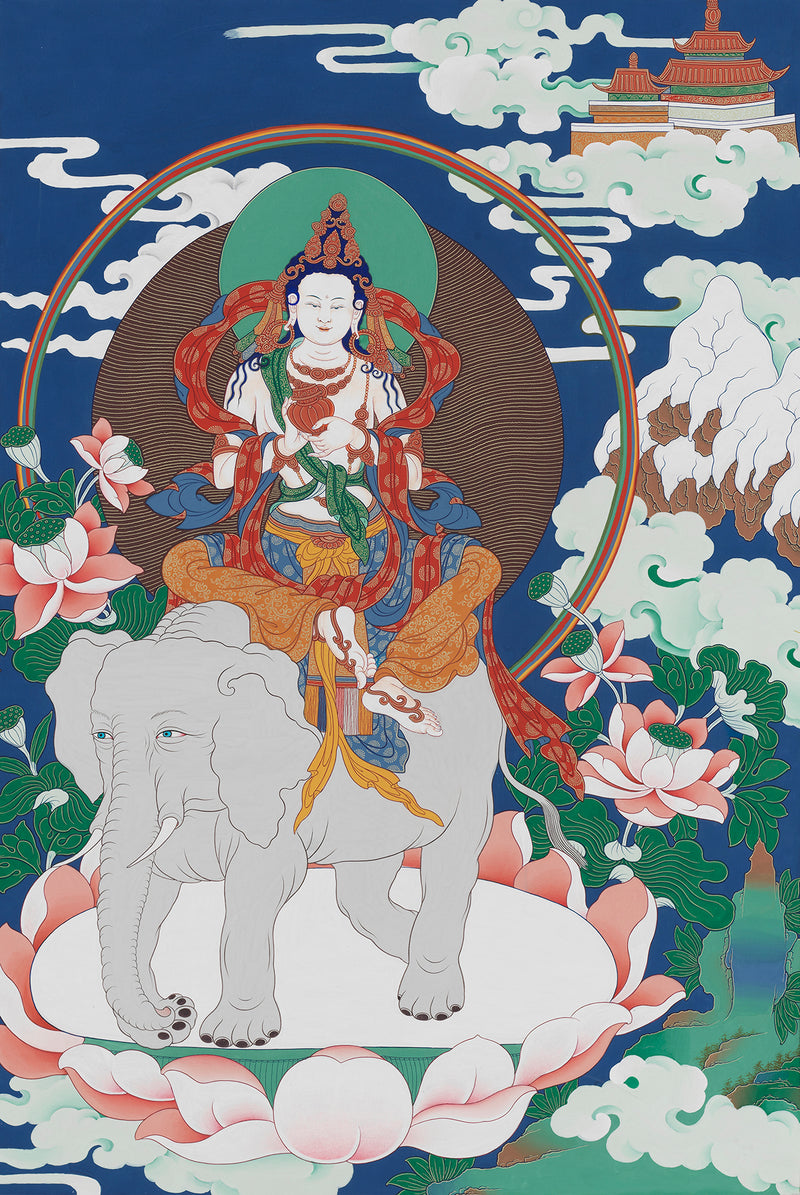
Luosang Daji · Cairang Dangzhou

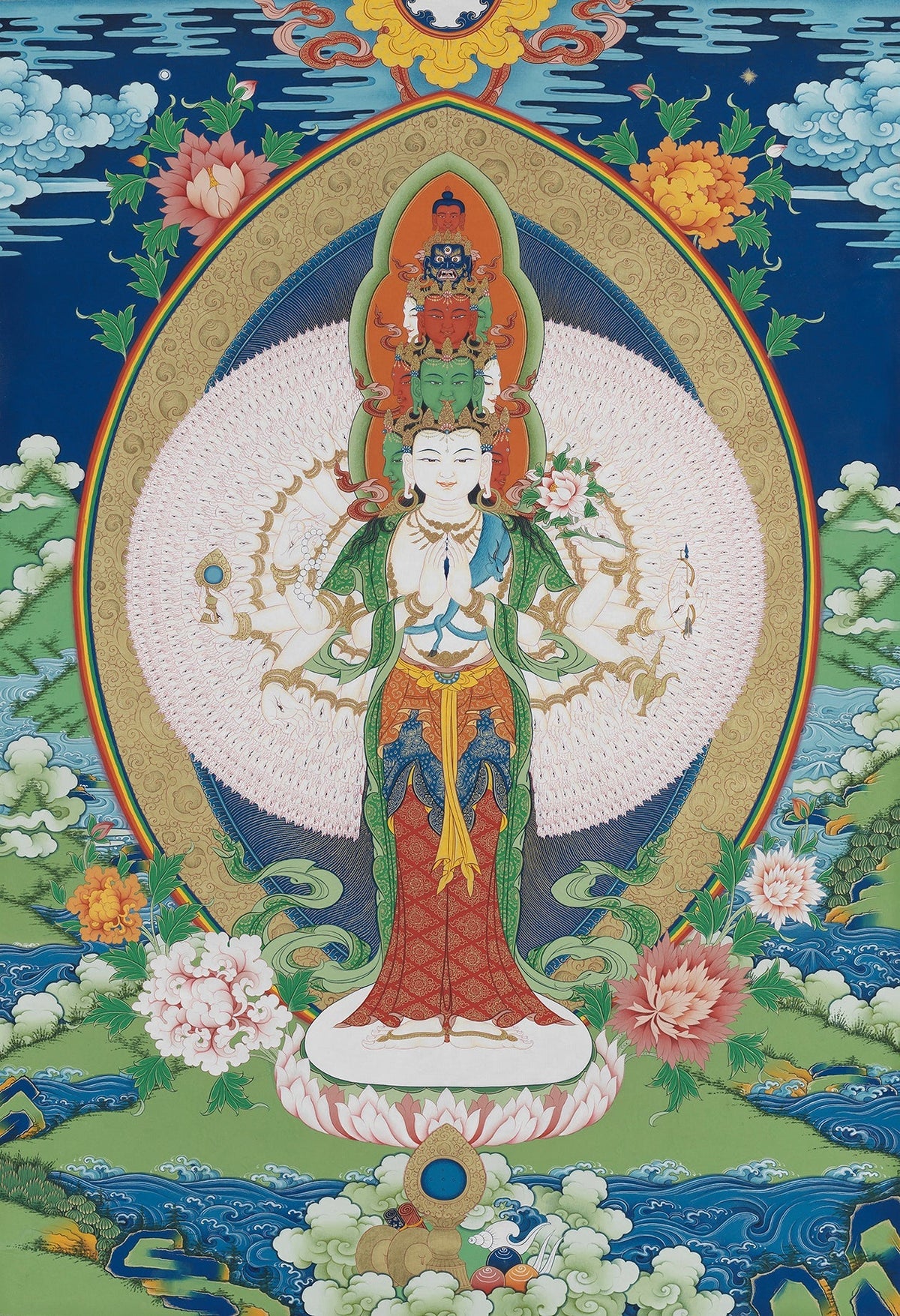
Thousand-Armed Avalokiteshvara

Artwork introduction

Thousand-Armed Avalokiteshvara (September 2015)

Seeing the world's suffering without end, Avalokiteshvara shattered in body and spirit. Through Amitabha's blessing, he manifested eleven faces and a thousand hands and eyes: eyes in the palms perceive every suffering, while a thousand hands reach out to support every soul on the verge of collapse. This ultimate act of rushing to help and holding others up teaches us to accept our own limits and regain the strength to continue.

White as jade, the principal figure stands upon a thousand-petaled pink lotus. A thousand hands unfold like a peacock's tail or a great white rising sun, while eleven faces watch over all ten directions. The joined palms at his chest shelter a mani jewel, safeguarding the true heart. Hands on the right hold a crystal rosary and golden wheel to dispel the confusion of cyclical existence; those on the left hold a pink lotus, bow and arrows, and a precious vase to soothe affliction. A thousand eyes in his palms silently witness every effort in the world. The jade-white body is set against a white solar disc, with a red-and-gold long skirt, malachite-green scarf, and flowing rainbow light, clear and sacred. Being seen is the beginning of healing; being supported is the strength to move forward, bringing lasting security.

$10,310.00
勉唐画派宗师传人 罗桑达吉·才让当周大师作品
Quantity:

Total: $10,310.00

  • AliPay
  • American Express
  • Apple Pay
  • Bancontact
  • Google Pay
  • Mastercard
  • MB WAY
  • Shop Pay
  • Union Pay
  • Visa

Explore the collection: Thousand-Armed Avalokiteshvara

SamantabhadraYama TeachingManjushriHayagrivaPalden Lhamo
  • Hand-painted Thangka Art
  • 📦 Artwork photographs and presentation details are confirmed before dispatch.
  • 🚚 Free Shipping, Trackable Logistics
  • ↩ 30-day returns on eligible non-custom works
Artwork Details & Confirmation

Each Thangka has its own composition, dimensions and presentation. Please review the photographs and catalogue notes, and contact the museum about the work’s condition, materials or mounting before ordering.

We confirm artwork photographs and dispatch details before shipping. For a commissioned work, the subject, dimensions, materials, schedule and any agreed review stages are discussed separately.

Eligible non-custom works may be returned within 30 days of receipt, subject to the return policy.

Delivery time

Estimated delivery for available works: 10–16 business days. This consists of 5–9 business days for preparation and 5–7 business days in transit.

Preparation: order and address confirmation, checking the selected Thangka’s condition and mounting, and protective packing appropriate to the work. Commissioned works follow an individually agreed schedule.

Transit: the carrier and tracking information are provided when the work is dispatched. Commissioned works or special mounting arrangements require a separately agreed schedule. See our shipping policy.

Returns & Refunds

30-day return window: contact the museum within 30 days of receipt for eligible non-custom works. The work must be unused, in its original condition and packaging, with proof of purchase.

Commissioned or personalised works: these are non-returnable unless damaged or defective. Please discuss any difference from the confirmed commission with the museum.

Return shipping: 香港合丰 covers damaged, defective or incorrect items. For a change of mind, size or preference, the customer pays the actual return shipping cost. There is no restocking fee. Obtain return instructions before sending the work.

Approved refunds are made to the original payment method within 10 business days. If more than 15 business days have passed after approval, contact the museum. See the full return policy.

Payment Method Guide

Payment methods available for your country and currency are displayed at checkout. Please use the options shown there to complete your order.

For questions about a particular Thangka, confirm its availability, dimensions and presentation with 香港合丰 before payment. See payment information.

香港合丰 Artwork introduction

About this Thangka

Thousand-Armed Avalokiteshvara

千手观音

Thousand-Armed Avalokiteshvara (September 2015)

Each day, we introduce a thangka. Today, we explore a classic standing figure in polychrome thangka painting, called the pinnacle of Eastern compassion, which offers complete comfort and acceptance to a weary heart: Thousand-Armed Avalokiteshvara.

Among all sacred Eastern images, why does Avalokiteshvara manifest no fewer than eleven faces and more than a thousand hands? Are two hands not enough to protect the world? Behind this image lies a story of compassion that strikes straight to the heart. It is said that Avalokiteshvara once made a great vow: if he could not liberate every suffering being, his body would shatter into dust. Later, seeing human suffering surge like waves, impossible to end however many he saved, his head and body instantly broke into fragments from overwhelming sorrow and compassion. Amitabha, his crowning teacher, came to him and, through supreme compassion, transformed the fragments into eleven faces watching over the ten directions, and his body into a thousand hands and eyes. Eyes grow in the palms to perceive every suffering; a thousand hands reach out to hold every soul on the verge of collapse. More than a manifestation of divine power, he embodies the feeling we most long for in despair: to be seen and held up. He teaches us to accept our limits when faced with helplessness and regret, and to understand that the world's deepest love always rushes toward us with all its strength.

With this story in mind, the painting's overall details suddenly become clear. White as jade, he stands upright and dignified upon a blossoming, thousand-petaled pink lotus. His thousand arms unfold magnificently like a peacock's spreading tail or a great white sun. Eleven faces rise in layers to watch over the world in every direction. Pink-and-white peonies bloom in clusters beside him, surrounded by green waves and flowing springs. The painter renders this standing figure with such expansive grandeur for more than an exaggeration of supernatural powers. It tells us that, however many hardships and dangers the world holds, a power of perfect goodness and gentleness always quietly embraces us out of sight.

Now look more closely at his sacred form and ritual objects. The mani jewel sheltered between the joined palms at his chest reminds us to preserve our authenticity and kindness within, for a peaceful heart is the greatest blessing. The crystal rosary and golden wheel held by hands on the right carry the vow to guide sentient beings and dispel the confusion of cyclical existence. Hands on the left raise a pink lotus, bow and arrows, and a precious vase. Drawing on the blue lotus's freedom from the mud's stain, arrows that cut through deluded thoughts, and a vase filled with nectar, they signify soothing wounds and purifying all afflictions. Each of the thousand outstretched hands has a wisdom eye in its palm, silently conveying that no grievance in the world is truly overlooked: there are always eyes witnessing your efforts.

In its color, Avalokiteshvara's whole body is as luminous and flawless as white jade. The thousand hands behind him form a huge, pure white, radiant solar disc. A brocade skirt of red and gold interweaves with a verdant malachite-green scarf, surrounded by multicolored rainbow light. Clear and pure in its palette, the painting reveals a sacred Eastern beauty that soothes agitation.

Once you understand this Thousand-Armed Avalokiteshvara, you will see that being seen is the beginning of healing, and being supported is the strength to move forward.

May someone understand you when you are weary in body and mind, and support you as you journey through wind and rain, bringing a lifetime of security and fulfillment.

Follow 香港合丰 to discover more of the Eastern stories held within these paintings!

Luosang Daji · Cairang Dangzhou

Luosang Daji · Cairang Dangzhou

Luosang Daji · Cairang Dangzhou began learning Thangka painting at seven and studied at Wutun Upper Temple under Master Xiawu Cairang. His practice is rooted in the Menri tradition.

View artist
Artwork & Order Confirmation

Artwork & Order Confirmation

Confirm the selected Thangka, its dimensions and presentation with the museum. After ordering, check that your contact details and delivery address are correct so we can discuss the work and its dispatch.
Details & Mounting

Details & Mounting

Review photographs of the actual work and confirm its condition and mounting before dispatch. For a commission, the subject, format, materials and review stages are agreed individually with the artist and museum.

Protective Packing & Delivery

Protective Packing & Delivery

The work is packed according to its dimensions, support and mounting. Tracking details are provided after dispatch. Keep the packaging until you have inspected the Thangka and confirmed that it has arrived safely.
Viewing & Care

Viewing & Care

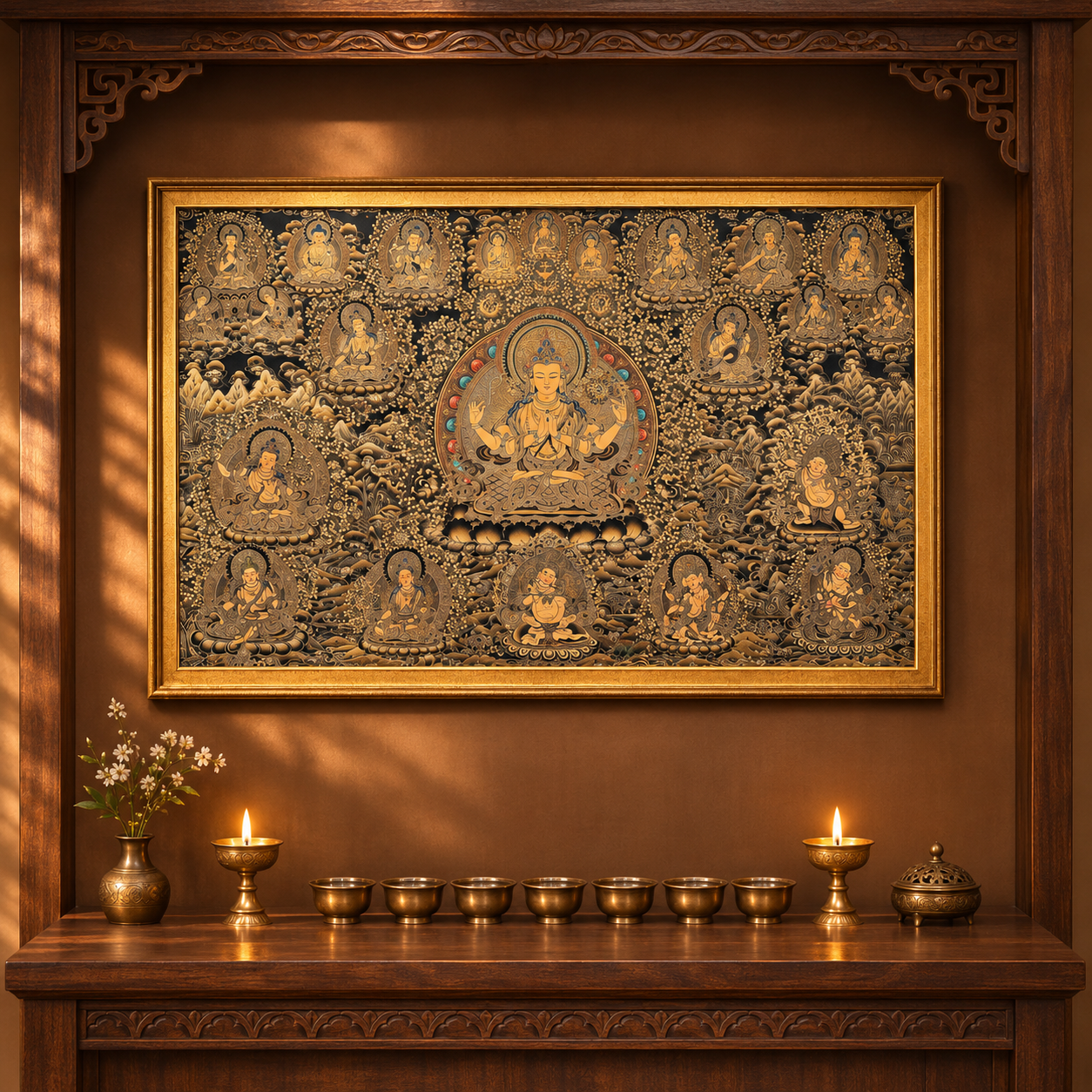
Spend time with the figures, line work and composition of the Thangka. Display it away from direct sunlight and damp conditions. Ask the museum for advice about mounting, framing or handling the specific work; avoid touching the painted surface.