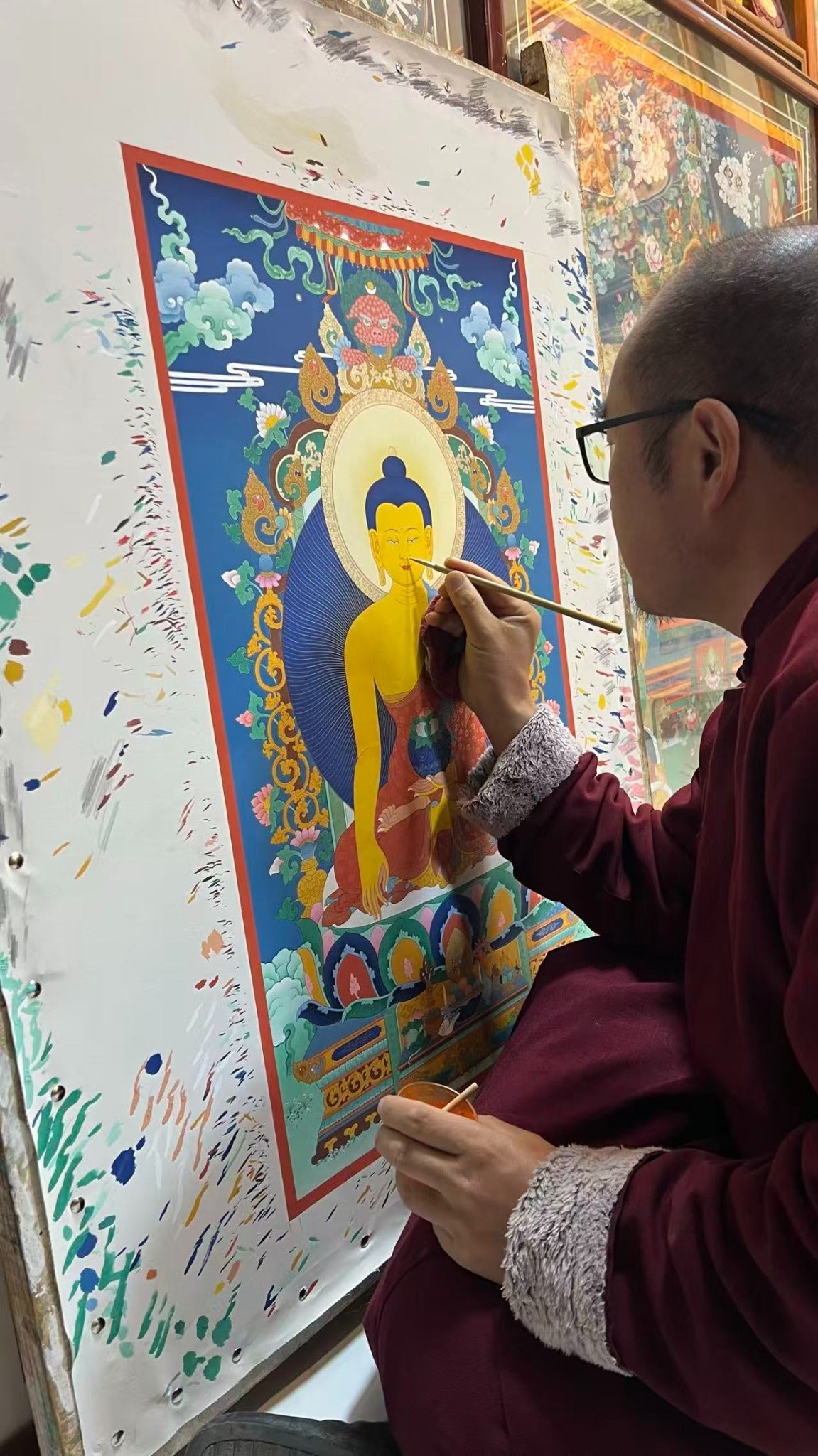
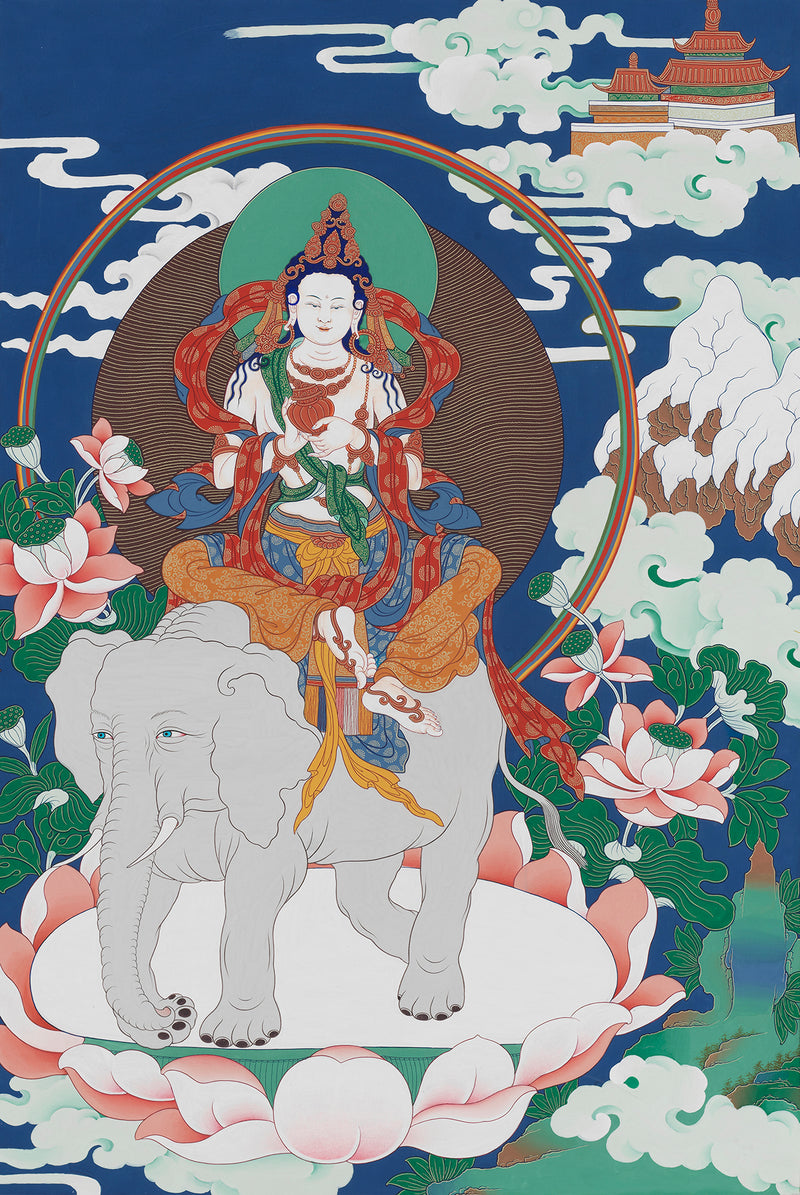
Luosang Daji · Cairang Dangzhou

Mahakala

Artwork introduction

Mahakala (March 2023)

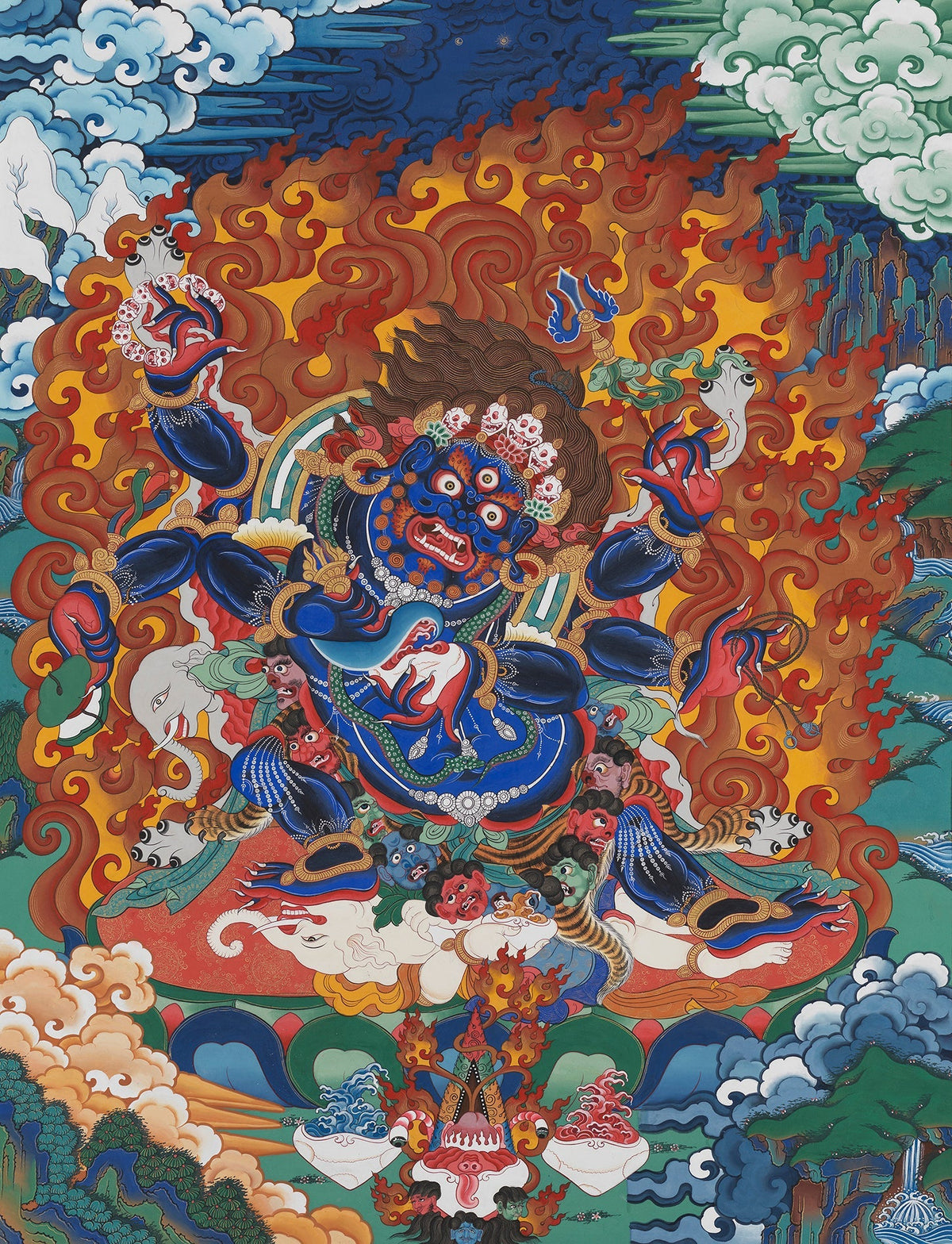
Six-armed Mahakala wears a necklace of fifty dripping human heads across his chest and brandishes weapons with all six arms. The fifty heads correspond precisely to the fifty Sanskrit syllables, suggesting the fifty distracting thoughts and delusions endlessly pulling against one another in the mind. Much of modern life's greatest torment comes from subconscious self-exhaustion. Mahakala does not direct violence outward; he is a shredder clearing mental rubbish, using thunderous force to sever the frantic negative thoughts within.

His dark lapis-blue body is weighty as cast iron, with three glaring eyes, upturned fangs, and six arms fanning outward. Hands stretch a white elephant skin behind him; his black feet firmly crush an elephant-headed demonic deity struggling faceup beneath him, all wrapped in fierce flames. His main arms hold a curved knife and kapala bowl to shatter ego-clinging and distractions; prayer beads and a hand drum awaken awareness; a trident and vajra noose lock down rampaging greed and hatred; crushing the elephant-headed deity subdues arrogance. The deep blue-black body and sky-filling cinnabar flames are stern and forceful, while white bone ornaments and the pallid elephant deity create an oppressive contrast. Dare to face the subconscious darkness and crush delusion, and you can rediscover the light of your own nature.

$10,310.00
勉唐画派宗师传人 罗桑达吉·才让当周大师作品
Quantity:

Total: $10,310.00

  • AliPay
  • American Express
  • Apple Pay
  • Bancontact
  • Google Pay
  • Mastercard
  • MB WAY
  • Shop Pay
  • Union Pay
  • Visa

Explore the collection: Mahakala

SamantabhadraYama TeachingManjushriHayagrivaPalden Lhamo
  • Hand-painted Thangka Art
  • 📦 Artwork photographs and presentation details are confirmed before dispatch.
  • 🚚 Free Shipping, Trackable Logistics
  • ↩ 30-day returns on eligible non-custom works
Artwork Details & Confirmation

Each Thangka has its own composition, dimensions and presentation. Please review the photographs and catalogue notes, and contact the museum about the work’s condition, materials or mounting before ordering.

We confirm artwork photographs and dispatch details before shipping. For a commissioned work, the subject, dimensions, materials, schedule and any agreed review stages are discussed separately.

Eligible non-custom works may be returned within 30 days of receipt, subject to the return policy.

Delivery time

Estimated delivery for available works: 10–16 business days. This consists of 5–9 business days for preparation and 5–7 business days in transit.

Preparation: order and address confirmation, checking the selected Thangka’s condition and mounting, and protective packing appropriate to the work. Commissioned works follow an individually agreed schedule.

Transit: the carrier and tracking information are provided when the work is dispatched. Commissioned works or special mounting arrangements require a separately agreed schedule. See our shipping policy.

Returns & Refunds

30-day return window: contact the museum within 30 days of receipt for eligible non-custom works. The work must be unused, in its original condition and packaging, with proof of purchase.

Commissioned or personalised works: these are non-returnable unless damaged or defective. Please discuss any difference from the confirmed commission with the museum.

Return shipping: 香港合丰 covers damaged, defective or incorrect items. For a change of mind, size or preference, the customer pays the actual return shipping cost. There is no restocking fee. Obtain return instructions before sending the work.

Approved refunds are made to the original payment method within 10 business days. If more than 15 business days have passed after approval, contact the museum. See the full return policy.

Payment Method Guide

Payment methods available for your country and currency are displayed at checkout. Please use the options shown there to complete your order.

For questions about a particular Thangka, confirm its availability, dimensions and presentation with 香港合丰 before payment. See payment information.

香港合丰 Artwork introduction

About this Thangka

Mahakala

Mahakala (March 2023)

Every day, we introduce a thangka. Today, we explore a major work in rich mineral colors that gives fullest expression to compassionate Avalokiteshvara's thunderous might and is devoted to severing the countless delusions and inner demons of the mind: Mahakala, painted in 2023.

Why, among all protector deities, does this six-armed Mahakala, his entire body deep black as night, wear a whole necklace of fifty dripping human heads across his chest, while all six arms brandish fearsome weapons? Behind this lies Eastern psychology's most thorough method for uprooting 'subconscious inner demons.' Six-armed Mahakala's full name means 'Great Black One,' representing in Sanskrit 'the absolute emptiness that swallows every color and attachment.' He is the 'swift manifestation' that the greatly compassionate Avalokiteshvara vowed to reveal when faced with stubborn demonic obstacles. According to the scriptures, the full fifty human heads around his chest correspond precisely to Sanskrit's fifty syllables, symbolizing the endlessly emerging 'fifty distracting thoughts and delusions' in the human mind. In today's information overload, many people's greatest suffering comes not from external difficulties, but from 'self-torment within the mind': countless thoughts battle daily, with anxiety, regret, and doubt constantly pulling against one another, trapping them in severe mental exhaustion. Mahakala's fierce violence has never been outward slaughter, but an inward 'storm of the mind.' He brandishes his sharp blade to cut off, with thunderous decisiveness, the negative energies running wildly through our heads. More than a wrathful deity, he is like a 'high-powered shredder for subconscious rubbish,' teaching us to be firm when the mind is in turmoil, to cut what must be cut and restore a completely pure inner space.

With this story in mind, the composition's overall details become clear. His whole body is a dark lapis-lazuli blue, weighty as cast iron, his mountain-like physique massive, all three eyes glaring wide and his fangs thrusting upward. Upright red hair erupts like rolling waves of fire, while his six arms on either side fan outward with their ritual implements. A white elephant-skin cape spreads behind him, and two powerful black feet press firmly down on the white elephant-headed demon struggling faceup beneath him. A searing, surging sea of cinnabar flames completely surrounds him. The painter gives Mahakala this unrivaled, commanding force precisely to tell us that the world's most stubborn inner demons and bad habits must be utterly suppressed with such uncompromising vigor before we can truly become masters of our own minds.

Look more closely at the sacred forms and details. The curved knife and kapala bowl held by his main arms at his chest are intended to shatter ego-clinging and distracting thoughts with sharp wisdom, transforming all worldly bitterness into nourishing nectar. The bone prayer beads and skull hand drum shaken high in his right hands suggest awakening another layer of awareness with each turn, using clear Dharma sounds to dispel inward numbness and decline. The trident and vajra noose raised on his left mean completely uprooting the three poisons of greed, hatred, and ignorance, and firmly restraining frantic loss of control. The white elephant-headed deity crushed beneath his feet uses the image of a subdued heavenly deity to warn us that only by subduing our own arrogance and conceit can we prevent blessings from becoming disasters.

In color, the principal deity's deep, weighty mineral blue-black body appears stern and forceful against the cinnabar-red flames sweeping across the sky behind him. The snowy-white pearls and bone ornaments on him and the pallor of the elephant-headed demon beneath his feet create a painfully striking and oppressive visual contrast amid the fire. Malachite-green mountains and a waterfall to the right appear around them. Extraordinary and vigorous in color, fearsome in its force, the painting displays an Eastern aesthetic of power through the most commanding masculine strength of this rich mineral-painting heritage.

Once you understand this six-armed Mahakala, you will see: only by severing distracting thoughts and inner demons can you recover your originally pure self. Dare to face the darkness, and the heart can attain great light.

May your heart be free of entanglement in life, untrapped by delusion, clothed in armor, advancing courageously and diligently, invincible wherever you go.

Follow 香港合丰 to discover more Eastern stories within these paintings!

Luosang Daji · Cairang Dangzhou

Luosang Daji · Cairang Dangzhou

Luosang Daji · Cairang Dangzhou began learning Thangka painting at seven and studied at Wutun Upper Temple under Master Xiawu Cairang. His practice is rooted in the Menri tradition.

View artist
Artwork & Order Confirmation

Artwork & Order Confirmation

Confirm the selected Thangka, its dimensions and presentation with the museum. After ordering, check that your contact details and delivery address are correct so we can discuss the work and its dispatch.
Details & Mounting

Details & Mounting

Review photographs of the actual work and confirm its condition and mounting before dispatch. For a commission, the subject, format, materials and review stages are agreed individually with the artist and museum.

Protective Packing & Delivery

Protective Packing & Delivery

The work is packed according to its dimensions, support and mounting. Tracking details are provided after dispatch. Keep the packaging until you have inspected the Thangka and confirmed that it has arrived safely.
Viewing & Care

Viewing & Care

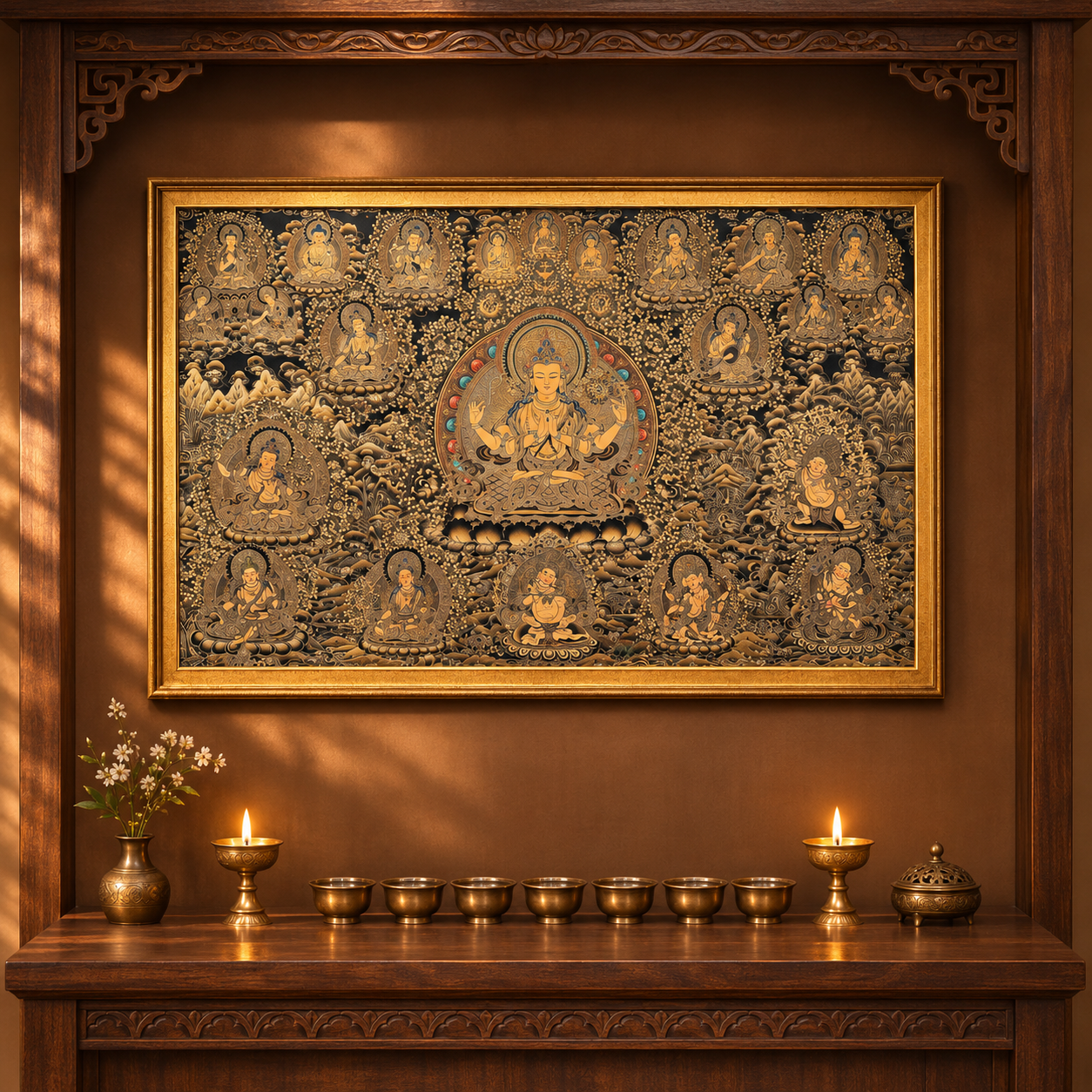
Spend time with the figures, line work and composition of the Thangka. Display it away from direct sunlight and damp conditions. Ask the museum for advice about mounting, framing or handling the specific work; avoid touching the painted surface.