Luosang Daji · Cairang Dangzhou

Three Bodhisattva Protectors

Artwork introduction

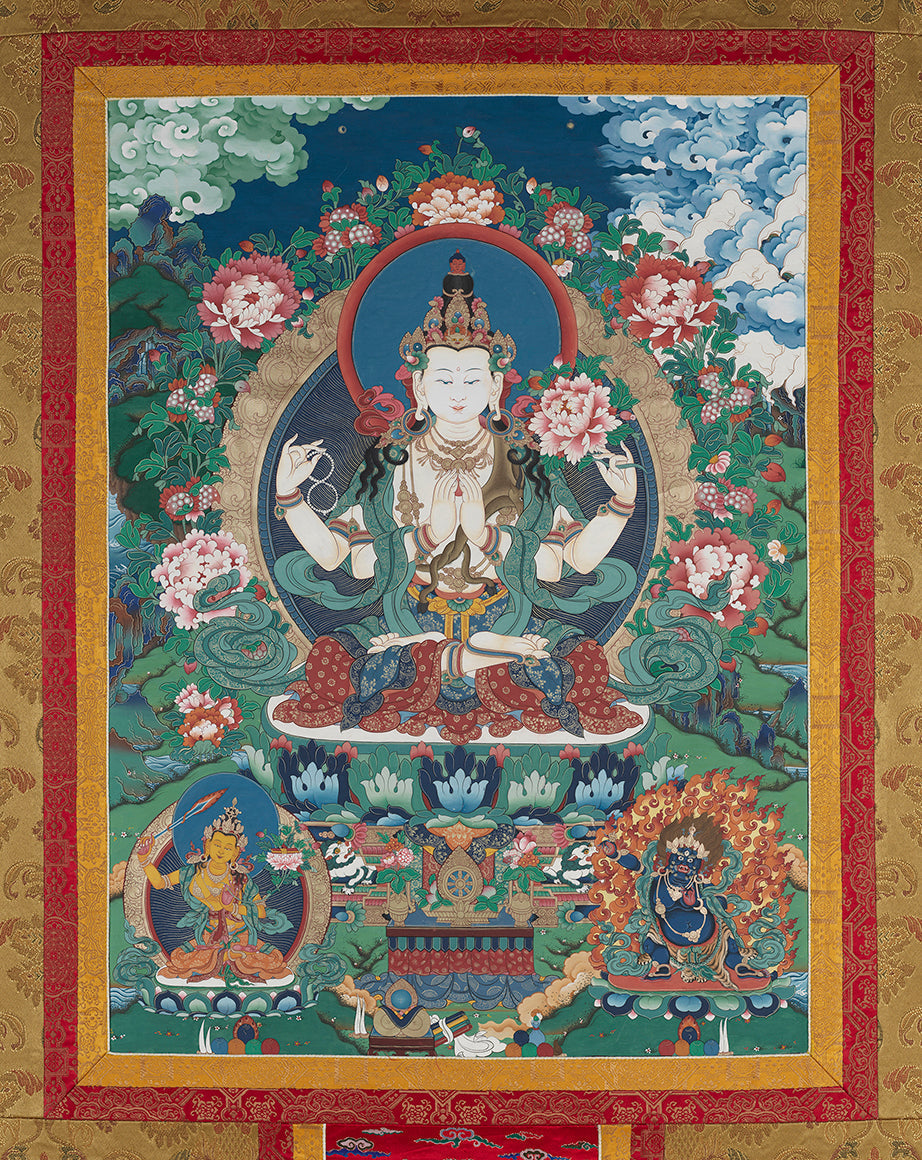
The Three Protectors: Four-Armed Avalokiteshvara as Principal Deity (2022)

Four-Armed Avalokiteshvara occupies the center, Manjushri holds a wisdom-awakening sword on the left, and Vajrapani subdues demons in flames on the right, re-creating a foundation of Tibetan spiritual life. The six-syllable great mantra washes away the six poisons of arrogance, jealousy, greed, ignorance, stinginess, and hatred. Yet goodwill alone is insufficient in the world: kindness needs Manjushri's wisdom to prevent deception and Vajrapani's steely courage to resist violence. Only when great compassion, great wisdom, and great courage take their proper places can life be sheltered from every storm.

Snow-white Avalokiteshvara sits on a three-colored lotus, embraced by peonies and a coral-red sun disc. An eight-spoked wheel of the true Dharma stands on the altar; Manjushri's golden body and Vajrapani's scarlet flames answer one another in the lower corners. Palms joined at the chest protect a red-agate jewel and preserve the original intention; the left hand raises a thousand-petaled pink peony, expressing composure; the Dharma wheel reverses difficult circumstances, while Vajrapani shatters timidity. The jade-white body and coral sun disc are gentle and sacred, while pink-white peonies brightly meet Vajrapani's blue-black body and fierce flames, creating dignified splendor. With great compassion as the axis, great wisdom as the rudder, and great courage as the oar, we can safely cross life's countless towering waves.

$10,310.00
勉唐画派宗师传人 罗桑达吉·才让当周大师作品
Quantity:

Total: $10,310.00

  • AliPay
  • American Express
  • Apple Pay
  • Bancontact
  • Google Pay
  • Mastercard
  • MB WAY
  • Shop Pay
  • Union Pay
  • Visa

Explore the collection: Three Bodhisattva Protectors

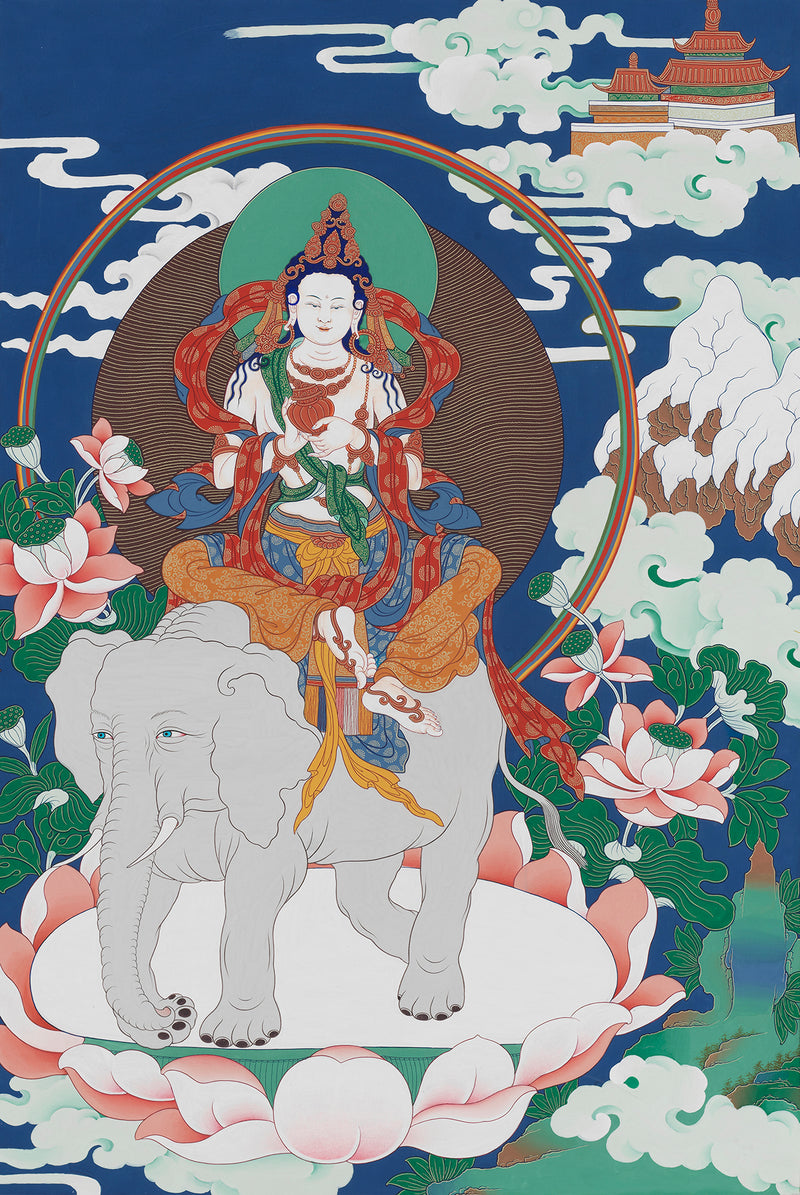
SamantabhadraYama TeachingManjushriHayagrivaPalden Lhamo
  • Hand-painted Thangka Art
  • 📦 Artwork photographs and presentation details are confirmed before dispatch.
  • 🚚 Free Shipping, Trackable Logistics
  • ↩ 30-day returns on eligible non-custom works
Artwork Details & Confirmation

Each Thangka has its own composition, dimensions and presentation. Please review the photographs and catalogue notes, and contact the museum about the work’s condition, materials or mounting before ordering.

We confirm artwork photographs and dispatch details before shipping. For a commissioned work, the subject, dimensions, materials, schedule and any agreed review stages are discussed separately.

Eligible non-custom works may be returned within 30 days of receipt, subject to the return policy.

Delivery time

Estimated delivery for available works: 10–16 business days. This consists of 5–9 business days for preparation and 5–7 business days in transit.

Preparation: order and address confirmation, checking the selected Thangka’s condition and mounting, and protective packing appropriate to the work. Commissioned works follow an individually agreed schedule.

Transit: the carrier and tracking information are provided when the work is dispatched. Commissioned works or special mounting arrangements require a separately agreed schedule. See our shipping policy.

Returns & Refunds

30-day return window: contact the museum within 30 days of receipt for eligible non-custom works. The work must be unused, in its original condition and packaging, with proof of purchase.

Commissioned or personalised works: these are non-returnable unless damaged or defective. Please discuss any difference from the confirmed commission with the museum.

Return shipping: 香港合丰 covers damaged, defective or incorrect items. For a change of mind, size or preference, the customer pays the actual return shipping cost. There is no restocking fee. Obtain return instructions before sending the work.

Approved refunds are made to the original payment method within 10 business days. If more than 15 business days have passed after approval, contact the museum. See the full return policy.

Payment Method Guide

Payment methods available for your country and currency are displayed at checkout. Please use the options shown there to complete your order.

For questions about a particular Thangka, confirm its availability, dimensions and presentation with 香港合丰 before payment. See payment information.

香港合丰 Artwork introduction

About this Thangka

Three Bodhisattva Protectors

The Three Protectors: Four-Armed Avalokiteshvara as Principal Deity (2022)

Every day, we introduce a thangka. Today, we explore a classic masterpiece in rich mineral colors, re-creating a foundation of Tibetan spirituality and bringing the six-syllable mantra and the highest protection of the snowy land into one scroll: The Three Protectors: Four-Armed Avalokiteshvara as Principal Deity, painted in 2022.

Why, in households throughout Tibet and even at the mani stone piles on every mountain pass, do even elders who cannot read insist on honoring the Three Protectors formed by Four-Armed Avalokiteshvara, Manjushri, and Vajrapani? Behind this lies Eastern culture's most fundamental approach to 'finding one's place and purpose in life.' We all know the six-syllable mantra 'Om Mani Padme Hum,' and Four-Armed Avalokiteshvara is its presiding deity. People of antiquity believed that all difficulties and setbacks in life have their roots in six inner poisons: arrogance, jealousy, greed, ignorance, stinginess, and hatred. The compassion of the six-syllable great mantra is specifically used to cleanse these six stains of the spirit. But compassion alone is not enough. When their ancestors built a civilization on the windswept, snowy plateau, they understood deeply that without Manjushri's clear wisdom, kindness could be exploited by ignorance, and without Vajrapani's steely commitment, compassion could be trampled by evil. Only with great compassion at the center, great wisdom on the left, and great courage on the right can inner demons truly be subdued and storms held in check. More than a protective image, he is like a 'complete handbook of self-protection' for traveling through a dangerous world, teaching us that however great life's upheavals, if we preserve compassionate goodwill as our axis and pair it with wisdom and courage, no obstacle is insurmountable.

With this story in mind, the composition's overall details become clear. At the center, Four-Armed Avalokiteshvara is snowy white, sitting peacefully on a layered, thousand-petaled lotus in deep blue, green, and pink. Luxuriant pink-white peonies and a coral-red sun disc gently encircle him. Directly below, before the central Dharma throne, stand a radiant golden eight-spoked wheel of the true Dharma and offerings of the five desirable sensory pleasures. In the lower left, Manjushri holds his wisdom-awakening sword; in the lower right, Vajrapani subdues demons amid fierce flames. The painting is framed in splendid old brocade with red-and-gold fretwork. The painter arranges this clearly layered sacred order seamlessly to tell us that when great compassion, great wisdom, and great courage each take their proper place in life, your life naturally forms a complete shelter through which wind and rain cannot pass.

Look more closely at the sacred forms and details. The red-agate jewel clasped between Avalokiteshvara's joined palms at his chest represents, in the scriptures, 'fulfilling all good wishes and purifying one's own mind,' guiding us to preserve a child's original goodness amid the temptations of fame and gain. What his upper left hand raises is no ordinary lotus, but an exceptionally large, full, thousand-petaled pink peony. Its associations with wealth, auspiciousness, fragrance, and completeness symbolize cultivating life's most unhurried bearing amid worldly complexity. The eight-spoked wheel of the true Dharma standing on the altar before his seat represents turning a difficult destiny through the Buddha's right path. In the lower right, Vajrapani grips a vajra and treads wrathfully on obstacles, representing the absolute strength that crushes timidity and hesitation and protects goodwill from harm.

In color, Avalokiteshvara's body, like creamy white jade, is sacred and clear against the warm coral-red sun disc and deep-blue aureole. The lush, delicate pink-white peonies around him create an exceptionally vivid yet harmonious meeting of colors with Manjushri's bright-yellow golden body and Vajrapani's deep blue-black body amid flames below. Gold and red echo in the surrounding silk brocade. Dignified and full in color, splendid and elegant, the entire painting radiates an Eastern vision of flourishing grandeur that brings peace to the spirit.

Once you understand this Three Protectors painting with Four-Armed Avalokiteshvara as principal deity, you will see: with great compassion as the axis, great wisdom as the rudder, and great courage as the oar, life can cross countless towering waves.

May goodwill endure and wisdom remain bright throughout life's long spiritual journey; may you have protection, move and rest according to your heart, and gain a lifetime of peace and fulfillment.

Follow 香港合丰 to discover more Eastern stories within these paintings!

Luosang Daji · Cairang Dangzhou

Luosang Daji · Cairang Dangzhou

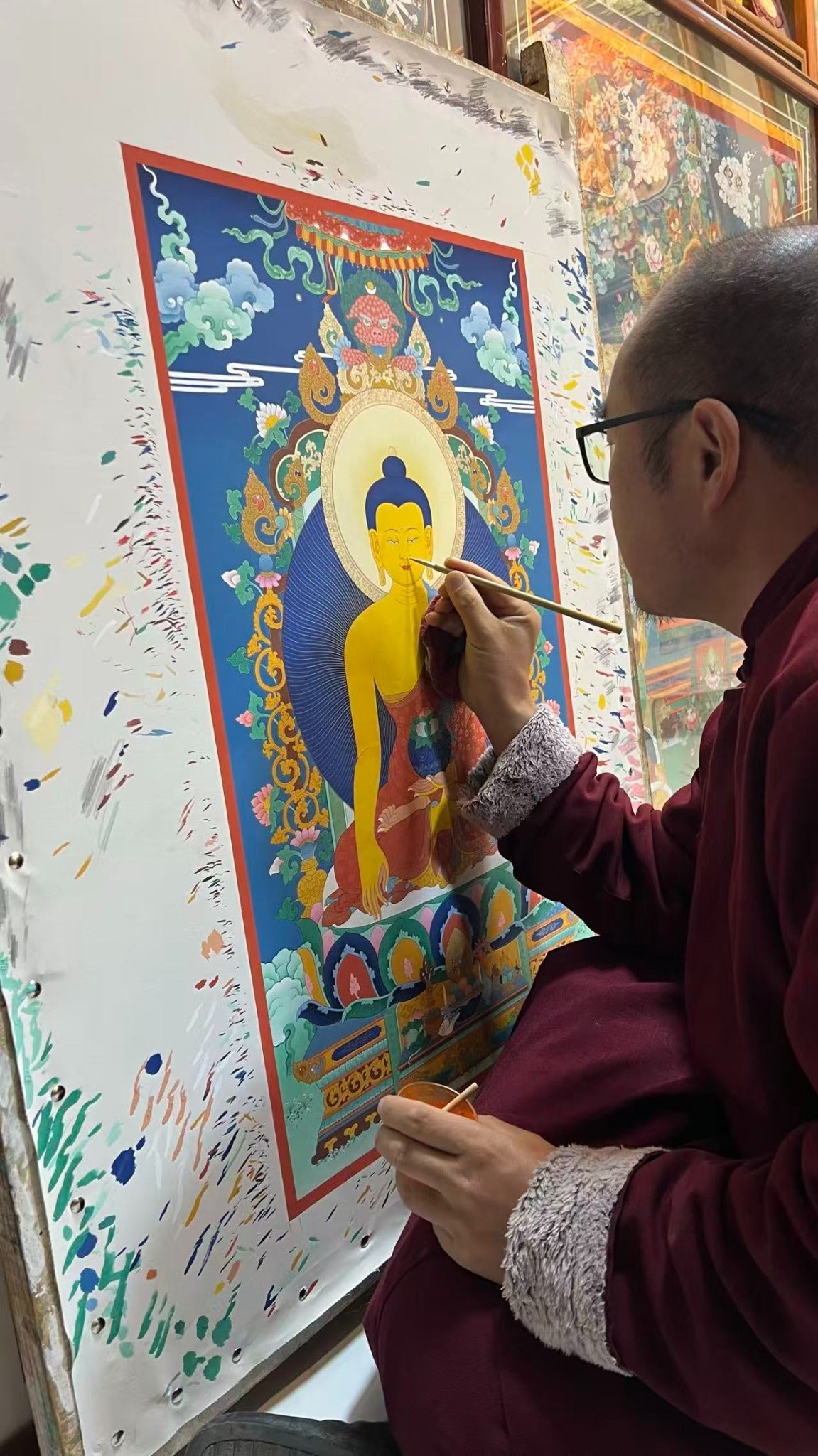
Luosang Daji · Cairang Dangzhou began learning Thangka painting at seven and studied at Wutun Upper Temple under Master Xiawu Cairang. His practice is rooted in the Menri tradition.

View artist
Artwork & Order Confirmation

Artwork & Order Confirmation

Confirm the selected Thangka, its dimensions and presentation with the museum. After ordering, check that your contact details and delivery address are correct so we can discuss the work and its dispatch.
Details & Mounting

Details & Mounting

Review photographs of the actual work and confirm its condition and mounting before dispatch. For a commission, the subject, format, materials and review stages are agreed individually with the artist and museum.

Protective Packing & Delivery

Protective Packing & Delivery

The work is packed according to its dimensions, support and mounting. Tracking details are provided after dispatch. Keep the packaging until you have inspected the Thangka and confirmed that it has arrived safely.
Viewing & Care

Viewing & Care

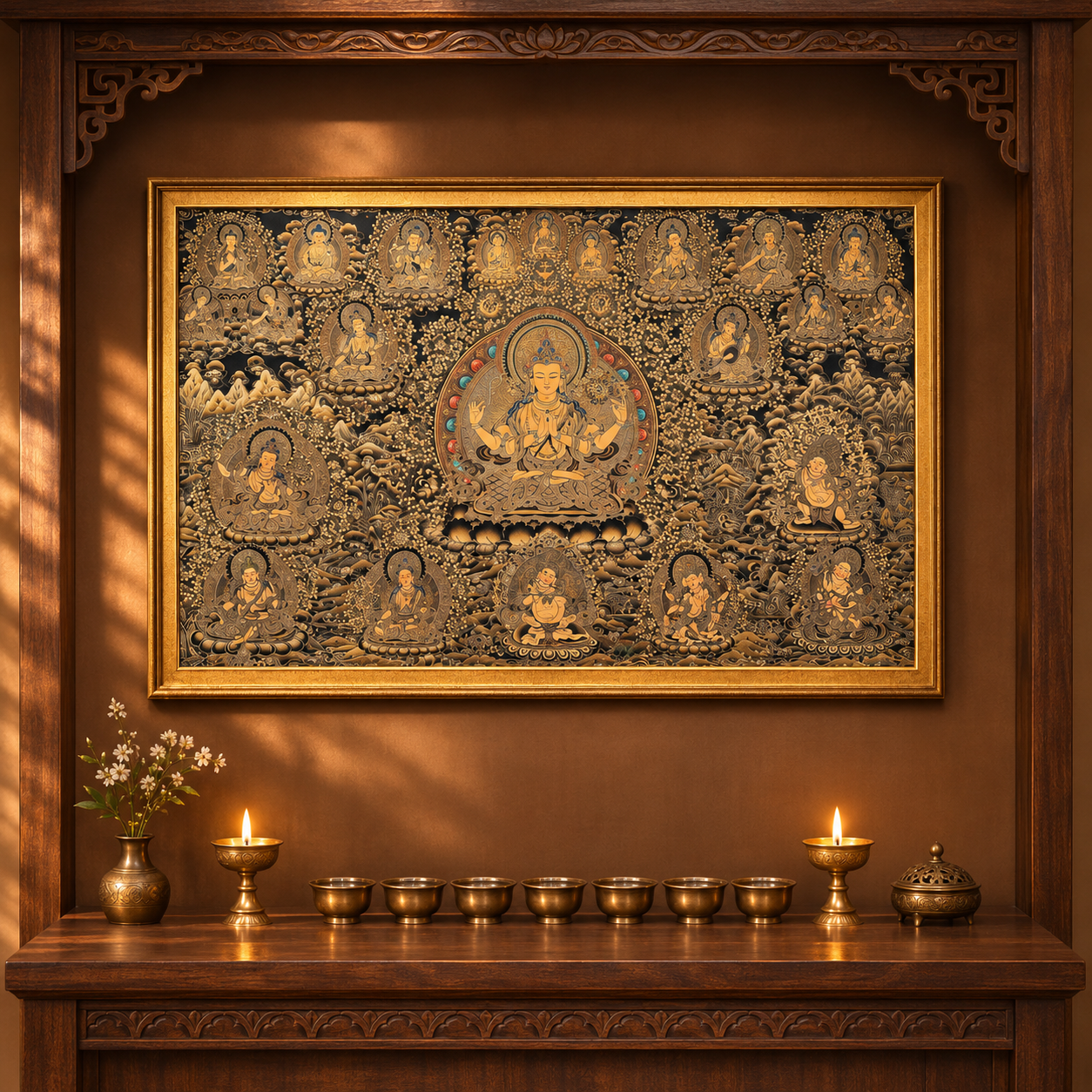
Spend time with the figures, line work and composition of the Thangka. Display it away from direct sunlight and damp conditions. Ask the museum for advice about mounting, framing or handling the specific work; avoid touching the painted surface.