Luosang Daji · Cairang Dangzhou

Five Forms of Manjushri

Artwork introduction

Five Forms of Manjushri (2018)

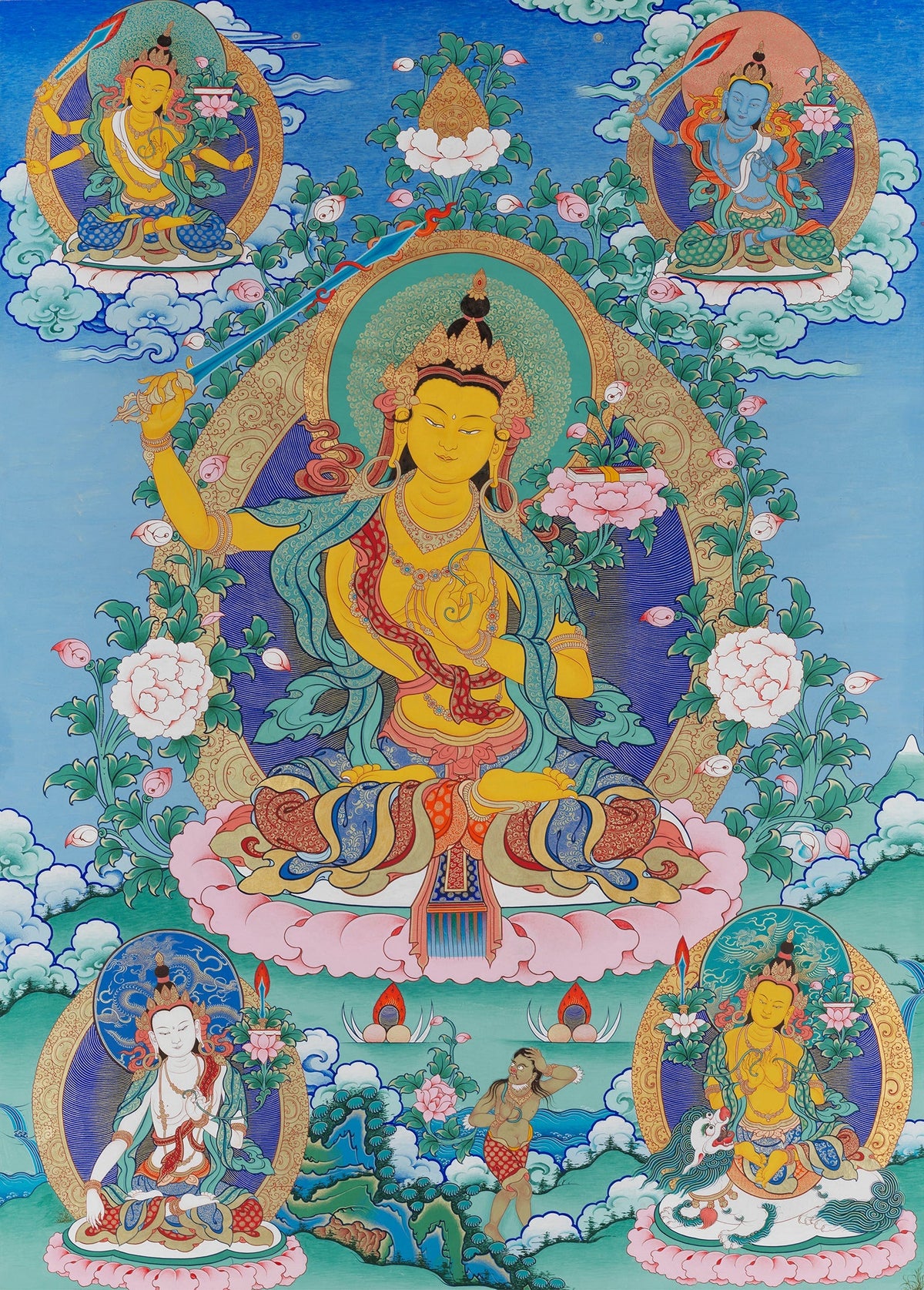
Yellow, White, Blue, Four-Armed, and lion-riding Manjushri gather together, revealing a system of supreme cognitive abilities: Yellow Manjushri grasps broad vision of the whole; White Manjushri strengthens learning and memory; Blue Manjushri cuts away prejudice and narrowness; Four-Armed Manjushri possesses multidimensional coordination and execution; and Lion's Roar Manjushri has the boldness to express himself confidently. Only with all five can we break through the cognitive confusion of an information explosion.

Golden Yellow Manjushri sits at the center, raising a sword and supporting a scripture. Four emanations surround him among green peaks and a sea of flowers; below, White Manjushri sits like jade, while Lion's Roar Manjushri rides his lion and looks around. The blue-bladed sword and Prajnaparamita Sutra cut through inner conflict and seek true knowledge; the four arms' bow, arrows, and sword command the whole situation; Blue Manjushri uproots stubbornness; White Manjushri opens spiritual insight; and the snow lion's roar through mountain forests grants the confidence to speak. Pure orpiment, deep lapis lazuli-blue bodily radiance, and the green mane of a white snow lion echoing malachite-green forests create a fresh, refined elegance. A broad perspective within, confidence in speech, and coordination in action open a clear and unobstructed life.

$17,795.00
勉唐画派宗师传人 罗桑达吉·才让当周大师作品
Quantity:

Total: $17,795.00

  • AliPay
  • American Express
  • Apple Pay
  • Bancontact
  • Google Pay
  • Mastercard
  • MB WAY
  • Shop Pay
  • Union Pay
  • Visa

Explore the collection: Five Forms of Manjushri

SamantabhadraYama TeachingManjushriHayagrivaPalden Lhamo
  • Hand-painted Thangka Art
  • 📦 Artwork photographs and presentation details are confirmed before dispatch.
  • 🚚 Free Shipping, Trackable Logistics
  • ↩ 30-day returns on eligible non-custom works
Artwork Details & Confirmation

Each Thangka has its own composition, dimensions and presentation. Please review the photographs and catalogue notes, and contact the museum about the work’s condition, materials or mounting before ordering.

We confirm artwork photographs and dispatch details before shipping. For a commissioned work, the subject, dimensions, materials, schedule and any agreed review stages are discussed separately.

Eligible non-custom works may be returned within 30 days of receipt, subject to the return policy.

Delivery time

Estimated delivery for available works: 10–16 business days. This consists of 5–9 business days for preparation and 5–7 business days in transit.

Preparation: order and address confirmation, checking the selected Thangka’s condition and mounting, and protective packing appropriate to the work. Commissioned works follow an individually agreed schedule.

Transit: the carrier and tracking information are provided when the work is dispatched. Commissioned works or special mounting arrangements require a separately agreed schedule. See our shipping policy.

Returns & Refunds

30-day return window: contact the museum within 30 days of receipt for eligible non-custom works. The work must be unused, in its original condition and packaging, with proof of purchase.

Commissioned or personalised works: these are non-returnable unless damaged or defective. Please discuss any difference from the confirmed commission with the museum.

Return shipping: 香港合丰 covers damaged, defective or incorrect items. For a change of mind, size or preference, the customer pays the actual return shipping cost. There is no restocking fee. Obtain return instructions before sending the work.

Approved refunds are made to the original payment method within 10 business days. If more than 15 business days have passed after approval, contact the museum. See the full return policy.

Payment Method Guide

Payment methods available for your country and currency are displayed at checkout. Please use the options shown there to complete your order.

For questions about a particular Thangka, confirm its availability, dimensions and presentation with 香港合丰 before payment. See payment information.

香港合丰 Artwork introduction

About this Thangka

Five Forms of Manjushri

Five Forms of Manjushri (2018)

Each day, we introduce you to a thangka. Today we explore a classic color thangka masterpiece uniting five Eastern dimensions of cognition, acclaimed as a supreme treasure for opening wisdom: Five Forms of Manjushri, painted in 2018.

We have seen a lone sword-bearing Manjushri and a teaching Manjushri seated on a lion throne, so why do a full five Manjushris appear together here: Yellow, White, Blue, Four-Armed, and one riding a snow lion? Behind this gathering lies Eastern psychology's most subtle analysis of supreme cognitive ability. Ancient people discovered long ago that awakening wisdom goes beyond a single quality called intelligence. It consists of five indispensable cognitive powers. Yellow Manjushri in the center represents the foresight to grasp the whole; White Manjushri at the lower left represents the memory that comes with broad learning; Blue Manjushri at the upper right represents critical discernment that severs prejudice; Four-Armed Manjushri at the upper left represents execution that draws a bow, holds a sword, and coordinates in multiple dimensions; and Lion's Roar Manjushri riding a snow lion at the lower right represents fearless boldness in confident expression. In this age of information overload, many people feel mentally overdrawn: the more they learn, the more confused they become, and when they want to speak, they shrink back in fear. These five Manjushris together are a comprehensive tool for upgrading cognition passed down by ancient people, teaching us that only with foresight, memory, decisiveness, coordination, and confidence together can we live clearly and lucidly in a complex, changing world, with every step illuminated.

With this story in mind, the painting's overall details become clear. See how Yellow Manjushri sits golden-bodied at the very center, his right hand raising a wisdom sword high into the clouds and his left lightly holding a blue lotus that securely supports a scripture. An emanation sits in each of the four directions around him: the upper two look down through the sky from auspicious clouds; below, White Manjushri sits like jade, and Lion's Roar Manjushri rides his lion and looks around. The artist places these five wisdom deities among green peaks and a sea of flowers like stars surrounding the moon to convey more than painterly skill: when all five dimensions of wisdom awaken within us, the blind spots of thought and the delusions of life are completely illuminated and dispelled.

Now look at the sacred forms and their details. The central deity's raised blue-bladed wisdom sword and Prajnaparamita Sutra guide us to cut through inner conflict and hesitation with one hand while cultivating true knowledge and insight with the other. At the upper left, Four-Armed Manjushri simultaneously holds a bow and arrows, a sharp sword, and a scripture, symbolizing comprehensive command through progress on multiple fronts and strategic coordination. At the upper right, Blue Manjushri holds a precious sword with cool fierceness, decisively uprooting deep-seated prejudice and stubbornness. At the lower left, White Manjushri, pure as white jade, bears the great vow to awaken spiritual insight and enhance memory and eloquence. At the lower right, Lion's Roar Manjushri rides a green-maned white lion, drawing on the majesty of the king of beasts whose roar shakes mountain forests, representing the ability to speak with confident assurance before any authority or challenge.

In its colors, the central deity's mellow, rich orpiment body shines with golden light against deep lapis lazuli-blue bodily radiance. The four surrounding emanations display their own splendor in white jade, bright yellow, and sapphire blue. The green mane of the white snow lion below echoes the malachite-green forests covering mountains and valleys, complemented by layers of blooming pink-and-white peonies. Fresh, richly elegant colors and clear layering radiate the scholarly refinement of Eastern wisdom at its most graceful.

Once you understand these Five Forms of Manjushri, you will see: true awakening of wisdom means breadth of vision in the heart, clear discernment in the eyes, real confidence in speech, and skillful coordination in action.

May learning and reflection advance together in your life, may wisdom and courage be complete, may your mind and vision stay clear, and may you enjoy a broad life of clarity without obstruction.

Follow 香港合丰 to discover more Eastern stories within the paintings!

Luosang Daji · Cairang Dangzhou

Luosang Daji · Cairang Dangzhou

Luosang Daji · Cairang Dangzhou began learning Thangka painting at seven and studied at Wutun Upper Temple under Master Xiawu Cairang. His practice is rooted in the Menri tradition.

View artist
Artwork & Order Confirmation

Artwork & Order Confirmation

Confirm the selected Thangka, its dimensions and presentation with the museum. After ordering, check that your contact details and delivery address are correct so we can discuss the work and its dispatch.
Details & Mounting

Details & Mounting

Review photographs of the actual work and confirm its condition and mounting before dispatch. For a commission, the subject, format, materials and review stages are agreed individually with the artist and museum.

Protective Packing & Delivery

Protective Packing & Delivery

The work is packed according to its dimensions, support and mounting. Tracking details are provided after dispatch. Keep the packaging until you have inspected the Thangka and confirmed that it has arrived safely.
Viewing & Care

Viewing & Care

Spend time with the figures, line work and composition of the Thangka. Display it away from direct sunlight and damp conditions. Ask the museum for advice about mounting, framing or handling the specific work; avoid touching the painted surface.