Luosang Daji · Cairang Dangzhou

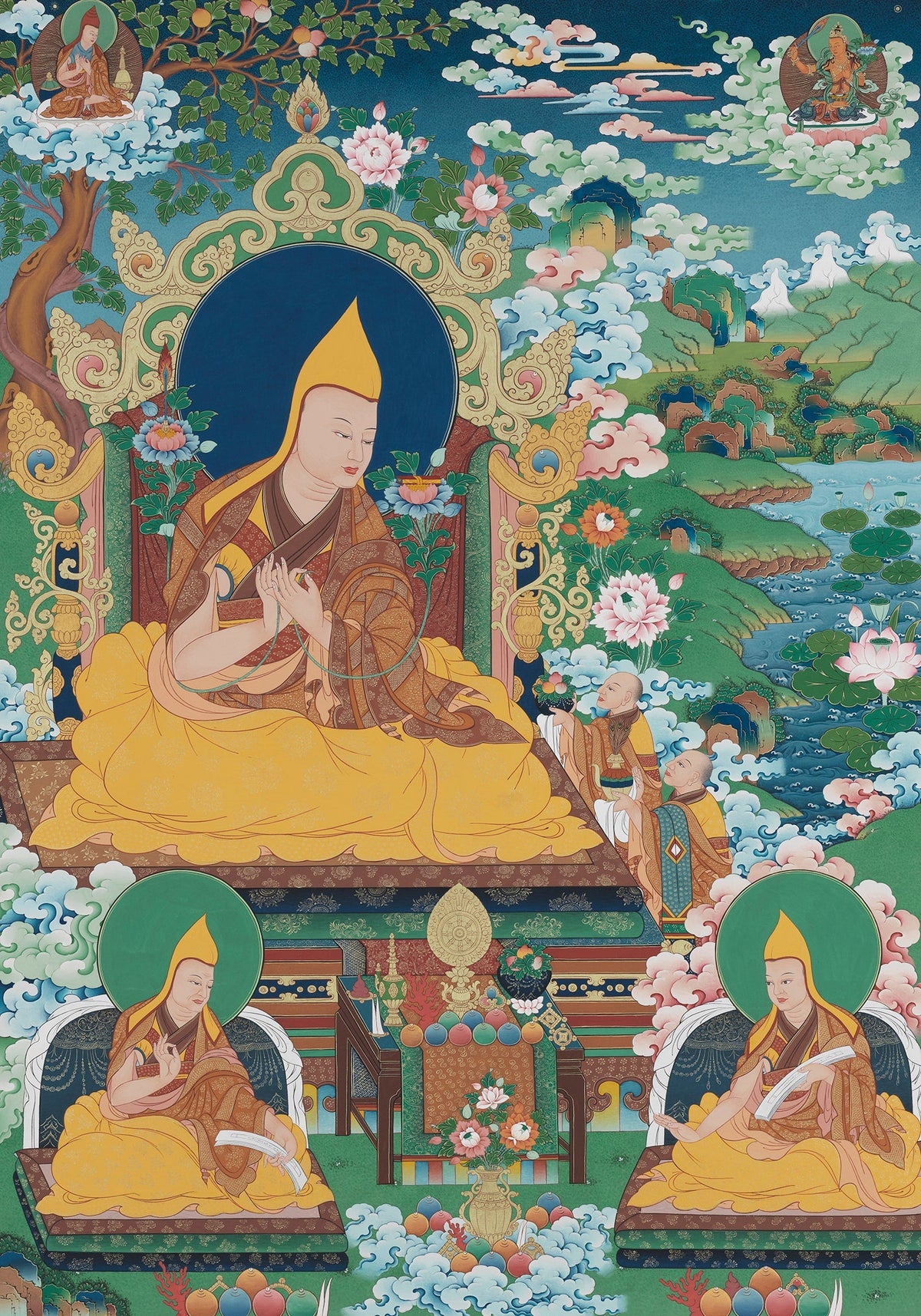
Tsongkhapa with Two Disciples

Artwork introduction

Tsongkhapa and His Two Principal Disciples (2020)

Rather than the solemn grandeur of a celestial pure land, this painting resembles an elegant lesson beneath trees beside a lotus pond, where the master and his accomplished disciples Gyaltsab Je and Khedrup Je sit together discussing the Way. We may travel faster alone, but only with an enlightened teacher to guide us and good companions beside us can we progress steadily and far. Like a hall of spiritual transmission, this thangka teaches us to remain humble and willing to learn, preserving grounded respect for teachers and their teachings amid the noise.

The master sits on a carved throne, leaning slightly and gazing attentively; his two chief disciples unroll scriptures to study, novices offer fresh flowers respectfully, and a lotus pond to the right ripples green beneath spreading leaves and the quiet fragrance of water lilies. The teaching mudra formed by both hands gently dispels doubts like a spring breeze and rain; the sword and Prajnaparamita Sutra at his shoulders symbolize both profound scriptural learning and decisive sharpness; the Dharma wheel before the table turns ceaselessly, carrying right understanding onward. Bright yellow pandita hats accent the blue-green landscape, cinnabar is antique and steady, and layered colors give the lotus pond a clear, fresh luster, full of scholarly refinement. Respect teachers and the Way, hold reverence in your heart, and walk with worthy teachers and friends, so that the journey of learning and exploration may continue without end.

$17,795.00
勉唐画派宗师传人 罗桑达吉·才让当周大师作品
Quantity:

Total: $17,795.00

  • AliPay
  • American Express
  • Apple Pay
  • Bancontact
  • Google Pay
  • Mastercard
  • MB WAY
  • Shop Pay
  • Union Pay
  • Visa

Explore the collection: Tsongkhapa with Two Disciples

SamantabhadraYama TeachingManjushriHayagrivaPalden Lhamo
  • Hand-painted Thangka Art
  • 📦 Artwork photographs and presentation details are confirmed before dispatch.
  • 🚚 Free Shipping, Trackable Logistics
  • ↩ 30-day returns on eligible non-custom works
Artwork Details & Confirmation

Each Thangka has its own composition, dimensions and presentation. Please review the photographs and catalogue notes, and contact the museum about the work’s condition, materials or mounting before ordering.

We confirm artwork photographs and dispatch details before shipping. For a commissioned work, the subject, dimensions, materials, schedule and any agreed review stages are discussed separately.

Eligible non-custom works may be returned within 30 days of receipt, subject to the return policy.

Delivery time

Estimated delivery for available works: 10–16 business days. This consists of 5–9 business days for preparation and 5–7 business days in transit.

Preparation: order and address confirmation, checking the selected Thangka’s condition and mounting, and protective packing appropriate to the work. Commissioned works follow an individually agreed schedule.

Transit: the carrier and tracking information are provided when the work is dispatched. Commissioned works or special mounting arrangements require a separately agreed schedule. See our shipping policy.

Returns & Refunds

30-day return window: contact the museum within 30 days of receipt for eligible non-custom works. The work must be unused, in its original condition and packaging, with proof of purchase.

Commissioned or personalised works: these are non-returnable unless damaged or defective. Please discuss any difference from the confirmed commission with the museum.

Return shipping: 香港合丰 covers damaged, defective or incorrect items. For a change of mind, size or preference, the customer pays the actual return shipping cost. There is no restocking fee. Obtain return instructions before sending the work.

Approved refunds are made to the original payment method within 10 business days. If more than 15 business days have passed after approval, contact the museum. See the full return policy.

Payment Method Guide

Payment methods available for your country and currency are displayed at checkout. Please use the options shown there to complete your order.

For questions about a particular Thangka, confirm its availability, dimensions and presentation with 香港合丰 before payment. See payment information.

香港合丰 Artwork introduction

About this Thangka

Tsongkhapa with Two Disciples

宗喀巴三尊大师

Tsongkhapa and His Two Principal Disciples (2020)

Each day, we introduce you to a thangka. Today we explore a classic masterpiece of transmission that unites an elegant teaching gathering of a great master of the Snow Land with a scholarly spirit in a single scroll: Tsongkhapa and His Two Principal Disciples, painted in 2020.

He is the same Master Tsongkhapa, so why did the previous painting depict a celestial pure land, while here the scene becomes a lesson beneath trees, with a quiet lotus pond and branches laden with flowers and fruit, and two accomplished students holding scriptures beside him? Behind this scene lies Eastern culture's warmest truth about transmission and the search for knowledge. In Tibetan history, Tsongkhapa and his two outstanding disciples, Gyaltsab Je and Khedrup Je, are known collectively as the Master and Two Disciples. The master spent his life writing and teaching, sharing his learning without reservation. His senior disciple Gyaltsab Je, steady and rigorous, organized the master's thought into written volumes; his second disciple Khedrup Je, eloquent in debate, spread their upright tradition far and wide. In modern society, amid uncertainty in our careers and lives, we often feel alone and without guidance: we want to learn but cannot find the right approach, and when difficulties arise, there is no one to consult. The three seated together teach us the great good fortune of respecting teachers and their teachings and sharing a guided path. In life, traveling alone may be fast, but only with an enlightened teacher to show the way and good friends walking hand in hand can we travel steadily and far. This religious scroll is like a hall of spiritual transmission, teaching us to remain humble and willing to learn and to preserve pure, grounded respect for teachers and the Way amid the worldly clamor.

With this story in mind, the painting's overall details become clear. See how the master sits on the central carved throne, leaning slightly forward and gazing gently toward those below. To either side beneath his seat, Gyaltsab Je and Khedrup Je study Tibetan-paper scriptures attentively, each with a clear emerald halo above his head. Beside them, two young novices respectfully offer fresh flowers and precious trays with both hands. On the right, a lotus pond spreads with leaves, and pink-and-white water lilies bloom quietly amid green ripples. The artist paints this sacred teaching scene like an elegant lecture in a grove to convey more than style: when the desire to learn is sufficiently sincere, even the world's deepest wisdom can become a beauty as peaceful and refreshing as a spring breeze.

Now look at the sacred forms and their details. The gesture gently formed by the master's hands before his chest is called the teaching mudra, expressing the transmission of teachings and learning with the gentleness of spring wind and rain, resolving every doubt in a student's heart. On the pink lotuses blooming at his shoulders stand a wisdom sword on the right and the Prajnaparamita Sutra on the left, symbolizing the supreme light of wisdom of Manjushri's emanation. They remind us to combine the decisiveness that severs attachment with the depth of broad scriptural study. The eight-spoked Dharma wheel and seven treasures standing on the table before his seat represent the ceaseless turning of the wheel of the right path, transmitting right understanding through the ages and dispelling every form of ignorance and blind conformity.

In its colors, the bright yellow pandita hats worn by the master and disciples provide accents like warm sunshine among the blue-green mountains and waters; cinnabar red and ocher in the master's robes are steady and antique. On the right, successive layers of natural malachite green and azurite blue in varying shades form the lotus pond, with pink-and-white lotuses scattered among them, while fruit weighs down the green branches. The clear, elegant, luminous palette is full of scholarly refinement, radiating the quiet warmth of Eastern painting and calligraphy.

Once you understand this Tsongkhapa and His Two Principal Disciples, you will see: alone we travel fast, together we travel far; respect teachers and the Way, carry reverence within, and the path of wisdom can continue without end.

May you encounter worthy teachers to guide your life and helpful friends to accompany you, achieve success in learning, and keep your heart clear and assured.

Follow 香港合丰 to discover more Eastern stories within the paintings!

Luosang Daji · Cairang Dangzhou

Luosang Daji · Cairang Dangzhou

Luosang Daji · Cairang Dangzhou began learning Thangka painting at seven and studied at Wutun Upper Temple under Master Xiawu Cairang. His practice is rooted in the Menri tradition.

View artist
Artwork & Order Confirmation

Artwork & Order Confirmation

Confirm the selected Thangka, its dimensions and presentation with the museum. After ordering, check that your contact details and delivery address are correct so we can discuss the work and its dispatch.
Details & Mounting

Details & Mounting

Review photographs of the actual work and confirm its condition and mounting before dispatch. For a commission, the subject, format, materials and review stages are agreed individually with the artist and museum.

Protective Packing & Delivery

Protective Packing & Delivery

The work is packed according to its dimensions, support and mounting. Tracking details are provided after dispatch. Keep the packaging until you have inspected the Thangka and confirmed that it has arrived safely.
Viewing & Care

Viewing & Care

Spend time with the figures, line work and composition of the Thangka. Display it away from direct sunlight and damp conditions. Ask the museum for advice about mounting, framing or handling the specific work; avoid touching the painted surface.