Luosang Daji · Cairang Dangzhou

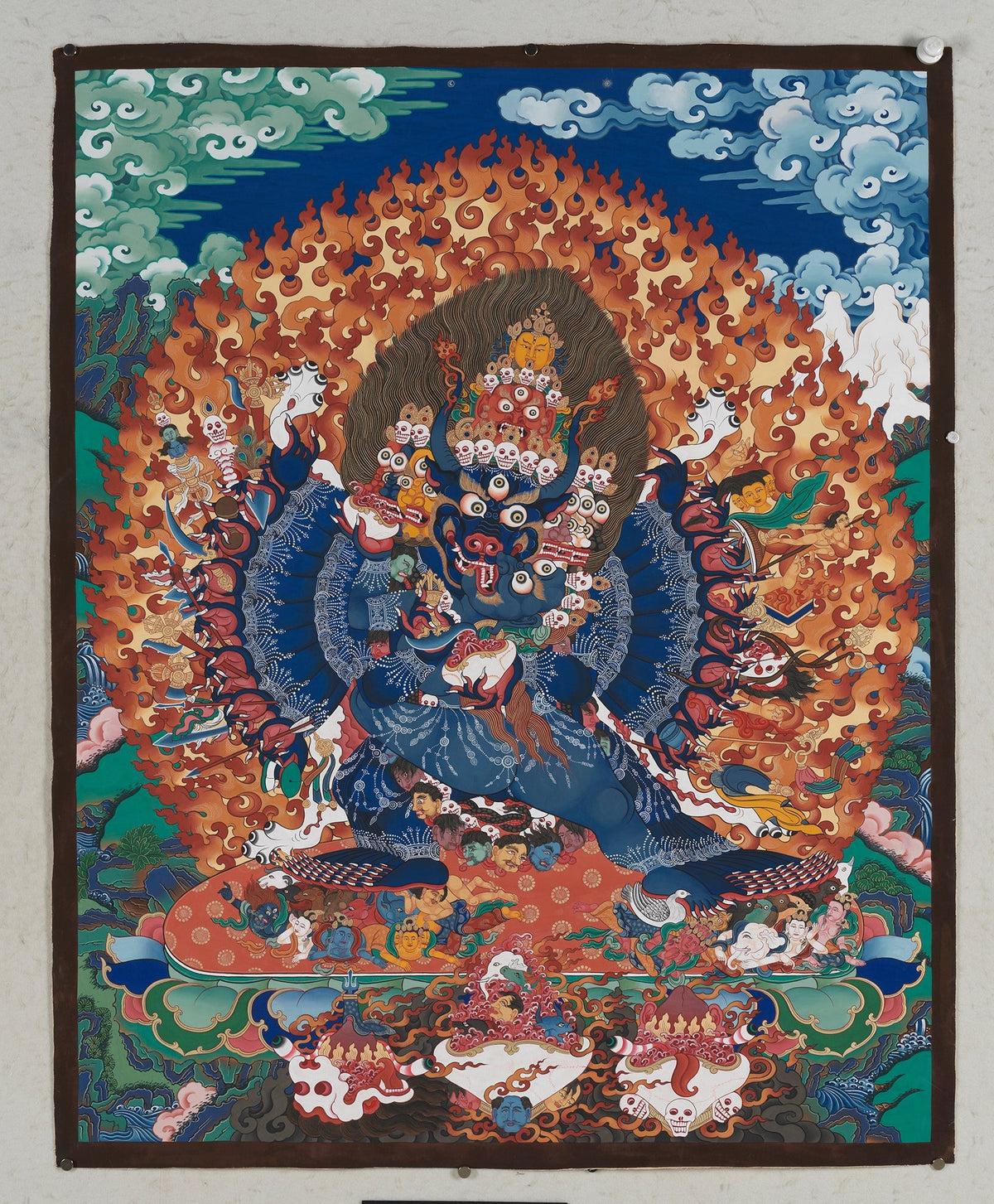
Vajrabhairava

Artwork introduction

Vajrabhairava (2018)

White elephant legs hang on either side of this Vajrabhairava's upright red hair, and he wears an entire immense white elephant skin. An elephant is powerful yet clumsy and blind, used in Buddhism as a metaphor for the ignorance and stubborn prejudice most difficult to uproot. Tearing off the white elephant skin and draping it behind him is a heavy hammer smashing the prison of thought, warning us that only by daring to break through blind spots and entrenched assumptions can we transform and be reborn.

The principal deity spans heaven and earth, with wisdom flames filling space. Thirty-four arms spread to either side like immense blue shields; the upper hands stretch open a white elephant skin; sixteen feet, like immensely heavy gates, trample fierce birds and beasts; and, embracing his consort, he looks down through nine faces. The white elephant skin urges us to tear apart entrenched prejudice; implements in the thirty-four arms calmly answer afflictions in many dimensions; and the sixteen feet grant the practical ability to carry things through. Cool lapis lazuli-blue flesh contrasts violently with a cinnabar sea of fire, while the white elephant skin is mellow as jade, creating a presence that could swallow mountains and rivers. Dare to tear apart your own stubbornness and relinquish prejudice, and you can rebuild an indestructible heart.

$17,795.00
勉唐画派宗师传人 罗桑达吉·才让当周大师作品
Quantity:

Total: $17,795.00

  • AliPay
  • American Express
  • Apple Pay
  • Bancontact
  • Google Pay
  • Mastercard
  • MB WAY
  • Shop Pay
  • Union Pay
  • Visa

Explore the collection: Vajrabhairava

SamantabhadraYama TeachingManjushriHayagrivaPalden Lhamo
  • Hand-painted Thangka Art
  • 📦 Artwork photographs and presentation details are confirmed before dispatch.
  • 🚚 Free Shipping, Trackable Logistics
  • ↩ 30-day returns on eligible non-custom works
Artwork Details & Confirmation

Each Thangka has its own composition, dimensions and presentation. Please review the photographs and catalogue notes, and contact the museum about the work’s condition, materials or mounting before ordering.

We confirm artwork photographs and dispatch details before shipping. For a commissioned work, the subject, dimensions, materials, schedule and any agreed review stages are discussed separately.

Eligible non-custom works may be returned within 30 days of receipt, subject to the return policy.

Delivery time

Estimated delivery for available works: 10–16 business days. This consists of 5–9 business days for preparation and 5–7 business days in transit.

Preparation: order and address confirmation, checking the selected Thangka’s condition and mounting, and protective packing appropriate to the work. Commissioned works follow an individually agreed schedule.

Transit: the carrier and tracking information are provided when the work is dispatched. Commissioned works or special mounting arrangements require a separately agreed schedule. See our shipping policy.

Returns & Refunds

30-day return window: contact the museum within 30 days of receipt for eligible non-custom works. The work must be unused, in its original condition and packaging, with proof of purchase.

Commissioned or personalised works: these are non-returnable unless damaged or defective. Please discuss any difference from the confirmed commission with the museum.

Return shipping: 香港合丰 covers damaged, defective or incorrect items. For a change of mind, size or preference, the customer pays the actual return shipping cost. There is no restocking fee. Obtain return instructions before sending the work.

Approved refunds are made to the original payment method within 10 business days. If more than 15 business days have passed after approval, contact the museum. See the full return policy.

Payment Method Guide

Payment methods available for your country and currency are displayed at checkout. Please use the options shown there to complete your order.

For questions about a particular Thangka, confirm its availability, dimensions and presentation with 香港合丰 before payment. See payment information.

香港合丰 Artwork introduction

About this Thangka

Vajrabhairava

Vajrabhairava (2018)

Each day, we introduce you to a thangka. Today we explore a monumental work of intangible-heritage mineral-color painting whose force seems to eclipse the sky and sun, bringing the subduing of stubborn attachment to its fullest expression: Vajrabhairava, painted in 2018.

Looking at this Vajrabhairava, have you noticed an extraordinarily striking detail that is often overlooked? Why does a pair of white elephant legs hang on each side of his upright red hair, with a huge white elephant skin unmistakably draped across his whole body? Behind it lies Eastern spiritual cultivation's most forceful metaphor for breaking stubbornness. In ancient legends, elephants possess immense strength, yet become extremely blind and clumsy when they run out of control. In Buddhism, they symbolize the ignorance and stubborn conceit most difficult to uproot from human nature. People often batter themselves bloody against life's obstacles because they are too obstinate rather than insufficiently capable. They cling to outdated prejudices and refuse to turn back even when they know they have reached a dead end, forcing themselves into despair. Vajrabhairava tears off the massive white elephant skin with his own hands and drapes it behind him to reveal that a truly powerful sage never confines himself to old ways. Only by daring to peel away your stubborn assumptions and blind arrogance can you turn past detours into armor protecting your next steps. This fierce ritual image is like a heavy hammer breaking the prison of thought, teaching us, when life reaches an impasse, to dare to break through our cognitive blind spots and undergo a complete transformation and rebirth.

With this story in mind, the painting's overall details become clear. See how Vajrabhairava spans heaven and earth. The prajna wisdom flames behind him almost fill all of space in the painting, turning the whole sky and earth red. His thirty-four arms open outward on either side like two immense blue shields resembling peacocks spreading their tails; his upper hands stretch open the entire white elephant-skin cape; and his sixteen feet descend like immensely heavy gates, trampling fierce birds, wild beasts, and worldly spirits. Embracing his consort, he looks down upon the world through nine faces. The painting has no elaborate worldly scenery. Through this pure, intense image amid a sea of fire, the artist tells us that when inner concentration is brought to its utmost, every external storm becomes empty space beneath our feet.

Now look at the sacred form and its details. The white elephant-skin cape stretched firmly open by the upper hands warns us to tear apart the rigid, stubborn prison of cognition within and avoid being held hostage by past experience. The thirty-four hands burst to either side in a wing-like fan, each holding implements such as swords, bows and arrows, shields, and intestine ropes. In scripture, these correspond to wise methods of removing life's thirty-four afflictions, symbolizing always having a weapon at hand to meet life's multidimensional challenges with composure. The sixteen kinds of birds, beasts, and harmful demonic obstacles crushed underfoot represent absolute power to act, trampling timidity and restlessness so that every step rests as firmly as solid rock.

In its colors, the profound, cool, deep lapis lazuli-blue body and the surging cinnabar-red sea of fire create a violent visual division between cool and warm. The white elephant skin and dense bone beads around his body give off a cold, sacred jade-white glow; red hair stands upright like erupting lava. Against a deep-blue night sky and emerald mountain ranges beneath the throne, the pure, intense palette has a grandeur that seems to swallow mountains and rivers, displaying the profoundly arresting visual tension of intangible-heritage mineral-color painting.

Once you understand this Vajrabhairava, you will see: only by daring to tear apart your own stubbornness can you rebuild an indestructible heart.

May you also break attachments, relinquish prejudice, put on your armor, and advance with courage in life.

Follow 香港合丰 to discover more Eastern stories within the paintings!

Luosang Daji · Cairang Dangzhou

Luosang Daji · Cairang Dangzhou

Luosang Daji · Cairang Dangzhou began learning Thangka painting at seven and studied at Wutun Upper Temple under Master Xiawu Cairang. His practice is rooted in the Menri tradition.

View artist
Artwork & Order Confirmation

Artwork & Order Confirmation

Confirm the selected Thangka, its dimensions and presentation with the museum. After ordering, check that your contact details and delivery address are correct so we can discuss the work and its dispatch.
Details & Mounting

Details & Mounting

Review photographs of the actual work and confirm its condition and mounting before dispatch. For a commission, the subject, format, materials and review stages are agreed individually with the artist and museum.

Protective Packing & Delivery

Protective Packing & Delivery

The work is packed according to its dimensions, support and mounting. Tracking details are provided after dispatch. Keep the packaging until you have inspected the Thangka and confirmed that it has arrived safely.
Viewing & Care

Viewing & Care

Spend time with the figures, line work and composition of the Thangka. Display it away from direct sunlight and damp conditions. Ask the museum for advice about mounting, framing or handling the specific work; avoid touching the painted surface.