Luosang Daji · Cairang Dangzhou

Shakyamuni Teaching — Gold Ground

Artwork introduction

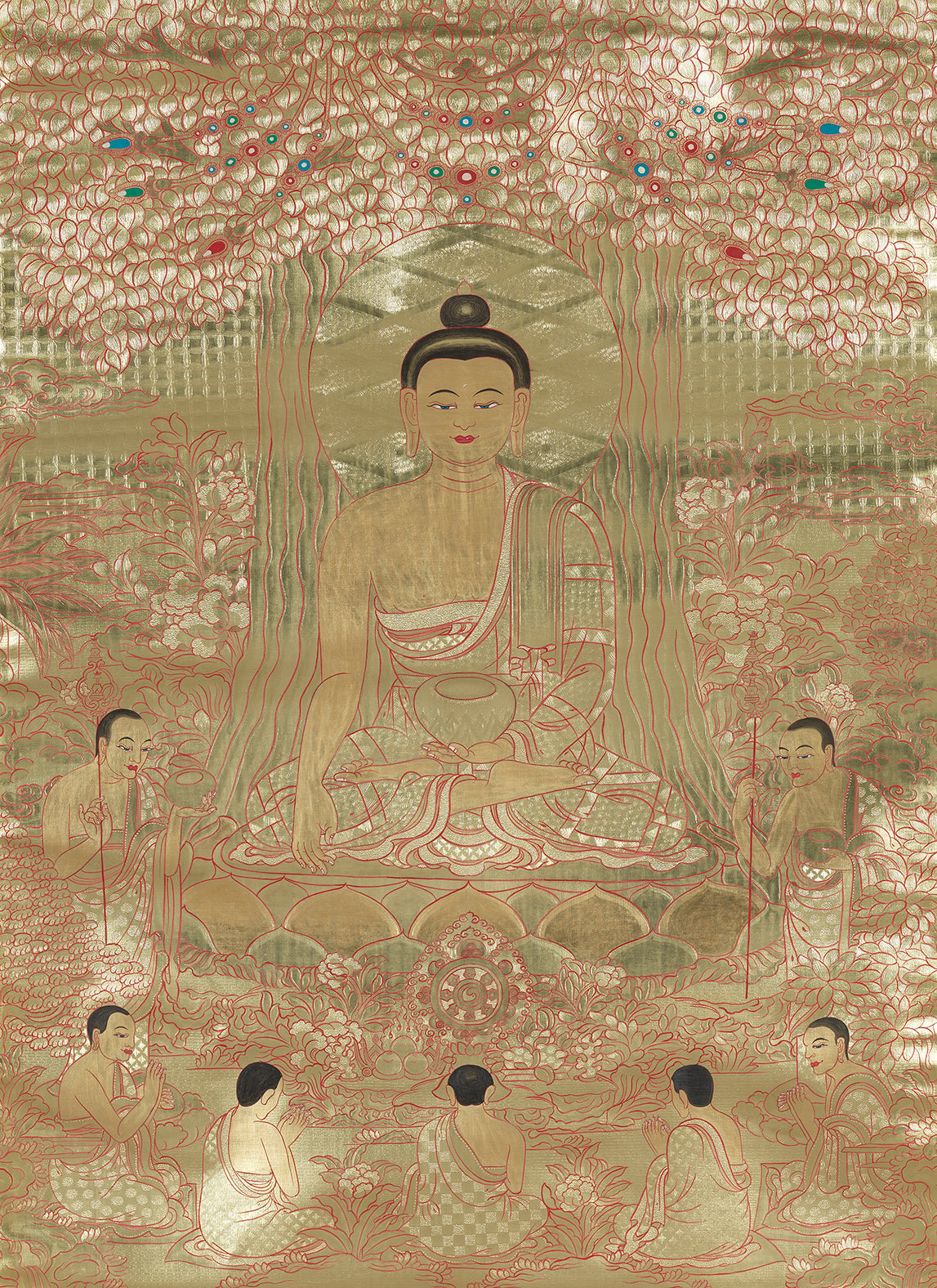
Gold Thangka of Shakyamuni Teaching (August 2013)

A unique, precious gold thangka, with a pure gold ground and cinnabar outlines. Gold survives repeated refining without destruction, symbolizing eternal truth unchanged through the ages; the pure red lines resemble a child's warm blood, representing a sincere and devoted heart. In a restless age of constant change and uncertainty, its enduring steadiness reaches through time, teaching us to preserve sincerity and calm amid transformation.

The Buddha sits upright on a lotus throne. Behind him, the luxuriant leaves of an entire bodhi tree are delicately drawn in cinnabar and touched with jewel-like luster; before the throne, an eight-spoked golden wheel turns continually and disciples listen respectfully, the whole scene immersed in pure golden space. The earth-touching mudra grants the upright strength to hold our boundaries, the nectar bowl guides us to empty ourselves of arrogance, and the eight-spoked golden wheel symbolizes breaking through impasses by following objective laws. The pure gold powder ground grows mellower with age; gold and red illuminate each other with refined grandeur, occasionally accented by malachite green and sapphire blue. Worldly affairs shift like passing clouds; only a heart as incorruptible and enduring as true gold can remain unruffled and grow ever fresh with time.

$17,795.00
勉唐画派宗师传人 罗桑达吉·才让当周大师作品
Quantity:

Total: $17,795.00

  • AliPay
  • American Express
  • Apple Pay
  • Bancontact
  • Google Pay
  • Mastercard
  • MB WAY
  • Shop Pay
  • Union Pay
  • Visa

Explore the collection: Shakyamuni Teaching — Gold Ground

SamantabhadraYama TeachingManjushriHayagrivaPalden Lhamo
  • Hand-painted Thangka Art
  • 📦 Artwork photographs and presentation details are confirmed before dispatch.
  • 🚚 Free Shipping, Trackable Logistics
  • ↩ 30-day returns on eligible non-custom works
Artwork Details & Confirmation

Each Thangka has its own composition, dimensions and presentation. Please review the photographs and catalogue notes, and contact the museum about the work’s condition, materials or mounting before ordering.

We confirm artwork photographs and dispatch details before shipping. For a commissioned work, the subject, dimensions, materials, schedule and any agreed review stages are discussed separately.

Eligible non-custom works may be returned within 30 days of receipt, subject to the return policy.

Delivery time

Estimated delivery for available works: 10–16 business days. This consists of 5–9 business days for preparation and 5–7 business days in transit.

Preparation: order and address confirmation, checking the selected Thangka’s condition and mounting, and protective packing appropriate to the work. Commissioned works follow an individually agreed schedule.

Transit: the carrier and tracking information are provided when the work is dispatched. Commissioned works or special mounting arrangements require a separately agreed schedule. See our shipping policy.

Returns & Refunds

30-day return window: contact the museum within 30 days of receipt for eligible non-custom works. The work must be unused, in its original condition and packaging, with proof of purchase.

Commissioned or personalised works: these are non-returnable unless damaged or defective. Please discuss any difference from the confirmed commission with the museum.

Return shipping: 香港合丰 covers damaged, defective or incorrect items. For a change of mind, size or preference, the customer pays the actual return shipping cost. There is no restocking fee. Obtain return instructions before sending the work.

Approved refunds are made to the original payment method within 10 business days. If more than 15 business days have passed after approval, contact the museum. See the full return policy.

Payment Method Guide

Payment methods available for your country and currency are displayed at checkout. Please use the options shown there to complete your order.

For questions about a particular Thangka, confirm its availability, dimensions and presentation with 香港合丰 before payment. See payment information.

香港合丰 Artwork introduction

About this Thangka

Shakyamuni Teaching — Gold Ground

释迦牟尼佛讲法

Gold Thangka of Shakyamuni Teaching (August 2013)

Each day, we introduce you to a thangka. Today we explore a precious gold thangka regarded as the height of distinction in the thangka world, its entire ground laid with pure gold and its forms outlined in cinnabar: Gold Thangka of Shakyamuni Teaching, painted in 2013.

It is another depiction of Shakyamuni teaching, so why are there neither green mountains and waters nor flames filling the sky, but instead a whole field of shimmering pure gold, with the entire sacred scene drawn line by cinnabar-red line? Behind it lies Eastern culture's ultimate pursuit of eternity and the original heart. In thangka art, gold thangkas represent unsurpassed nobility. Ancient people spared no expense in painting with pure gold because gold survives a hundred refinings without decay and ten thousand years without destruction. It symbolizes the truths taught by the Buddha, which will never fade even after thousands upon thousands of years of testing. Drawing natural cinnabar-red lines on gold is traditionally called red lines on a gold ground: cinnabar represents the warm, devoted innocence of a child's heart, and gold represents indestructible truth. In this hurried, restless age, when information can become obsolete at any moment, much anxiety arises precisely from the loss of certainty. Trends change, hearts change, and so much vanishes in an instant. The impact of this gold thangka comes from its enduring steadiness, which reaches through time and teaches us, in an unpredictable world of impermanence, to hold on to qualities as lasting as true gold: sincerity, kindness, and inner composure.

With this story in mind, the painting's overall details become clear. See how the Buddha sits on the central thousand-petaled lotus throne, his golden body shining in the light. The countless leaves of the ancient bodhi tree behind him are all painstakingly drawn with cinnabar-red lines; scattered through the canopy are jewel-like accents resembling turquoise and red coral. Before his throne stands an eight-spoked golden wheel that turns the true Dharma; chief disciples holding a ringed staff and alms bowl attend on either side, and below them five monk disciples kneel with palms joined, listening devoutly. The artist fixes this sacred teaching scene in pure golden space to convey more than expense: when truth takes root and grows within the heart, every distracting noise recedes, revealing only the original radiance of life.

Now look at the sacred form and its details. The earth-touching mudra offered by the Buddha's lowered right hand comes from the story of his invoking the earth as his pledge and overcoming every temptation and fear. It grants us the expansive upright strength to stand firm and hold our boundaries in uncertain times. The nectar bowl supported before his abdomen in his left hand symbolizes the cultivation of an open heart capable of embracing all things, guiding us to empty ourselves of arrogance so that wisdom can enter. The eight-spoked golden wheel delicately described in cinnabar before the throne expresses the deeper meaning of the Dharma wheel turning ceaselessly and dispelling every deluded attachment, representing timeless truth breaking through impasses and bringing clarity wherever we turn.

In its colors, precious pure gold powder covers the entire ground. After more than ten years of mellowing, it shows no trace of oxidation, instead giving off an exceptionally warm, elegant golden glow enriched by age. Natural pure cinnabar-red lines minutely describe individual hairs, the checked pattern of the robe, and the bodhi tree's branches and leaves. Red and gold illuminate one another, while an occasional touch of mineral malachite green and sapphire blue between the leaves provides a finishing accent. The work achieves the utmost in the luxurious refinement, solemn stillness, and lofty artistry of Eastern fine-brush painting.

Once you understand this gold thangka of Shakyamuni, you will see: worldly affairs change like passing clouds, while sincerity and steadfastness within can endure like true gold for ten thousand years.

May you also possess composure and sincerity that withstand the tempering of time, remain unruffled by waves, and grow ever fresh through the years.

Follow 香港合丰 to discover more Eastern stories within the paintings!

Luosang Daji · Cairang Dangzhou

Luosang Daji · Cairang Dangzhou

Luosang Daji · Cairang Dangzhou began learning Thangka painting at seven and studied at Wutun Upper Temple under Master Xiawu Cairang. His practice is rooted in the Menri tradition.

View artist
Artwork & Order Confirmation

Artwork & Order Confirmation

Confirm the selected Thangka, its dimensions and presentation with the museum. After ordering, check that your contact details and delivery address are correct so we can discuss the work and its dispatch.
Details & Mounting

Details & Mounting

Review photographs of the actual work and confirm its condition and mounting before dispatch. For a commission, the subject, format, materials and review stages are agreed individually with the artist and museum.

Protective Packing & Delivery

Protective Packing & Delivery

The work is packed according to its dimensions, support and mounting. Tracking details are provided after dispatch. Keep the packaging until you have inspected the Thangka and confirmed that it has arrived safely.
Viewing & Care

Viewing & Care

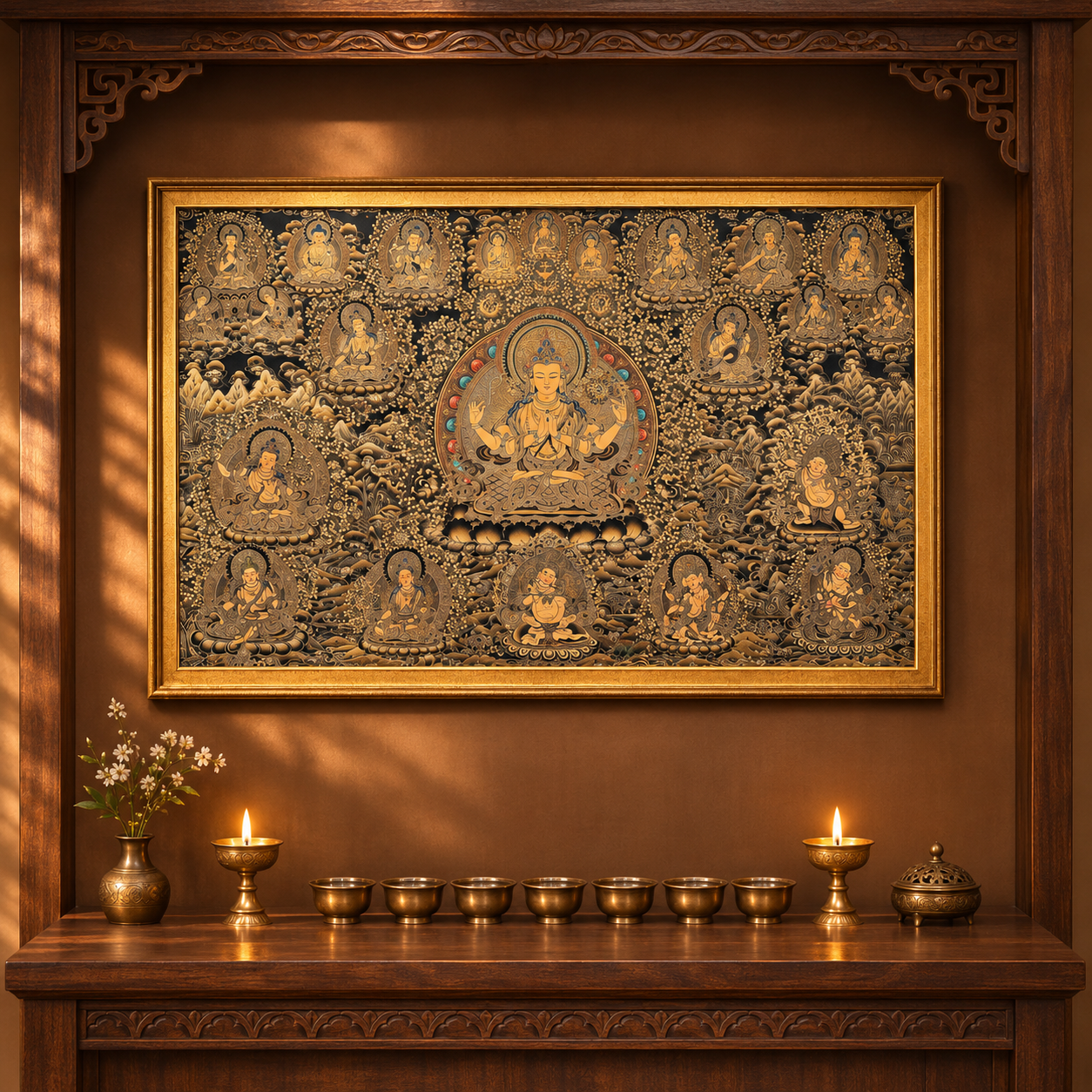
Spend time with the figures, line work and composition of the Thangka. Display it away from direct sunlight and damp conditions. Ask the museum for advice about mounting, framing or handling the specific work; avoid touching the painted surface.